

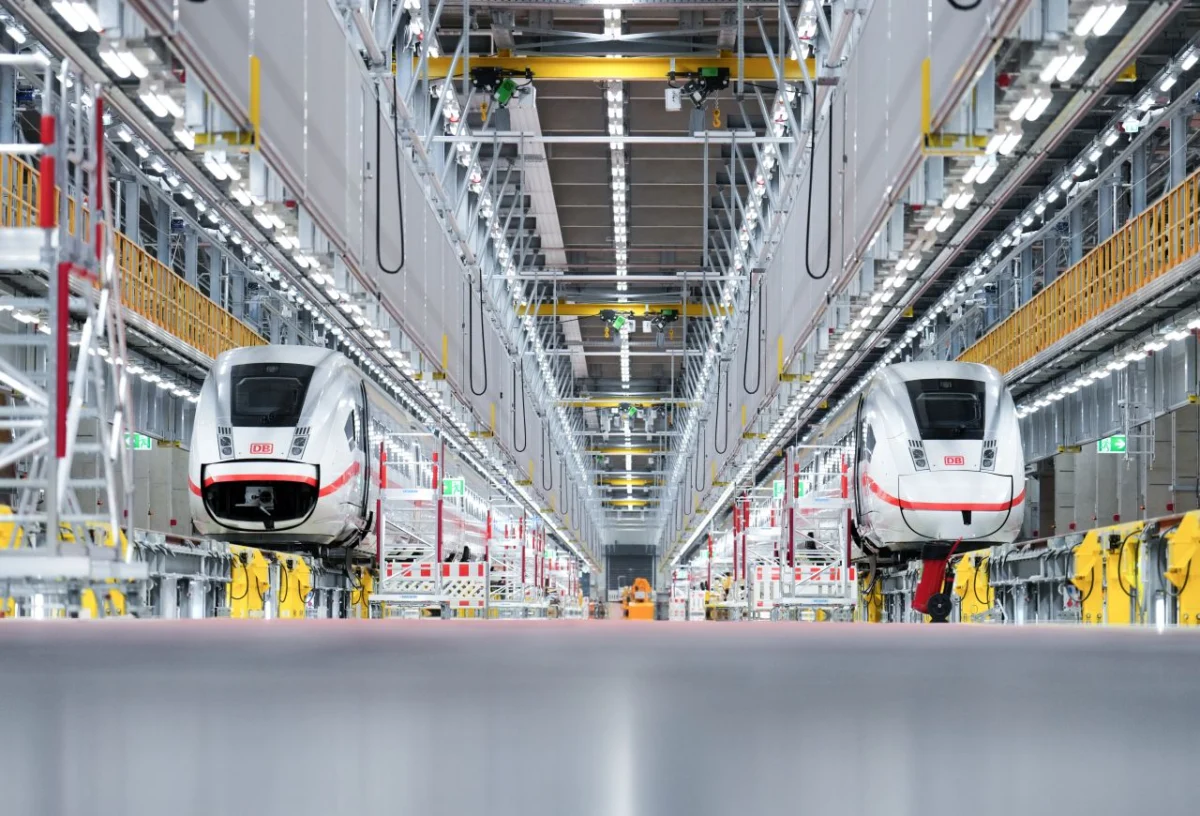
One year after the inauguration of its state-of-the-art maintenance facility in Cottbus, Deutsche Bahn (DB) is celebrating a major operational triumph. The plant, which represents a cornerstone of the railway operator’s modernization strategy, has successfully navigated its inaugural ramp-up phase, proving that innovation and localized efficiency can drastically improve the reliability of Germany’s long-distance rail network. By streamlining the maintenance of its flagship ICE 4 fleet, DB is not only optimizing its technical workflows but is also signaling a broader industrial revival for the Lusatia region.
Main Facts: A Year of Operational Success
Since the commencement of operations, the Cottbus workshop has functioned as a high-precision engine room for DB’s long-distance fleet. In its first twelve months, the facility successfully processed 13 ICE 4 trainsets, encompassing a total of more than 160 individual carriages.
This performance did more than simply meet the ambitious targets set during the facility’s commissioning; the maintenance teams actually outperformed expectations, completing the final overhaul of 2024 ahead of schedule. This efficiency was not merely a matter of internal metrics—it had a tangible impact on the traveling public. By ensuring a higher volume of operational trains during the critical Christmas travel season, the Cottbus plant played a direct role in maintaining reliable, high-frequency service across the national network during one of the year’s busiest periods.
As the facility enters 2025, its scope is expanding. For the first time, a seven-car ICE 4 variant will undergo maintenance in Cottbus. This shift is part of a strategic decision by DB to consolidate heavy maintenance for all ICE 4 configurations—ranging from the seven-car sets to the massive 13-car "XXL" versions—under one roof. With 137 units in service, the ICE 4 remains the backbone of DB’s long-distance strategy, and the ability to centralize its care in Lusatia is a pivotal achievement for the group’s technical division.
The Chronology of Transformation
The path to the current success in Cottbus was paved with significant infrastructural investments and strategic foresight.
- Early 2024: Construction began on Hall 1, a gargantuan structure spanning over 500 meters. Designed to house three maintenance tracks, a commissioning track, and a dedicated painting track, this hall represents the future of heavy overhaul work.
- Throughout 2024: Hall 2 became the operational heartbeat of the site. Focused on the "IS 600" maintenance stage—the smaller of the two major service intervals—it showcased the benefits of a facility built specifically for the ICE 4.
- Late 2024: The facility hit its stride, completing its 13th trainset overhaul ahead of schedule, proving the efficacy of the optimized processes designed by the engineering teams.
- January 2025: The facility officially expanded its mandate to include the seven-car ICE 4 variants, signaling the successful acceleration of the plant’s integration into the wider DB maintenance network.
Originally, DB had intended to maintain a longer transition period, utilizing a decentralized network of workshops to handle the heavy maintenance of the ICE 4 fleet. However, the unique design of the Cottbus plant, coupled with the high proficiency of the localized workforce, allowed DB to truncate this timeline. By bringing maintenance together in Lusatia sooner than anticipated, the railway operator has managed to reduce the logistical burden of moving trains across the country for specialized service.
Technical Innovations and Operational Data
The effectiveness of the Cottbus plant lies in its radical departure from traditional, multi-purpose workshop designs. Hall 2, for instance, is a masterclass in workflow optimization.
The IS 600 Workflow
The IS 600 maintenance stage requires a train to be serviced every 600,000 kilometers. In Hall 2, the design allows trains to enter at their full length under their own power, eliminating the need for shunting locomotives and saving precious time. The hall is engineered for "three-level" maintenance:
- The Roof Level: Dedicated access allows technicians to service air conditioning systems and pantographs with ease.
- The Side Level: Specialized flaps allow direct access to the complex electronic and mechanical systems embedded in the carriage flanks.
- The Pit Level: A continuous work pit enables comprehensive inspection of the train’s undercarriage.
Furthermore, the facility features elevated tracks where bogies—the wheel assemblies—come to a precise stop on dedicated work stands. The ability to fold away rails allows for the near-instantaneous replacement of wheelsets, while overhead lines can be swung aside, ensuring that no structural element of the workshop hinders the technical team.
The IS 700 and Future Expansion
While Hall 2 handles the IS 600, the more intensive "IS 700" maintenance stage—required after 3.3 million kilometers—is the next frontier for the site. This stage is significantly more involved, requiring carriages to be uncoupled. Technicians perform exhaustive checks on couplings, carriage transitions, braking systems, and front-nose assemblies. As Hall 1 nears completion, these heavy-duty overhauls will transition into the new space, allowing Hall 2 to remain dedicated to the faster IS 600 cycles.
In 2025, DB plans to scale up significantly: 24 ICE 4 trains are slated for maintenance, including 12 short seven-car sets and 12 long-format trains (12 or 13 carriages). Of these, 14 will undergo the comprehensive IS 700 overhaul.
Official Perspectives: A Catalyst for Restructuring
Dr. Daniela Gerd tom Markotten, DB Board Member for Digitalization and Technology, has been vocal about the strategic importance of the Cottbus facility. Reflecting on the first year, she noted, "The ICE maintenance in Lusatia is already a great success. Our experts designed the two-track workshop for rapid and efficient maintenance, especially of the ICE 4. The teams in Cottbus have implemented the optimized processes in practice even faster than expected."
According to Dr. Gerd tom Markotten, the facility is not merely a repair shop; it is a vital component of the broader "restructuring of the DB Group." By ensuring high vehicle availability, the plant directly supports the stability of the entire rail network. In the context of DB’s ongoing efforts to improve punctuality and reliability, the ability to keep the ICE 4 fleet in prime condition is a non-negotiable requirement.
Implications for the Future
The implications of the Cottbus success are manifold. First, it validates the strategy of building "dedicated" workshops rather than relying on legacy infrastructure that requires constant retrofitting. By tailoring the architecture to the specific dimensions and technical requirements of the ICE 4, DB has created a blueprint for future maintenance facilities.
Second, the economic impact on the Lusatia region is substantial. With the total expansion of the two halls, DB is creating 1,200 high-skilled training and industrial jobs. This transition of a former coal-mining region into a high-tech hub for railway engineering is a significant success story for regional development in Germany.
Finally, for the average traveler, the success of the Cottbus plant means more reliable, more frequent, and better-maintained trains. As DB continues to ramp up its capacity in 2025, the "Cottbus model" will likely become the standard for the company’s nationwide fleet management. By mastering the maintenance of its most vital asset—the ICE 4—Deutsche Bahn is proving that the future of European rail travel is not just about building new trains, but about the industrial excellence required to keep them moving.

