

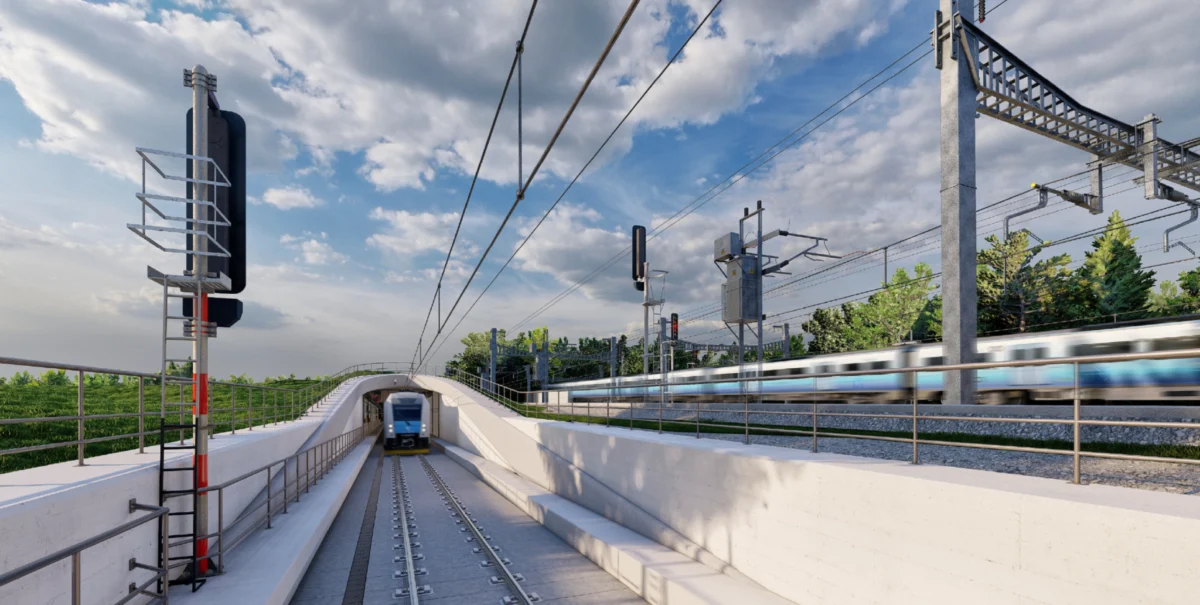
WARSAW, POLAND — In a major milestone for Poland’s most ambitious transport infrastructure endeavor, construction firm Porr has officially awarded Alstom a high-value contract to design, supply, and integrate cutting-edge railway traffic control systems. The contract centers on the forthcoming Łódź high-speed long-distance rail tunnel—a cornerstone of the Centralny Port Komunikacyjny (CPK) mega-project.
Under the terms of the agreement, Alstom will take full charge of deploying its proprietary Onvia mainline signalling portfolio. This involves comprehensive engineering, installation, and seamless integration with the existing infrastructure at the Łódź Widzew station area. The agreement marks a critical step forward for the CPK initiative, bridging modern digital rail traffic management with unprecedented civil engineering feats in Central Europe.
Main Facts: The Scope of the Project and Alstom’s Role
The partnership between Porr and Alstom brings together two heavyweights in European infrastructure to execute one of the most technically challenging segments of Poland’s evolving high-speed rail network.
Key Project Specifications:
- The Contractor: Porr is the main civil engineering contractor selected to construct the physical bore of the Łódź high-speed tunnel.
- The Subcontractor: Alstom was selected by Porr to deliver the rail traffic control and signalling infrastructure.
- Technology Portfolio: Alstom will utilize its advanced Onvia mainline signalling portfolio to ensure the highest standards of safety, automated train protection, and operational efficiency.
- Integration Scope: The works encompass the complete design, delivery, and system integration within the long-distance tunnel, culminating in a smooth interface with the Łódź Widzew station area.
- Strategic Significance: This represents Alstom’s inaugural signalling contract linked directly to high-speed rail infrastructure under Poland’s national Port Polska investment programme.
The engineering work will be spearheaded by Alstom’s highly qualified technical team based in Katowice, Poland. Drawing on decades of domestic and international expertise, the Katowice branch will oversee the intricate technical execution required to manage high-speed train movements safely underground.
Chronology and Historical Context: The Evolution of CPK and the "Y" Line
To understand the magnitude of the Łódź tunnel contract, one must examine the broader historical and strategic trajectory of Poland’s rail modernization efforts over the past two decades.
From Legacy Networks to Modern Corridors
For decades, Poland’s railway network suffered from underinvestment, fragmented regional governance, and legacy Soviet-era signalling equipment that severely limited line speeds and capacity. While freight and passenger volumes steadily grew following the country’s accession to the European Union in 2004, cross-country transit times remained uncompetitive compared to private automotive travel and expanding European aviation networks.
Recognizing the urgent need for a paradigm shift, the Polish government conceived the Centralny Port Komunikacyjny (CPK) initiative—a multi-modal transport hub combining a brand-new centralized national airport with an entirely greenfield high-speed rail network.
The "Y" Line Timeline:
- Conception and Planning (Late 2010s): Planners outlined the strategic "Y" railway line, designed to connect Warsaw, the new CPK mega-airport, Łódź, Wrocław, and Poznań.
- Legislative and Financial Mobilization (2020–2023): Feasibility studies, environmental impact assessments, and European Union TEN-T corridor alignments were formalized. The project was integrated directly into the North Sea–Baltic corridor.
- Procurement and Groundbreaking (2024–2026): Porr was selected to execute the grueling civil works for the underground urban crossing in Łódź, paving the way for specialized sub-contracts like Alstom’s signalling agreement.
- Target Operational Milestones:
- 2032: Scheduled completion of the core segment connecting Warsaw, the CPK airport, and Łódź.
- 2035: Full rollout of high-speed rail connections extending westward to Wrocław and Poznań.
Supporting Data: Engineering Marvels and Technical Specifications
The Łódź high-speed tunnel is not merely a regional transit link; it is an engineering masterpiece designed to shatter domestic infrastructure records.
Physical Dimensions and Civil Engineering Scale
- Length: 4.6 kilometers, making it the longest railway tunnel in Poland.
- Diameter: 14 meters, establishing it as the largest-diameter railway tunnel structure ever built in the country.
- Depth: Trains will navigate the subterranean urban core at depths ranging dynamically from 25 to 35 meters beneath existing city infrastructure, historical foundations, and municipal utilities.
- Operational Speeds: Within the tunnel itself, trains will safely navigate at speeds of up to 160 km/h, transitioning to up to 350 km/h on open stretches of the CPK "Y" line network.
Division of Labor: Long-Distance vs. Regional Traffic
To prevent capacity bottlenecks and streamline operations through the densely populated heart of Łódź, Polish transport authorities split the subterranean strategy into two distinct projects:
- The CPK High-Speed Tunnel: Constructed by Porr and equipped by Alstom, this 14-meter-diameter bore is dedicated exclusively to long-distance high-speed services.
- The PKP PLK Regional Tunnel: Running in parallel, Poland’s national railway infrastructure manager, PKP PLK, is advancing a separate tunnel initiative specifically engineered to handle regional and commuter traffic, optimizing local transit flows independently of high-speed intercity movements.
Alstom’s Proven Track Record in Poland
Alstom is uniquely positioned to deliver this complex project given its deep industrial footprint within Poland. The company’s historical contributions to Polish rail modernization include:

- ERTMS Level 2 Implementation: Pioneering the very first commercial deployment of European Rail Traffic Management System (ERTMS) Level 2 in the country.
- Network-Wide Deployments: Rolling out ERTMS Level 2 across ten distinct mainline corridors for PKP PLK.
- Centralized Traffic Control (CTC): Constructing over 30 modern CTC systems nationwide.
- Interlocking Systems: Installing advanced computer-based interlocking systems across more than 220 railway stations.
- Level Crossing Modernization: Upgrading safety signalling at over 1,700 level crossings across Poland.
Official Responses and Industry Perspectives
Key stakeholders have emphasized the transformative impact of the contract on European transport security, technological self-reliance, and national infrastructure pride.
Alstom Leadership Speaks
Adam Juretko, Managing Director of Alstom’s Katowice branch, highlighted the technical gravity and strategic weight of the undertaking:
"The design and installation of the railway traffic control system in the Łódź long-distance tunnel are of strategic importance for the safety and reliability of the entire investment. This is a unique project, both in terms of its scale and technical requirements. In delivering it, we will draw on the extensive experience of our qualified engineering team in Katowice in designing and implementing control systems, gained both in Poland and through international projects across Europe."
Industry analysts have similarly noted that leveraging local engineering talent from the Katowice hub ensures that the intellectual property and technical know-how remain embedded within Poland’s domestic industrial ecosystem, fostering long-term maintenance capabilities.
CPK and European Integration
Representatives from CPK and international transport bodies have repeatedly underscored that the Łódź tunnel is far more than a local convenience—it is a vital geopolitical and economic link. By tying Poland directly into the North Sea–Baltic corridor of the Trans-European Transport Network (TEN-T), the project bridges Western European high-speed rail standards with Central and Eastern European transit aspirations.
Implications: Economic, Environmental, and Geopolitical Impacts
The convergence of Porr’s civil engineering capabilities and Alstom’s advanced signalling technology in Łódź carries profound implications for Poland’s future.
1. Economic Transformation and Commuter Mobility
Once operational in the early 2030s, the CPK "Y" line will fundamentally compress geographic time and space within Poland. Travel times between Warsaw, Łódź, Poznań, and Wrocław will be slashed by more than half, turning disparate economic regions into a unified, highly integrated labor and consumer market. Business travel, tourism, and daily commuting will experience unprecedented fluidity.
2. Environmental Sustainability and Modal Shift
By offering a viable, ultra-fast alternative to domestic air travel and heavy highway usage, the high-speed rail network directly supports European Union decarbonization goals. Modern signalling systems like Alstom’s Onvia portfolio allow for tighter headways, maximized track capacity, and energy-efficient, automated driving profiles that reduce carbon emissions per passenger-kilometer to a fraction of their road or air equivalents.
3. Geopolitical and Strategic Integration
Positioned along the TEN-T North Sea–Baltic corridor, the infrastructure enhances military mobility and cross-border commercial resilience across NATO’s eastern flank. Fast, reliable rail logistics ensure that passenger and freight capacities can scale rapidly in response to regional demands, reinforcing Poland’s status as the logistical heartbeat of Central Europe.
4. Setting a Benchmark for Future Phases
As Alstom executes its first high-speed signalling contract under the Port Polska umbrella, the successes or lessons learned from the Łódź tunnel will serve as the operational blueprint for subsequent phases of the CPK master plan. With billions of euros flowing into rail modernization, the flawless execution of this underground artery will validate Poland’s capacity to deliver mega-projects on time, on budget, and to the absolute highest safety standards of the modern railway era.

