

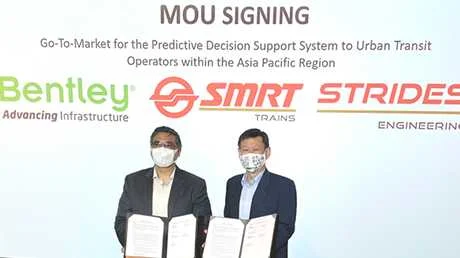
In a significant move to reshape the future of urban transit in the Asia Pacific region, Bentley Systems—a global leader in engineering software—has announced a strategic partnership with Strides Engineering, a business arm of Singapore’s SMRT Corporation. The collaboration, formalized through a Memorandum of Understanding (MoU), aims to deploy advanced predictive maintenance solutions designed to elevate the reliability, safety, and efficiency of metro and rail networks across the region.
By synthesizing Bentley’s cutting-edge digital infrastructure software with Strides Engineering’s extensive operational expertise, the partnership seeks to move the rail industry away from traditional, reactive maintenance cycles toward a data-driven, preemptive operational model.
Main Facts: A Synergy of Tech and Operations
The partnership represents a fusion of two distinct, yet highly complementary, skill sets. Bentley Systems brings its robust AssetWise platform to the table—a solution capable of visualizing, managing, and analyzing complex rail asset data. Meanwhile, Strides Engineering contributes deep-rooted domain knowledge acquired from managing one of the world’s most dense and high-frequency transit systems.
The core objective of this MoU is to provide a holistic "Predictive Decision Support System" (PDSS) for urban transit operators. This system allows operators to:
- Visualize Asset Information: Creating a "digital twin" environment where every component of the rail track is tracked and mapped.
- Monitor Real-time Conditions: Utilizing sensor data to detect irregularities before they result in service disruptions.
- Analytical Decision-Making: Using AI-driven analytics to predict when a component is likely to fail, allowing for maintenance to be scheduled during non-operational hours, thereby minimizing impact on commuters.
The Chronology: From Pilot to Regional Standard
The partnership is not born of theory but of proven success on the ground in Singapore. The timeline of this collaboration underscores a rigorous testing and validation process:
- Initial Development: Bentley Systems and SMRT Trains began working together to develop a PDSS tailored to the unique demands of Singapore’s high-traffic metro network.
- North-South and East-West Line Implementation: The PDSS was first deployed across the North-South and East-West lines (NSEWL). These lines, spanning 282 kilometers, serve as the backbone of Singapore’s public transport.
- Validation of Results: Following the integration of Bentley’s AssetWise Linear Analytics, SMRT Trains observed a significant uptick in performance metrics, most notably achieving over 1 million kilometers between failure (MKBF).
- Strategic Expansion: Building on the success of the NSEWL, SMRT Trains commenced the rollout of the PDSS across the Circle Line (CCL).
- Formalization of the Partnership: With the proven success of these implementations, Bentley Systems and Strides Engineering signed the MoU to export this model to other urban transit operators throughout the Asia Pacific.
Supporting Data: The Power of Predictive Analytics
In the rail industry, "Mean Kilometers Between Failure" (MKBF) is the gold standard for measuring reliability. A failure often translates to delays, passenger frustration, and increased maintenance costs. The shift toward predictive maintenance is fundamentally changing this metric.
The implementation of the PDSS on Singapore’s rail lines has demonstrated that data-driven maintenance is not merely an improvement but a necessity for modern urban transit. By leveraging AssetWise Linear Analytics, operators can synthesize massive datasets—ranging from vibration sensors on train wheels to thermal imaging of track components—to predict failures with high precision.
- Reliability Milestones: The achievement of exceeding 1 million MKBF on the North-South and East-West lines serves as the primary benchmark for the effectiveness of the solution.
- Asset Lifecycle Management: By identifying wear and tear early, the system allows for targeted component replacement rather than wholesale track upgrades, significantly extending the lifespan of infrastructure and reducing capital expenditure.
Official Responses: Aligning Visions for the Future
The collaboration has been met with enthusiasm from the leadership teams of both organizations, who view the partnership as a catalyst for regional infrastructure improvement.
Kaushik Chakraborty, Vice President of Bentley Asia South, emphasized the broader impact on the public: "With our combined strengths and industry experience, we will empower rail and metro operators in the region to improve the reliability of the infrastructure that serves citizens and residents."

From the SMRT perspective, the focus remains on the shift from reactive to proactive maintenance. A representative for the operator noted: "Leveraging technology and taking pre-emptive actions are two very important components in the plan to help us improve and maintain rail reliability for the train lines SMRT Trains operates. PDSS represents both components, and its successful implementation for the North-South and East-West lines has given us much confidence to scale it for the rest of our lines."
Implications for the Asia Pacific Rail Sector
The implications of this partnership extend far beyond the immediate technical deployment. It represents a shift in how transit authorities view their digital assets.
H3: The "Digital Twin" Mandate
As cities across the Asia Pacific expand, the pressure on rail infrastructure is intensifying. New lines are being built in Indonesia, Vietnam, and India to cope with rapid urbanization. This partnership signals that "building" is no longer enough; "maintaining" through digital intervention is the new mandate. The Bentley-Strides model provides a roadmap for emerging transit authorities to integrate smart maintenance from the outset.
H3: Economic Efficiency and Sustainability
Maintenance is one of the highest operational costs for any metro system. By reducing the frequency of emergency repairs—which often require expensive overtime labor and last-minute procurement—operators can achieve significant cost savings. Furthermore, optimized maintenance schedules reduce the environmental footprint of operations by ensuring that materials are replaced only when necessary, minimizing waste.
H3: Enhanced Passenger Experience
Ultimately, the goal is to improve the experience for the daily commuter. In an era where reliability defines the attractiveness of public transport, the ability to avoid "signal faults" or "track-related delays" through predictive foresight is a massive competitive advantage. If the Bentley-Strides solution can replicate its Singapore success across the region, it will set a new standard for urban transit reliability.
Conclusion: A Blueprint for Global Transit
The collaboration between Bentley Systems and Strides Engineering is more than just a software sale; it is a knowledge-transfer model. By combining the digital prowess of Bentley with the operational "war stories" and field expertise of SMRT, the partnership is positioned to solve the most pressing challenges of the modern rail industry.
As they begin their joint marketing efforts across the Asia Pacific, the industry will be watching closely. If this model proves successful in diverse urban environments—from the sprawling, high-density networks of Tokyo to the emerging systems in Southeast Asia—it could solidify the PDSS framework as the universal standard for urban rail maintenance.
For now, the success in Singapore remains the primary proof point. The integration of AssetWise Linear Analytics has not only kept the trains running on time; it has provided a robust, scalable blueprint for how technology can bridge the gap between ageing infrastructure and the modern demand for seamless, reliable, and sustainable urban mobility. The future of rail, it seems, is not just in the steel and electricity that moves the trains, but in the data that monitors them every step of the way.

