

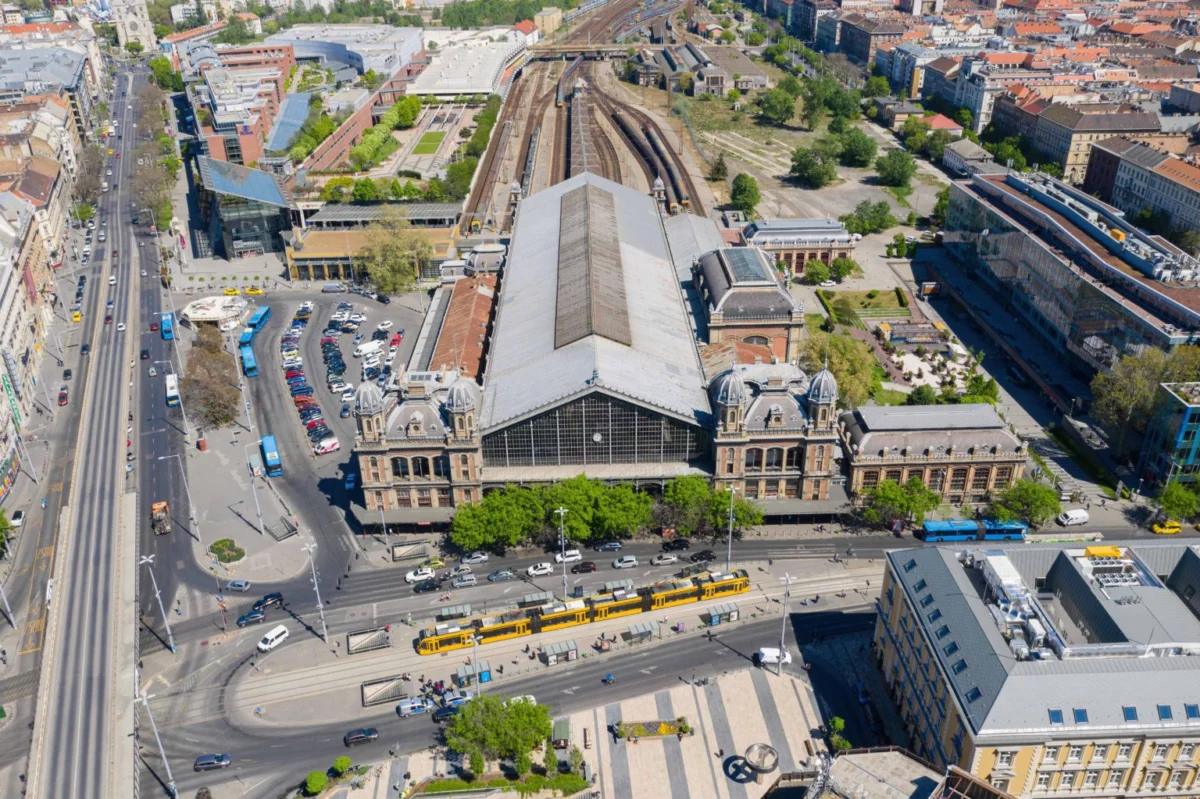
BUDAPEST — In an ambitious move to redefine urban and regional mobility, the Budapest Development Agency (BFK) has officially unveiled the Budapest Agglomeration Railway Strategy (BAVS). This comprehensive, multi-decade master plan aims to fundamentally reshape how millions of commuters navigate the Hungarian capital and its surrounding metropolitan area. Designed to combat chronic traffic congestion, lower carbon emissions, and drastically improve regional connectivity, the strategy sets a bold target: an 80% surge in suburban railway passenger numbers by the year 2040.
Backed by a staggering total investment value of HUF 2 trillion (approximately EUR 5.6 billion), the BAVS represents one of the most significant infrastructure overhauls in modern Central European history. By integrating advanced rolling stock, expanding rail networks, modernizing out-of-date infrastructure, and introducing seamless ticketing systems, the strategy seeks to entice hundreds of thousands of daily drivers out of their cars and onto clean, efficient rail transit.
Main Facts: The Blueprint for a Modernized Capital
At its core, the Budapest Agglomeration Railway Strategy is a holistic, 60-measure roadmap divided into infrastructure modernization, service development, regulatory frameworks, and rolling stock procurement. The overarching goal is simple yet transformative: double public transport usage across the wider suburban and Budapest region, and quadruple urban transport accessibility through streamlined connectivity.
Key highlights of the BAVS include:
- Massive Financial Commitment: The total budget stands at HUF 2 trillion (EUR 5.6 billion). Crucially, HUF 1 trillion (EUR 2.8 billion) is already secured for the initial rollout, bolstered by funding from the European Union’s 2021–2027 multiannual financial framework.
- Ridership Surge: BFK projects that an additional 500,000 passengers will abandon automobile commuting in favor of rail, doubling total regional ridership to a milestone 1 million daily users.
- Environmental and Traffic Relief: The modal shift aims to remove approximately 115,000 cars from Budapest’s congested roads every day, dramatically reducing urban air pollution and cutting daily commutes by an average of 15 minutes per passenger.
- Airport Express Enhancements: Liszt Ferenc International Airport will soon be accessible from the city center in just 20 minutes, integrated via 16 brand-new rail stops designed to bridge current service gaps.
- Intermodal Integration: By 2040, modernized rail services will provide direct, frictionless access to at least three of Budapest’s metro lines, all accessible via a unified single-ticket system.
Chronology and Phased Implementation: From Vision to Reality
To manage the immense scale of engineering and financial outlay required, the BAVS is structured across two distinct chronological phases spanning the next two decades.
Phase One: Foundation and Immediate Connectivity (Present to 2030)
The first phase focuses on unblocking major bottlenecks, constructing high-impact missing links, and initiating the most complex civil engineering projects.
- The Southern Railway Ring & Danube Crossing: A cornerstone of Phase One is the expansion of the Southern Railway Ring, which will be complemented by the construction of a brand-new Danube bridge. This vital link will establish direct, rapid connections between South Buda and South Pest, regions historically underserved by heavy rail transit.
- The Inner-City Rail Tunnel: Among the most technically challenging projects is the creation of a 4.5 km inner-city rail tunnel running beneath the Danube River. This underground artery will seamlessly connect disparate suburban lines, allowing regional trains to pierce straight through the heart of the capital without requiring lengthy surface detours.
- Line 5 Modernization: Planners will systematically overhaul HÉV suburban lines and advance development on Line 5. Current assessments indicate that a staggering 53% of existing track sections require total renovation to handle future capacity demands safely and efficiently.
Phase Two: Expansion, Optimization, and Maturity (2030 to 2040)
Building upon the heavy infrastructure laid in the first decade, Phase Two will concentrate on service optimization, rolling stock fleet expansion, and final network integration. During this period, secondary lines will be upgraded to match trunk-line standards, and peripheral suburban nodes will be fully integrated into a high-frequency timetable framework. By 2040, the final pieces of the BAVS puzzle will lock into place, delivering a unified, highly resilient regional transit web.
Supporting Data: The Scale of Budapest’s Transit Ecosystem
To understand the magnitude of the BAVS, it is necessary to examine the existing transit ecosystem of Budapest. The city’s current public transport network is a massive operation, moving roughly 5 million passenger journeys every single day across a complex matrix:
- 4 Metro Lines serving the urban core
- 5 Suburban Rail (HÉV) Lines connecting outlying districts and towns
- 30 Tram Lines weaving through historical streets
- 276 Bus Routes providing critical last-mile and regional feeder services
Despite this extensive network, the Budapest agglomeration suffers from systemic friction. Historically, transport planning has treated the city and its surrounding suburbs as separate entities. Commuters driving in from the agglomeration face inadequate park-and-ride facilities, infrequent regional train schedules, and complex fare structures that discourage multi-modal travel.
Under the new strategy, service schedules are projected to dramatically improve. Most major railway lines will see frequencies standardized to provide two rapid suburban trains and four local trains per hour. These departures will be meticulously synchronized with local bus networks and newly constructed park-and-ride facilities, turning peripheral train stations into vibrant mobility hubs.
Official Responses and Strategic Vision
The unveiling of the BAVS has drawn praise from government and transit leadership alike, who frame the strategy as an overdue and essential intervention for the future viability of the metropolitan area.
Balázs Fürjes, Minister of State for Budapest and the Development of the Capital’s Metropolitan Area, emphasized the dual economic and environmental imperatives driving the initiative.
"The new railway development plans will be useful for both inside and outside Budapest," Fürjes stated. "Many people today do not choose public transport because it often does not provide an adequate standard around Budapest, which is why the city is congested. We want a solution, a way out that saves time, makes the air in Budapest cleaner, reduces traffic in the city centre, and helps climate targets."
Further elaborating on the operational mechanics of the strategy, Dávid Vitézy, CEO of the Budapest Development Agency—whose comprehensive insights were extensively featured in the October and November issues of Railway PRO Magazine—has repeatedly stressed that the success of modern European capitals relies on subverting car-centric urban planning. Under Vitézy’s leadership, the BFK has prioritized passenger-centric design, ensuring that regional rail functions with the reliability, frequency, and simplicity typically associated with underground metro networks.
Implications: A Greener, Faster, and More Connected Future
The implications of successfully executing the Budapest Agglomeration Railway Strategy extend far beyond mere transit statistics. If realized, the BAVS will fundamentally alter the real estate, economic, and environmental landscape of Hungary.
Economic and Regional Cohesion
By reducing the commuting time from outer suburbs to the city center by 15 minutes or more daily, the strategy effectively expands the functional economic zone of Budapest. Towns and villages along the modernized rail corridors will become far more attractive places to live, work, and invest, helping to decentralize population pressures from the urban core while maintaining robust economic ties to the capital.
Environmental Transformation and Climate Goals
Transportation remains one of the most stubborn contributors to greenhouse gas emissions and particulate pollution in urban Europe. By removing over 115,000 cars from local roadways daily, Budapest will take a monumental leap toward fulfilling its national and municipal climate obligations. Cleaner air, reduced urban noise pollution, and a smaller carbon footprint will tangibly elevate the quality of life for the city’s nearly two million residents.
A Blueprint for Central Europe
As cities across the globe grapple with post-pandemic mobility shifts and the urgent need to decarbonize, the Budapest Agglomeration Railway Strategy serves as a compelling case study. By pairing visionary, long-term political commitment with secured European financial backing and rigorous, phased engineering planning, Budapest is proving that high-capacity rail is not merely an alternative to the automobile—it is the foundational cornerstone of the 21st-century sustainable metropolis.

