

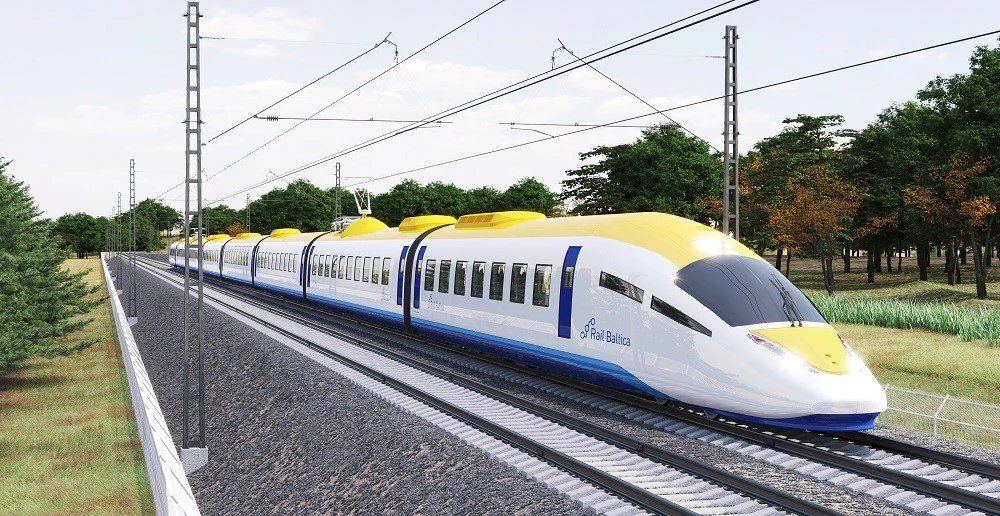
RIGA, Latvia — The ambitious Rail Baltica mega-project has reached a critical juncture in its engineering roadmap. RB Rail AS, the central coordinator of the largest rail infrastructure development in the Baltic States, has officially launched a new international procurement procedure aimed at securing advanced design consultancy services for the energy subsystem spanning Latvia and Lithuania.
This latest tender marks a decisive step forward in the detailed technical development, deployment, and long-term operational readiness of the corridor’s comprehensive electrification framework. By dividing the tender into two distinct geographical lots, project leaders hope to attract specialized international engineering consortia while actively encouraging the participation of experienced regional design firms capable of navigating local regulatory frameworks.
As Europe’s green transition gathers momentum, the integration of a fully electrified, high-speed rail corridor across Estonia, Latvia, and Lithuania is no longer just a regional transport upgrade; it is a vital geopolitical and environmental anchor for the European Union’s Trans-European Transport Network (TEN-T).
Main Facts: Scope, Structure, and Specifications of the Tender
The newly announced procurement framework is structured to address the complex engineering demands of modern high-speed railway electrification. According to the tender documentation released by RB Rail AS, the contract has been partitioned into two independent lots:
- Lot 1: Dedicated exclusively to the territory of Latvia.
- Lot 2: Dedicated exclusively to the territory of Lithuania.
Interested economic operators, engineering firms, and multidisciplinary design partnerships have the flexibility to submit bids for either individual country lot or for both, depending on their operational capacity and technical expertise.
Core Components of the Energy Subsystem
The scope of the design consultancy services covers the backbone of the corridor’s power architecture. Specifically, the selected consultants will be tasked with providing independent engineering expertise, design oversight, and technical validation for:
- Traction Substations: The facilities responsible for drawing power from the national high-voltage grids and converting it to the specifications required by modern high-speed electric locomotives.
- High-Voltage Components: Grid connection points, step-down transformers, and transmission infrastructure necessary to guarantee a robust and uninterrupted power supply.
- Contact Line Infrastructure (Catenary System): The overhead wire networks engineered to transfer electrical energy safely and reliably to trains operating at speeds up to 249 km/h.
RB Rail has underscored that the primary objective of this contract is to secure independent, top-tier design expertise. This ensures that every facet of the electrification subsystem is technically sound, highly efficient, and fully compliant with European Interoperability Technical Specifications (TSIs) and local safety regulations.
Submission Guidelines and Strict Deadlines
Compliance with administrative protocols is paramount for this tender. RB Rail AS has instituted a strictly enforced digital submission policy:
- Submission Channel: Electronic format exclusively through the official Latvian E-Tenders system.
- Deadline: May 7, 2026, at 11:00 a.m. Riga time.
- Important Caveat: Proposals submitted via email, physical mail, or any alternative channels will be automatically rejected without evaluation.
Chronology: The Evolution of Rail Baltica’s Electrification Strategy
To understand the significance of the May 2026 tender, it is necessary to trace the evolutionary timeline of the Rail Baltica project, specifically regarding its energy and power supply planning.
Phase 1: Conceptualization and Feasibility (2015–2018)
In the early years following the establishment of RB Rail AS as a joint venture representing Estonia, Latvia, and Lithuania, initial feasibility studies focused primarily on alignment, socio-economic impact, and standard-gauge (1,435 mm) track integration. Early on, planners recognized that operating a dual-purpose passenger and freight high-speed line on diesel propulsion would contradict European climate goals. Consequently, full electrification was baked into the project’s baseline DNA from the outset.
Phase 2: Preliminary Design and Standardization (2019–2022)
During this period, global engineering firms were contracted to complete the preliminary technical designs for the entire 870-kilometer route. Engineers mapped out power demand forecasts, factoring in future high-speed passenger services operating at up to 249 km/h and heavy freight trains weighing up to 2,000 tonnes. Standardization became a watchword, ensuring seamless electrical interoperability across borders.
Phase 3: Global Procurement and Civil Works Mobilization (2023–2025)
As construction permits were issued and civil works commenced on key sections—such as the Riga Central Station, Rīga International Airport station, and various cross-border stretches in Lithuania—the focus shifted from civil earthworks to specialized railway systems. Procurement for the primary energy subsystem, including high-voltage grid connections and overall electrification delivery models, began taking shape through international tenders.
Phase 4: Detailed Technical Design and Subsystem Refinement (2026 and Beyond)
The launch of the design consultancy tender in April 2026 represents the current phase of granular execution. While civil construction alters the physical landscape, this tender ensures that the invisible technological arteries—the substations and catenary wires—receive the rigorous, independent design oversight required before mass installation can begin.
Supporting Data: Economic, Technical, and Strategic Metrics
The scale of Rail Baltica dwarfs almost any other civil engineering undertaking in the Baltic region since the restoration of independence. The electrification subsystem alone represents an engineering challenge of massive proportions.
Quantitative Overview of Rail Baltica
- Total Corridor Length: Approximately 870 kilometers.
- Design Speed: Up to 249 km/h for passenger services; 120 km/h for freight operations.
- Gauge: 1,435 mm (European standard gauge), breaking the historical 1520 mm Russian gauge isolation of the Baltic states.
- Energy Demand: The ultimate full-build electrification scheme will require massive energy draw, necessitating dedicated high-voltage interconnectors with national transmission system operators (TSOs) in Estonia, Latvia, and Lithuania.
- Substations Required: Dozens of traction substations strategically positioned along the alignment to prevent voltage drops and ensure redundancy.
Financial and Funding Architecture
Financing an infrastructure project of this magnitude requires robust multilateral backing. Rail Baltica is heavily co-financed by the European Union through the Connecting Europe Facility (CEF), alongside national budgetary allocations from Estonia, Latvia, and Lithuania.

The inclusion of independent design consultancy services in this procurement cycle is directly tied to prudent financial governance. By ensuring meticulous design quality early on, project managers aim to mitigate the risk of costly construction change-orders, material delays, and technical incompatibilities down the line.
Official Responses and Stakeholder Perspectives
The rollout of the energy subsystem tender has drawn commentary from key stakeholders across the Baltic transport sector, emphasizing both the technical gravity and the collaborative spirit of the undertaking.
RB Rail AS Leadership on Technical Excellence
In official statements accompanying the tender release, representatives from RB Rail AS stressed that securing robust technical solutions is one of the project’s central priorities.
"As work on the Rail Baltica electrification accelerates across all three Baltic states, we are moving past the macro-planning phase into deep technical execution," an RB Rail spokesperson noted. "The energy subsystem is the lifeblood of this railway. It must be resilient, future-proof, and capable of supporting high-frequency passenger and heavy-duty freight operations without missing a beat. Independent design expertise is our safeguard to ensure absolute compliance and world-class engineering standards."
Encouraging Regional and International Synergy
RB Rail has deliberately structured the procurement to foster collaboration between global engineering powerhouses and regional design firms. By inviting local firms with proven track records in Latvia and Lithuania to participate—either independently or as part of international consortia—the project aims to build long-term local capacity.
Regional engineering associations have welcomed this approach, noting that local firms possess invaluable, boots-on-the-ground knowledge regarding local geotechnical conditions, environmental restrictions, and interactions with national utility providers.
Implications: Strategic, Economic, and Environmental Impact
The advancement of the Rail Baltica electrification tender carries profound implications that extend far beyond the immediate rail sector, influencing regional security, economic integration, and Europe’s environmental targets.
1. Geopolitical and Regional Security
Historically, the Baltic states’ rail infrastructure was structurally integrated with the Russian and Belarusian transport networks (1520 mm gauge), creating an infrastructural vulnerability. Rail Baltica physically and operationally integrates the Baltics into the European rail grid (1435 mm gauge).
The electrification of this corridor ensures energy independence for the railway network. Rather than relying on imported fossil fuels for diesel-powered locomotives, the electrified system will draw power directly from European-integrated, green-leaning national grids, reinforcing the strategic decoupling of Baltic infrastructure from non-EU energy and transport dependencies.
2. Environmental Sustainability and the European Green Deal
As a flagship project of the TEN-T core network, Rail Baltica is designed from the ground up to support the objectives of the European Green Deal. Shifting substantial volumes of freight from carbon-intensive road transport to an electrified, high-speed rail corridor will drastically reduce greenhouse gas emissions across the Baltic corridor.
Furthermore, modern traction substations equipped with regenerative braking capabilities will allow energy generated by decelerating trains to be fed back into the grid or utilized by accelerating services, maximizing operational energy efficiency.
3. Economic Growth and Market Integration
Improved connectivity translates directly to economic vitality. By slashing travel times between major Baltic urban centers—such as Tallinn, Pärnu, Riga, Panevėžys, Kaunas, Vilnius, and onward to Warsaw—Rail Baltica will effectively transform the Baltic states into a single, highly integrated economic region.
The business community stands to benefit from faster, more reliable freight logistics, opening new supply chain avenues northward to Finland (via future Gulf of Finland fixed-link concepts) and southward into Central and Western Europe.
Conclusion and Outlook
The launch of the design consultancy tender for the Rail Baltica energy subsystem in Latvia and Lithuania represents a vital stepping stone in Europe’s most significant greenfield rail project. As engineering firms prepare their bids ahead of the May 7, 2026 deadline, the project demonstrates steady, irreversible momentum.
By prioritizing independent expertise, rigorous technical compliance, and sustainable electrification, RB Rail AS is laying the groundwork for a safe, modern, and high-performance transport corridor. When completed, Rail Baltica will not only redefine mobility in the Baltic states but will also stand as a testament to European engineering cooperation, climate consciousness, and strategic resilience for generations to come.

