

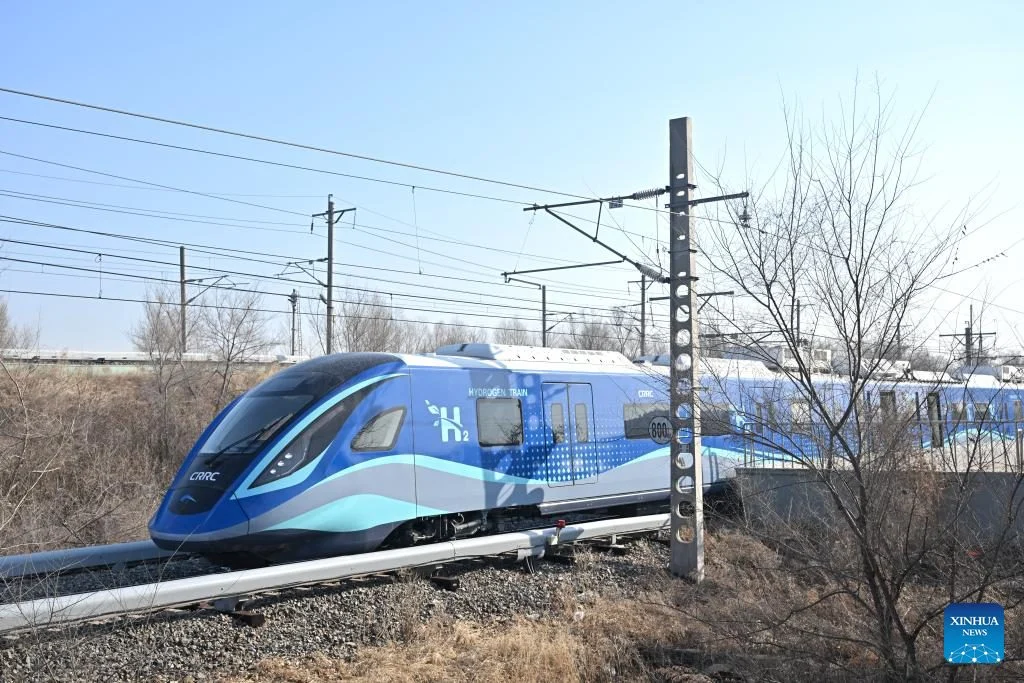
CHANGCHUN, CHINA — In a major milestone for sustainable transportation, China has successfully tested its first domestically developed hydrogen-powered urban train, reaching a maximum speed of 160 kilometers per hour (approx. 100 mph). The achievement marks a significant technological leap forward in the commercial application of hydrogen energy within the global rail sector, pointing toward a cleaner, greener future for mass transit.
Developed by CRRC Changchun Railway Vehicles—a subsidiary of the state-owned China Railway Rolling Stock Corporation (CRRC)—the cutting-edge vehicle underwent rigorous performance evaluations on Thursday at the company’s dedicated testing facility in Changchun, located in northeast China’s Jilin province.
This breakthrough test not only underscores China’s growing manufacturing and engineering prowess in green technologies, but it also fires a starting pistol in the global race to decarbonize passenger rail networks that cannot economically support expensive overhead electrification lines.
Main Facts
The newly tested hydrogen city train represents a paradigm shift in how urban and regional rail networks can source clean energy. Unlike traditional diesel locomotives, which are heavy polluters, or conventional electric trains that depend on continuous power supplied by overhead catenary wires or third rails, this hydrogen-powered unit generates its own electricity onboard through electrochemical reactions.
Core Technical Specifications:
- Top Operational Speed: 160 km/h (99.4 mph).
- Maximum Range: Over 1,000 kilometers (621 miles) on a single refueling cycle.
- Energy Efficiency: An average energy consumption rate of just 5 kilowatt-hours per kilometer.
- Power Source: Built-in hydrogen fuel cell systems providing a high-output, long-lasting energy supply.
- Developer: CRRC Changchun Railway Vehicles Co., Ltd.
The integration of hydrogen fuel cells and advanced supercapacitors allows the train to store and deliver energy smoothly, meeting the rigorous demands of high-speed urban transit without emitting carbon dioxide or particulate matter. Its water-only exhaust makes it a true zero-emission vehicle at the point of operation.
Chronology of Development
The successful high-speed run on Thursday was the culmination of years of intensive research, design, engineering, and iterative testing by Chinese rail engineers. While hydrogen technology has been explored globally for over a decade, translating it into a high-speed, high-capacity urban passenger platform required overcoming monumental technical hurdles.
- Early Research and Conceptualization (2019–2021): Engineers at CRRC Changchun began laying the groundwork for hydrogen-powered rail transport, focusing on optimizing fuel cell efficiency, thermal management, and lightweight materials for car bodies.
- Rollout of the Prototype (Late 2022): The first iteration of the hydrogen train rolled off the production line in Changchun, capturing international attention for its futuristic design and promising green credentials. Initial low-speed yard tests were conducted to verify basic propulsion systems.
- System Integration and Safety Validations (2023): Throughout the past year, the train underwent rigorous subsystem testing, including hydrogen storage safety trials, battery-fuel cell hybrid power management tests, and durability evaluations under simulated extreme weather conditions.
- The 160 km/h Milestone (March 2024): On Thursday, the train completed its comprehensive performance evaluation on CRRC’s company-owned test track, officially validating its high-speed operational capabilities, system-wide stability, and energy consumption metrics at the targeted 160 km/h threshold.
Supporting Data and Comparative Analysis
The data gathered during Thursday’s evaluation places China’s new hydrogen train at the cutting edge of global rail technology. When benchmarked against international competitors and older transit modes, the metrics reveal compelling advantages in both efficiency and operational range.
Energy Consumption and Efficiency
According to telemetry data released following the test, the hydrogen city train achieved an average energy consumption of 5 kilowatt-hours (kWh) per kilometer. This figure places the Chinese vehicle firmly in line with—and in some cases exceeding—the performance benchmarks established by global leaders in hydrogen rail technology, such as France’s Alstom.
Range and Infrastructure Independence
One of the most profound limitations of battery-electric trains (EMUs) is their restricted range and the lengthy downtime required for recharging. Conversely, diesel trains offer long ranges but fail to meet modern environmental standards.
The CRRC Changchun train bridges this gap by offering a maximum range of more than 1,000 kilometers. This puts it on par with international pioneers like the Alstom Coradia iLint—which successfully demonstrated its long-distance capabilities in Canada and various European nations—while maintaining the rapid acceleration and passenger capacity expected of a modern city train.

| Metric | CRRC Hydrogen City Train | Traditional Diesel Train | Standard Catenary Electric Train |
|---|---|---|---|
| Emissions | Zero (Water vapor only) | High ($CO_2$, $NO_x$, soot) | Zero at point of use |
| Range | > 1,000 km | 800 – 1,200 km | Unlimited (while connected to grid) |
| Infrastructure Cost | Low (Requires only refueling stations) | Low (Uses existing tracks/fuel depots) | Extremely High (Substations & overhead wires) |
| Energy Consumption | ~5 kWh/km | Varies (High carbon footprint) | Varies (Grid dependent) |
Official Responses and Industry Reactions
News of the successful test has reverberated globally, drawing praise from state media, engineering bodies, and industry analysts alike.
According to reports from China’s official Xinhua news agency, the milestone is viewed as a "remarkable breakthrough in the application of hydrogen energy in rail transport." Chinese state planners have increasingly emphasized the importance of green manufacturing and clean energy innovations as part of the country’s broader "dual carbon" goals—peaking carbon dioxide emissions before 2030 and achieving carbon neutrality before 2060.
Representatives from CRRC Changchun highlighted the meticulous nature of the testing process. In an official statement, the company noted that the vehicle underwent a comprehensive validation process across "a variety of scenarios and operational contexts on a company-owned test track." Engineers tested everything from emergency braking systems to peak-load energy distribution, ensuring the train met strict safety protocols before moving toward potential commercial deployment.
International rail experts have also weighed in, noting that China’s rapid scaling of hydrogen infrastructure could accelerate the adoption of similar technologies in developing economies across Asia, Africa, and South America, where electrifying entire rail networks remains prohibitively expensive.
Global Implications and the Future of Rail Transport
The successful test of China’s 160 km/h hydrogen city train carries profound implications for the future of global mobility, urban planning, and the energy transition.
1. Decarbonizing Non-Electrified Lines
While high-speed rail corridors and dense metropolitan subway networks are easily electrified via overhead catenary systems or third rails, thousands of kilometers of regional, suburban, and rural rail lines worldwide remain uneconomical to electrify. Installing overhead wires requires massive capital investments, complex land-use approvals, and years of construction. Hydrogen trains offer a plug-and-play alternative: they can operate on existing tracks without any infrastructure modifications, save for the construction of localized hydrogen refueling depots.
2. Geopolitical and Industrial Competition
The race for hydrogen supremacy in transportation is heating up. While European countries—particularly Germany, France, and Italy—have pioneered early commercial rollouts of hydrogen regional trains, China’s entry into the high-speed hydrogen market (at 160 km/h) changes the competitive landscape. With massive domestic manufacturing capacity, robust supply chains, and state-backed financial support, Chinese rail manufacturers are well-positioned to export hydrogen technology to emerging markets seeking affordable, green transit solutions.
3. Scaling the Hydrogen Economy
The viability of hydrogen transit depends heavily on the broader availability of "green hydrogen" produced via water electrolysis using renewable energy sources like wind and solar. As projects like CRRC’s hydrogen train gain traction, they create a reliable, high-demand anchor customer for hydrogen producers, driving down the overall cost of the fuel and stimulating the growth of a robust hydrogen economy.
Conclusion
China’s successful test of its first hydrogen city train at 160 km/h is far more than a technical trial—it is a glimpse into the future of mass transit. By combining the speed and comfort of modern electric trains with the autonomy and zero-emission benefits of hydrogen fuel cells, CRRC Changchun has delivered a potent tool for global decarbonization. As the world searches for viable pathways away from fossil fuels, innovations like this prove that the age of hydrogen rail is no longer a distant vision, but a rapidly accelerating reality.

