

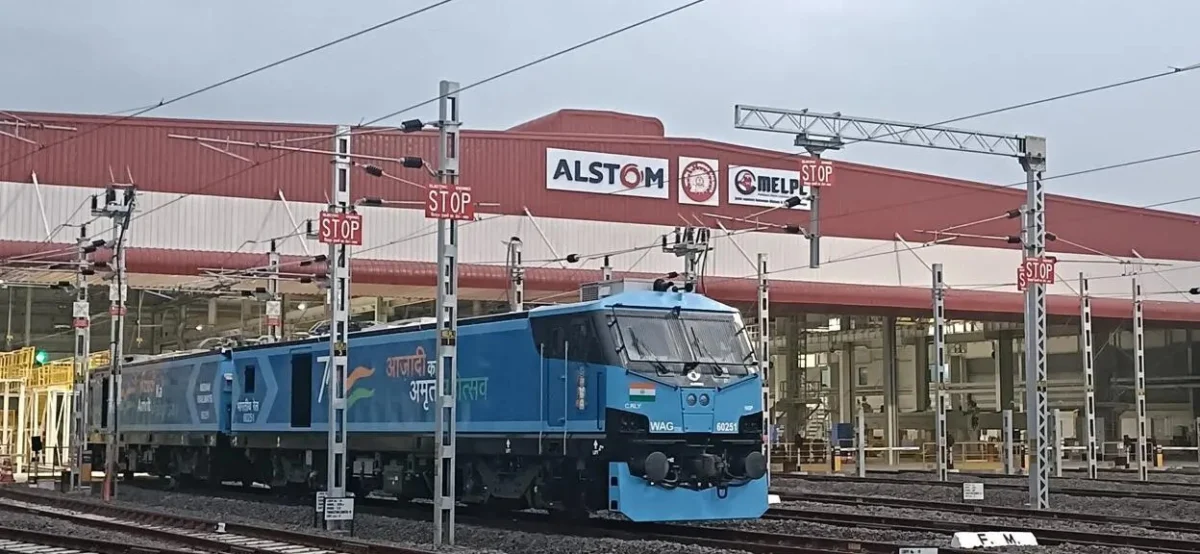
In a significant reinforcement of its industrial footprint in South Asia, Alstom, the global leader in sustainable mobility, has secured a new maintenance contract valued at €107 million. The agreement, centered on the high-performance WAG-12B electric freight locomotives, marks a pivotal milestone in the long-standing collaboration between the French multinational and Indian Railways. By extending the operational support for 250 locomotives based at the Nagpur depot, the partnership underscores a shared vision for modernizing India’s logistics infrastructure through cutting-edge technology and localized industrial expertise.
The contract is executed through Madhepura Electric Locomotive Private Limited (MELPL), a strategic joint venture between Alstom and the Indian Ministry of Railways. This five-year commitment ensures the continued seamless operation of the Prima T8 WAG-12B series, which serves as the backbone of India’s heavy-haul freight network.
The Core Agreement: Sustaining the Backbone of Indian Freight
The newly finalized contract is more than a simple service agreement; it is a testament to the operational success of the preceding four-year term. Under the terms of the deal, MELPL will provide comprehensive, full-cycle maintenance for 250 WAG-12B units. Beyond the locomotives themselves, the contract encompasses the maintenance of the state-of-the-art depot infrastructure in Nagpur, which has become a flagship facility for high-tech rail maintenance in the region.
The Nagpur depot, strategically located at the heart of India, functions as a center of excellence. It is designed to handle the sophisticated diagnostics and heavy-duty repairs required for the Prima T8 fleet. By securing this five-year extension, Alstom aims to maintain the high availability rates that have characterized the fleet’s performance since its introduction, ensuring that India’s dedicated freight corridors remain efficient and reliable.
Technical Superiority: The WAG-12B "Prima T8"
To understand the magnitude of this contract, one must look at the technical prowess of the locomotives involved. The WAG-12B is not merely a train; it is a 12,000-horsepower engineering marvel designed specifically for the rigorous demands of the Indian landscape.
Key Specifications:
- Power Output: 12,000 horsepower (CP), allowing for superior acceleration and haulage capacity.
- Payload Capacity: Capable of hauling heavy freight loads of up to 6,000 metric tons.
- Operational Velocity: Capable of reaching speeds of up to 120 km/h.
- Strategic Role: These locomotives are the primary workhorses for the Western and Eastern Dedicated Freight Corridors (DFC). By transitioning freight traffic from conventional lines to these high-capacity corridors, Indian Railways is drastically increasing throughput while reducing the carbon footprint per ton-kilometer.
These locomotives feature advanced propulsion technology, regenerative braking systems, and an aerodynamic design that minimizes energy consumption. Their deployment is instrumental in the Indian government’s objective to reach net-zero carbon emissions by 2070, as rail remains the most energy-efficient mode of long-distance surface transport.
A Chronology of Collaboration: From Concept to Maintenance Milestone
The relationship between Alstom and Indian Railways has evolved from a simple procurement model to a deep, integrated industrial partnership.
- 2015: The foundation was laid when Alstom won a historic €3.5 billion contract to supply 800 electric locomotives to Indian Railways, representing one of the largest foreign direct investments in the Indian rail sector.
- 2018: The first WAG-12B shell was unveiled at the Madhepura factory, signaling the start of a transformative era for Indian freight.
- 2020: The first locomotive was officially inducted into the Indian Railways fleet, marking the commencement of the inaugural four-year maintenance cycle.
- 2024: Following the successful completion of the initial contract, where the Nagpur depot achieved industry-leading benchmarks for locomotive uptime and reliability, the five-year extension was negotiated and signed.
This timeline reflects a successful "design, build, and operate" lifecycle, showcasing how international expertise can be successfully embedded within a national framework to drive systemic change.
Official Perspectives: Commitment to a "Freight Revolution"
The renewal of this contract has been met with enthusiasm from both the private and public sectors. Olivier Loison, Managing Director of Alstom India, emphasized that the extension is a direct result of the trust built during the initial phase of the partnership.

"The renewal of this contract is a strong confirmation of our commitment to Indian Railways and the success of our partnership," Loison stated. "We are proud that the trust placed in us has translated into the proven performance and reliability of the WAG-12B electric locomotives, which are essential to the freight transport revolution in India."
This sentiment is echoed by officials at Indian Railways, who have viewed the MELPL joint venture as a model for future Public-Private Partnerships (PPP). The ability of the Nagpur depot to maintain such a high volume of complex assets has provided the necessary confidence to scale up operations across the DFC network.
Implications: Building Local Resilience and Skills
The implications of this €107 million investment extend far beyond the mechanical maintenance of trains. The contract serves as a catalyst for the broader "Make in India" and Atmanirbhar Bharat (Self-Reliant India) initiatives.
Rapid Response and Depot Efficiency
The contract formalizes the continued operation of Alstom’s mobile rapid-response teams. These specialized units, equipped with high-tech diagnostic tools and a ready supply of critical spare parts, are stationed at strategic locations along the freight corridors. By decentralizing maintenance, Alstom ensures that technical issues are resolved in situ, minimizing downtime and ensuring that the locomotives are available for service 24/7.
Human Capital and Skill Development
A critical component of this agreement is the ongoing on-site training program. Alstom is heavily invested in transferring technical knowledge to the local workforce. By training Indian technicians on the latest European standards for electric locomotive maintenance, the partnership is fostering a new generation of railway experts. This "upskilling" is vital for the long-term sustainability of the rail sector in India, ensuring that local talent is capable of managing sophisticated, high-speed rail systems independently.
Alstom’s Strategic Footprint in India
The maintenance contract in Nagpur is merely one piece of a much larger industrial puzzle. Alstom currently operates through an extensive network of six manufacturing facilities and five major engineering centers across India. This infrastructure allows the company to provide an end-to-end service, ranging from the design and manufacturing of rolling stock to the installation of signaling systems and long-term maintenance.
By aligning its operational strategy with the Indian government’s vision for infrastructure development, Alstom has successfully navigated the complexities of one of the world’s most dynamic rail markets. Their focus on domestic supply chains—sourcing components locally whenever possible—further cements their position as a cornerstone of the Indian rail ecosystem.
Conclusion: Driving the Future of Rail Logistics
As India continues to expand its Dedicated Freight Corridors, the role of the WAG-12B fleet becomes increasingly critical. The ability to move goods faster, more reliably, and with lower environmental impact is the engine of India’s economic growth.
The €107 million maintenance contract for the Nagpur depot ensures that this engine keeps running at peak efficiency. By combining European engineering excellence with local operational expertise, Alstom and Indian Railways are not just maintaining trains—they are sustaining the vital arteries of a nation on the move. As the partnership moves into this new five-year phase, it stands as a shining example of how international collaboration can solve complex logistical challenges, foster industrial growth, and pave the way for a more sustainable, interconnected future in global freight transportation.

