

The Irish government has officially signaled the commencement of the detailed tender phase for Dublin’s MetroLink, a monumental transport project that promises to redefine the capital’s urban mobility. Announced on September 16, this decision marks a definitive transition from the planning and preliminary design stages into the procurement of the global expertise required to construct and operate one of the most ambitious infrastructure projects in Ireland’s history. With contracts worth several billion euros on the table, the project is set to attract a consortium of international engineering and rail firms, setting the stage for a decade-long transformation of Dublin’s transit landscape.
The Scope of the Project: Connecting a Growing Capital
MetroLink is designed as the backbone of a modern, sustainable Dublin. Spanning 19 kilometers, the line will traverse the city’s critical north-south axis, connecting the northern suburbs of Estuary and Swords to the southern terminus at Charlemont.
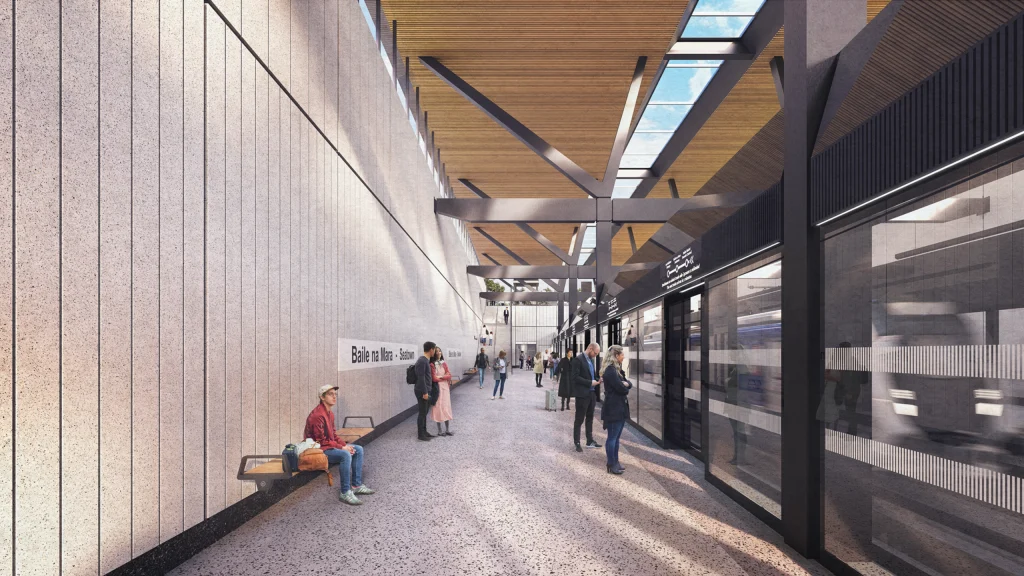
The route is engineered for maximum utility, running primarily underground through the dense northern and central city corridors. It will feature 16 state-of-the-art stations, strategically placed to serve as hubs for the city’s most vital nodes. Key stops include Dublin Airport—a critical link for international connectivity—as well as major educational and healthcare institutions such as Dublin City University (DCU), the Mater Hospital, and the Rotunda Hospital. By weaving these high-traffic destinations into a single, seamless rail corridor, MetroLink addresses the long-standing need for rapid transit that bypasses the chronic road congestion currently stifling the city.
Chronology: From Concept to Procurement
The journey to this point has been characterized by meticulous planning, extensive public consultation, and rigorous fiscal oversight.
- 2018–2020: Conceptualization and Initial Planning: The National Transport Authority (NTA) unveiled the initial plans for MetroLink, which replaced the previous, more limited Metro North proposal.
- 2021–2022: Public Consultation and Refinement: The project underwent several rounds of intense public scrutiny, leading to design adjustments to accommodate local environmental and heritage concerns.
- 2023–2024: Statutory Approvals and Business Case Finalization: The Department of Transport and the NTA finalized the detailed business case, securing the necessary government backing to proceed.
- September 2024: The Irish Government greenlit the start of the formal tender process.
- Early 2025 (Projected): Commencement of preparatory works, including site clearance and utility diversion.
- Late 2025/2026 (Projected): Commencement of major tunneling operations and the procurement of the primary construction and operating partners.
This roadmap reflects a transition from theoretical planning to the physical reality of heavy construction, a process that will be overseen by the recently appointed Jacobs AECOM consortium, which has been tasked with project management and cross-phase coordination.
Financial Architecture: The €15.7 Billion Question
Infrastructure of this magnitude brings significant financial implications. According to the comprehensive business case developed by the Department of Transport and the NTA, the projected cost of MetroLink is estimated at a central figure of €15.75 billion.
This estimate is not a fixed price, but rather a sophisticated projection that includes significant contingencies for risks, currency fluctuations, and anticipated inflation. The Department has acknowledged a potential cost range between €14.5 billion and €17.5 billion, excluding VAT.
Critics and analysts have pointed to the volatility of global construction costs, noting that infrastructure projects of this scale are notoriously susceptible to budget creep. However, the government has maintained that the final cost structure will be refined once the competitive tender process is completed next year. By inviting international bids, the state aims to leverage competitive tension to secure the most efficient delivery model while ensuring that taxpayers receive the best possible value for money.
Technical Specifications: Automation and Capacity
MetroLink is not merely a train line; it is a high-capacity, automated rapid transit system designed for the 21st century. The system will be fully electrified, adhering to Ireland’s climate action commitments by providing a low-carbon alternative to private vehicle use.
High-Frequency, High-Capacity Operations
The technical requirements for the fleet are robust. The system will deploy 64-meter-long trains designed to operate at three-minute intervals during peak hours. This level of frequency ensures that the system will be able to transport up to 20,000 passengers per direction, every hour. To put this into perspective, this capacity is more than double that of the current Luas Green line, effectively providing the high-volume throughput required for a city with Dublin’s rapid population growth.
Fully Automated Infrastructure
The line will be driverless, utilizing Grade of Automation 4 (GoA4) technology. This allows for constant, synchronized movement, reducing human error and allowing for more precise scheduling. Furthermore, the infrastructure is designed for full interoperability. MetroLink will not exist in a vacuum; it is being built to integrate seamlessly with the existing DART (Dublin Area Rapid Transit) network, the Luas tram system, and the city’s extensive bus network, effectively creating a unified "mobility hub" across the greater Dublin area.
Official Responses and Strategic Significance
The government’s decision to move to the tender phase has been framed as a historic milestone. Minister for Transport, Eamon Ryan, emphasized that the project is essential for the future of the Irish economy. "MetroLink is the missing link in our transport network," he noted. "By connecting the airport to the city center and integrating it with our rail and bus services, we are creating a Dublin that is accessible, sustainable, and capable of supporting a growing population."
The appointment of the Jacobs AECOM consortium serves as a testament to the scale of the challenge. Their role is to act as the "eyes and ears" of the state, ensuring that the consortium of builders—yet to be selected—adheres to the strict safety, environmental, and financial guidelines set forth by the NTA.
Implications: A City Transformed
The completion of MetroLink will have profound implications for the social and economic fabric of Dublin.
Economic Impact
The construction phase alone will generate thousands of jobs, requiring specialized skills in tunneling, systems engineering, and urban planning. Post-construction, the line is expected to unlock significant development potential along the route, particularly in the northern corridor where housing density can be increased around the new stations.
Urban Planning and Sustainability
Dublin has historically struggled with urban sprawl and traffic congestion. By providing a reliable, high-speed, and high-capacity alternative to the car, MetroLink is expected to significantly reduce the carbon footprint of the city’s daily commute. It will enable the development of "transit-oriented development" (TOD) zones, where residential and commercial hubs are clustered around transit nodes, reducing the need for long-distance commuting.
Social Connectivity
For residents in areas like Swords and Ballymun, MetroLink represents more than just a commute; it represents social and economic inclusion. The line will provide faster access to employment, healthcare at the Mater and Rotunda, and education at DCU. By shrinking the perceived distance between the city’s periphery and its core, the project promises to equalize access to the opportunities that a capital city offers.
Conclusion: The Road Ahead
As the tender process opens, the focus shifts to the global stage. The Irish government is now seeking partners capable of navigating the complex geological and logistical challenges of tunneling under a historic city while maintaining the continuity of daily life.
The MetroLink project is, in many ways, the ultimate test of Ireland’s capability to deliver large-scale infrastructure in a modern, democratic, and environmentally conscious regulatory environment. While the financial cost is substantial, the cost of inaction—measured in lost productivity, carbon emissions, and social fragmentation—is widely viewed as being far higher.
As 2025 approaches, the eyes of the construction and transport industries will remain fixed on Dublin. The procurement phase is just the beginning of a long journey, but with the government’s firm commitment, the path toward a transformed, connected, and efficient Dublin has never been clearer. The city is preparing for a new era of mobility, one where the rhythm of life is dictated by the pulse of the metro.

