

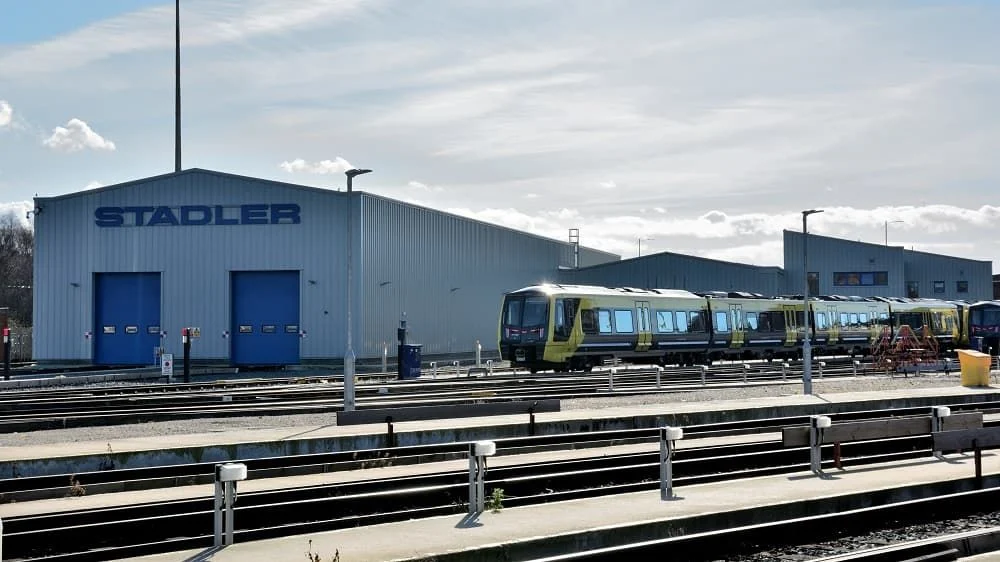
In a move set to redefine the technological landscape of European rail transport, Swiss rolling stock giant Stadler and the Portuguese high-tech firm Critical Software have announced the formation of a joint venture: Stadler Digital Labs (STADL). This collaboration marks a significant shift in how railway operators approach the integration of complex digital ecosystems, cybersecurity, and safety-critical engineering. By marrying Stadler’s industrial pedigree in manufacturing state-of-the-art trains with Critical Software’s decades of expertise in high-integrity systems, the new entity aims to become a powerhouse for rail digitalization.
Main Facts: A Synergistic Partnership
The joint venture operates under a 51% (Stadler) and 49% (Critical Software) equity split, reflecting a balanced commitment to both industrial scale and specialized engineering agility. The new entity, headquartered in Portugal, is designed to serve as an internal and external innovation hub, tackling the challenges of modern rail—a sector increasingly defined by software-driven performance rather than just mechanical prowess.
STADL will operate out of two primary hubs in Portugal: Coimbra and Lisbon, with the latter embedded within the existing infrastructure of Critical Software. The venture launches with an initial workforce of 100 specialists, with an aggressive scaling roadmap that targets a headcount of 300 highly skilled engineers within the next three years. Under the leadership of CEO Rogério Gomes, the company is poised to standardize software development practices across the Stadler group, ensuring that safety-critical systems are not only robust but also scalable and interoperable.
Chronology: The Road to STADL
The genesis of Stadler Digital Labs is the culmination of a multi-year trend toward the "software-defined train." While Stadler has long been a leader in train production, the complexity of modern railway signaling, passenger information systems, and automated driving has necessitated a more centralized digital strategy.
- 1998: Founding of Critical Software, which began building its reputation in space, defense, and medical devices—sectors where failure is not an option.
- Early 2020s: As the rail industry faced pressure to adopt ERTMS (European Rail Traffic Management System) and move toward fully automated, driverless operations, Stadler began intensifying its search for partners capable of managing high-level digital complexity.
- 2024–2025: Strategic discussions between Stadler and Critical Software deepened, centering on the need to harmonize disparate software stacks across Stadler’s various global projects.
- February 2026: Official announcement of the Stadler Digital Labs joint venture, establishing a permanent operational footprint in Portugal to leverage the country’s growing reputation as a European tech hub.
Supporting Data: Engineering the Future
The rationale behind the formation of STADL is supported by a critical shift in railway economics. Modern rolling stock is no longer just a vehicle; it is a mobile data center.
The Scale of Ambition
- Initial Workforce: 100 professionals.
- Three-Year Growth Target: 300 specialists, focusing on cybersecurity, embedded software, and systems engineering.
- Operational Footprint: Dual-site operations in Coimbra and Lisbon to tap into Portugal’s engineering talent pipeline.
- Sectoral Focus: Rail, with potential cross-pollination from Critical Software’s experience in aerospace and defense.
Technical Expertise
The collaboration is built upon the concept of "reusable software assets." In the past, railway software was often bespoke, leading to high maintenance costs and security vulnerabilities. STADL intends to standardize these processes, utilizing:
- Safety-Critical Systems Engineering: Applying methodologies from the space and medical sectors to rail, where the risk of software failure is catastrophic.
- Cybersecurity Lifecycle Management: Implementing "Security by Design" to protect trains from the increasing threat of digital infiltration.
- Advanced Digital Solutions: Developing predictive maintenance algorithms and diagnostic software that can be updated over-the-air (OTA).
Official Responses and Strategic Vision
The leadership teams of both organizations emphasize that this venture is not merely a service provider, but a strategic engine for growth.
Rogério Gomes, CEO of Stadler Digital Labs, framed the initiative as a contribution to European infrastructure: "Stadler Digital Labs reflects the strategic alignment between two organizations with converging visions on innovation, safety, and modernization of the railway sector. Railways are not only relevant for the growth of the Portuguese economy, but also for the development of a safe and interoperable European mobility ecosystem."

Gonçalo Quadros, President of Critical Software, highlighted the technical necessity of the partnership: "Our experience in critical software engineering and complex systems will help bring Stadler’s ambitious vision for the rail and mobility sector to fruition. We are bringing a culture of rigorous verification and validation—honed in environments like space flight—to the tracks."
Implications: The Digital Transformation of Rail
The creation of STADL has profound implications for the rail industry at large.
1. The "Standardization" Movement
One of the greatest challenges in the rail industry is fragmentation. Different operators use different signaling systems, proprietary software, and varying hardware configurations. By creating a dedicated lab for software development, Stadler is aiming to establish a "standardized language" for its rolling stock. This will allow for faster deployment of new trains, easier software updates, and a more predictable maintenance cycle for transit authorities.
2. Cybersecurity in a Connected World
As trains become more connected—to internet networks, passenger Wi-Fi, and centralized traffic control centers—the attack surface for malicious actors expands. STADL is positioned to act as a security bastion. By integrating cybersecurity at the earliest stage of the design process, the venture ensures that Stadler’s future fleets are built with a "zero-trust" architecture, protecting both passenger data and the operational integrity of the rail network.
3. A Boost for the Portuguese Tech Sector
The selection of Portugal as the home for STADL is a strategic nod to the country’s emergence as a competitive European engineering hub. With access to universities and a skilled workforce, STADL is expected to act as an anchor institution, attracting high-end engineering talent and fostering a local ecosystem of sub-contractors and technology partners.
4. Competitive Advantage for Stadler
For Stadler, this venture provides a massive competitive advantage. While other manufacturers often outsource their digital development to various third parties, Stadler is now effectively "in-housing" a specialized software engineering firm. This vertical integration allows for tighter control over quality and faster time-to-market for complex digital features, such as semi-autonomous driving capabilities or energy-optimization software.
Conclusion: Shaping the Next Generation of Mobility
The establishment of Stadler Digital Labs is more than a corporate merger; it is a signal that the rail industry has officially entered the era of the "software-defined vehicle." As public demand for efficient, safe, and green transportation continues to rise, the ability to iterate on software—to push updates, patch vulnerabilities, and optimize performance—will determine which manufacturers succeed in the global market.
By combining the industrial reliability of a Swiss giant with the agile, mission-critical software expertise of a Portuguese innovator, STADL is well-positioned to write the code that will power the trains of tomorrow. Whether through the development of fully automated, sensor-rich commuter trains or the enhancement of long-distance high-speed rail, the work conducted in the labs of Coimbra and Lisbon will resonate across the entire European rail network for decades to come. As the venture moves into its growth phase, the industry will be watching closely to see how this blend of safety-critical culture and industrial manufacturing transforms the daily experience of millions of rail passengers.

