

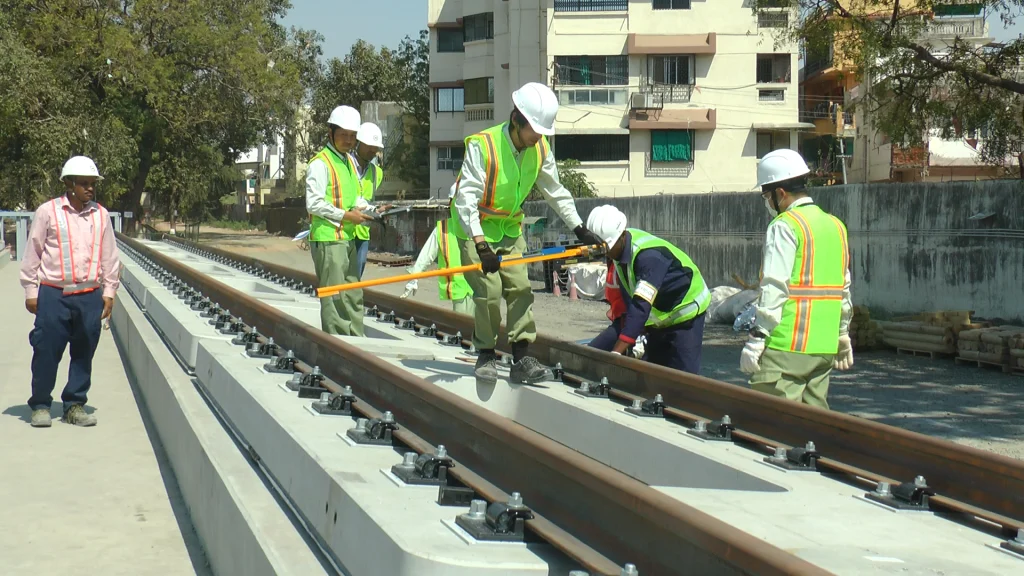
NEW DELHI — In a monumental leap forward for India’s ambitious transportation infrastructure landscape, Indian engineering and construction conglomerate Larsen & Toubro (L&T) has emerged as the lowest bidder for the single largest infrastructure package of the Mumbai–Ahmedabad High-Speed Rail (MAHSR) project. The announcement, made by the National High Speed Rail Corporation Limited (NHSRCL), marks a definitive stride toward materializing the nation’s maiden bullet train corridor.
Valued at an astronomical USD 4.6 billion (approximately INR 24,985 crore based on prevailing estimates at the time of financial opening), the contract encompasses nearly half of the total project alignment. This high-stakes tender underlines the monumental scale of India’s infrastructural transformation, setting new benchmarks for engineering prowess, project execution velocity, and domestic manufacturing integration.
Main Facts: The Scope and Scale of the Mega-Contract
The financial bid submitted by L&T covers Package C4, which accounts for roughly 47% of the entire 508-kilometer high-speed rail alignment. The geographic span of this contract stretches from Vapi—specifically at Zaroli Village along the Maharashtra-Gujarat border—deep into the heart of Gujarat up to Vadodara.
Key Technical and Structural Deliverables:
- Corridor Length: Design and construction of a 237-kilometer continuous high-speed rail line.
- Stations Included: Four major state-of-the-art elevated stations located at Vapi, Billimora, Surat, and Bharuch.
- Depot Infrastructure: Complete construction of a major rolling stock maintenance depot in Surat.
- Engineering Complexity: The package requires advanced viaducts, multiple major bridges, mountain/tunnel interfaces (where applicable), and intricate urban transit integrations.
The tender evaluation process was characterized by intense competition. Following the opening of technical bids on September 23, 2020, NHSRCL executed a rigorous, multi-tiered technical evaluation. In a testament to administrative efficiency and streamlined project management, the financial bids were unlocked in less than a month, positioning the project for swift final award and ground-level mobilization. Alongside L&T, two other formidable consortium groupings—comprising a total of seven major national and international construction entities—had fiercely contested the technical and financial parameters of the tender.
Chronology of Events: From Blueprint to Bidding Milestone
The journey of the Mumbai–Ahmedabad High-Speed Rail project has been meticulously planned, traversing through international diplomatic frameworks, complex land acquisitions, massive surveying exercises, and systematic procurement phases.
2017–2019: Laying the Groundwork
- September 2017: The formal foundation stone for the MAHSR project was laid jointly in Ahmedabad by Indian Prime Minister Narendra Modi and Japanese Prime Minister Shinzo Abe, underscoring the deep bilateral and technological partnership between India and Japan.
- 2018–2019: NHSRCL engaged extensively in geotechnical investigations, environmental impact assessments, utility shifting, and large-scale land acquisition across the states of Maharashtra, Gujarat, and the Union Territory of Dadra and Nagar Haveli. Simultaneously, training grounds and specialized civil engineering academies—such as the Training Track in Vadodara—began taking shape.
2020: Accelerating Tendering and Procurement
- January–March 2020: NHSRCL floated critical civil package tenders, drawing global interest despite the emerging shadows of the global COVID-19 pandemic. As part of continuous stakeholder engagement, NHSRCL organized three online pre-bid meetings to address technical intricacies for the construction of 14 major bridges along the route.
- August 2020: Momentum surged as the authority invited separate bids for the design and construction of an 18-kilometer viaduct stretching between Anand and Sabarmati. This sub-segment notably included high-speed rail stations at Ahmedabad and Sabarmati, alongside 31 crossing bridges, including six advanced steel truss bridges.
- August 2020 (Later in the month): In a major consolidation milestone, NHSRCL opened three major technical bids cumulatively covering 64% of the entire high-speed rail alignment (representing 325 kilometers and five out of the 12 planned stations).
- September 23, 2020: Technical bids for the monumental 237-kilometer C4 package (Vapi to Vadodara) were officially unlocked.
- October 2020: Following stringent technical vetting, the financial bids were opened, revealing L&T as the lowest bidder with its USD 4.6 billion valuation.
Supporting Data and Technical Specifications of the MAHSR Project
The Mumbai–Ahmedabad High-Speed Rail corridor is not merely a faster transit option; it represents a technological leap into ultra-modern railway engineering. Modelled on Japan’s legendary Shinkansen bullet train system, the project incorporates bleeding-edge safety, signaling, and civil infrastructure standards.
Core Project Parameters:
- Total Corridor Length: 508 kilometers connecting India’s financial capital (Mumbai) to Gujarat’s bustling commercial hub (Ahmedabad).
- Number of Stations: 12 strategically placed stations, namely: Mumbai, Thane, Virar, Boisar, Vapi, Billimora, Surat, Bharuch, Vadodara, Anand, Ahmedabad, and Sabarmati.
- Operational Speed: Trains will operate at a design speed of 320 km/h, slashing travel times dramatically. While conventional trains take upwards of 6 to 8 hours to traverse the distance, the high-speed rail will complete the journey in approximately 2 hours (express services) or 2 hours and 58 minutes (stopping at all stations).
- Passenger Projections: During the nascent years of commercial operation, daily ridership is projected to reach approximately 17,900 passengers per day per direction, scaling rapidly as regional economies integrate further.
- Track Gauge: Standard Gauge (1435 mm), ensuring compatibility with global high-speed rolling stock standards.
- Signalling System: Implementing Japan’s Digital Automatic Train Control (ATC) system, ensuring absolute safety margins and microscopic headway intervals.
Economic Implications and Job Creation
Beyond its transit utility, the Mumbai–Ahmedabad High-Speed Rail project functions as a massive macroeconomic stimulus package for India, injecting vital momentum into core industrial sectors at a time of global economic recalibration.
Employment Generation
Industry analysts and NHSRCL projections estimate that the construction phase alone will directly and indirectly generate more than 90,000 jobs. These opportunities span a diverse spectrum of skill sets, including:
- High-precision civil engineers, structural designers, and geotechnicians.
- Heavy machinery operators, project managers, and safety compliance experts.
- Ancillary service providers, logistics personnel, and local hospitality and supply chain workers.
Boosting Domestic Manufacturing (Make in India)
A defining characteristic of the MAHSR procurement strategy is its commitment to domestic resource utilization. Unlike traditional foreign-funded infrastructure projects that heavily import raw materials, the construction of the bullet train corridor will rely intensely on domestic industrial ecosystems:
- Cement and Concrete: Millions of metric tons of high-grade cement will be sourced directly from Indian manufacturers, providing a massive boon to the domestic cement sector.
- Steel and Structural Steel: Rebar, structural girders, and specialized steel alloys required for viaducts and station frameworks will be manufactured within India.
- Heavy Construction Equipment: The mobilization of heavy cranes, launching girders, pile-boring rigs, and transit mixers will supercharge the domestic construction machinery and equipment leasing markets.
Official Responses and Strategic Vision
The rapid progression of the tender process has drawn widespread acclaim from industry leaders, administrative authorities, and international partners.
Government and Corporate Leadership Perspectives
Speaking on the advancements of the project, senior officials from the Ministry of Railways emphasized that the MAHSR project is a laboratory for future national infrastructure. "The speed at which these multi-billion-dollar tenders are being evaluated and awarded demonstrates India’s maturing capability to execute ultra-complex, mega-scale infrastructural projects with transparency and professional rigor," an NHSRCL spokesperson noted.
Larsen & Toubro’s aggressive and successful bidding for the C4 package reaffirms its status as India’s premier infrastructure powerhouse. Company executives have frequently highlighted that undertaking a project of this magnitude is a matter of national pride. L&T’s engineering teams are uniquely positioned to manage the geological, logistical, and structural challenges associated with laying high-speed rail viaducts across densely populated urban fringes, rivers, and agricultural tracts.
Furthermore, diplomatic observers have noted that the project serves as a cornerstone of India-Japan strategic cooperation. Japanese financial backing through soft loans, coupled with technical knowledge transfer regarding earthquake-resistant structures, noise barriers, and aerodynamic train design, sets a gold standard for bilateral developmental projects.
Looking Ahead: The Future of High-Speed Rail in India
As L&T prepares to mobilize resources for the 237-kilometer Vapi-Vadodara stretch, attention is rapidly shifting toward the remaining packages of the MAHSR corridor. With technical bids for over 64% of the alignment already open and bridge construction tenders well underway, the physical skyline of western India is undergoing an irreversible transformation.
The successful execution of this project is widely expected to serve as a proof-of-concept for India’s proposed future high-speed rail corridors, including routes connecting Delhi-Varanasi, Delhi-Ahmedabad, Mumbai-Nagpur, and Chennai-Bangalore.
As tracks are laid, stations rise, and training academies prepare the next generation of locomotive pilots and maintenance engineers, India stands firmly on the threshold of a high-speed transit revolution—one that promises to shrink distances, unify regional markets, and redefine the future of national mobility.

