

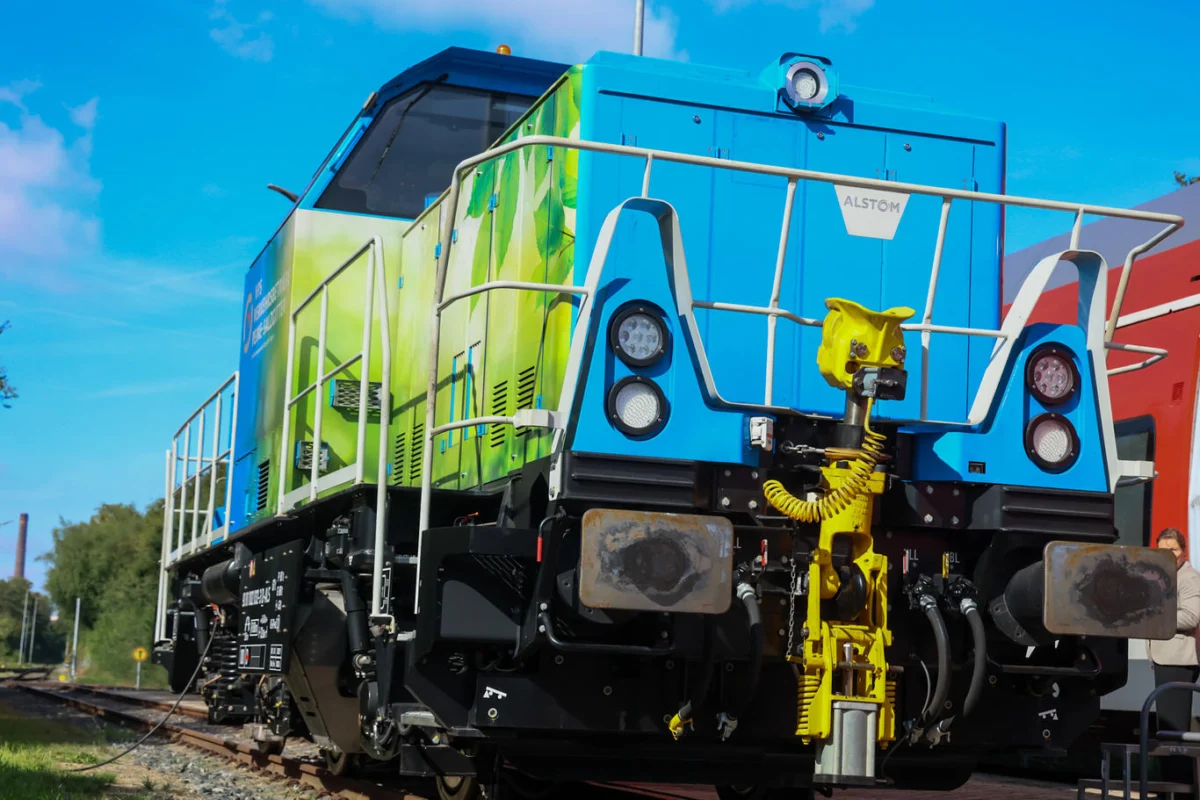
SALZGITTER, GERMANY — In a landmark development for the European rail sector, global rail technology leader Alstom has successfully completed the world’s first test run of a shunting locomotive retrofitted from diesel to hydrogen power. Conducted at Alstom’s facility in Salzgitter, Germany, this milestone represents a monumental leap forward in the decarbonization of heavy industrial rail operations, proving that zero-emission alternatives are viable not only for mainline passenger and freight trains, but also for the complex, grueling demands of yard shunting.
The pioneering modernization initiative is the result of a powerful collaborative consortium. Alstom partnered with VPS Verkehrsbetriebe Peine-Salzgitter (the logistics subsidiary of steelmaker Salzgitter AG), engine research specialists WTZ Roßlau gGmbH, the Technical University of Braunschweig (TU Braunschweig), and the Fraunhofer Institute for Surface Engineering and Thin Films. Financial backing has been anchored by the city of Salzgitter, which contributed EUR 1.5 million from Lower Saxony’s EUR 50 million structural aid package.
Following its maiden voyage, the retrofitted vehicle is set to undergo rigorous industrial testing under real-world conditions at the Salzgitter Group’s sprawling steel production facilities through October 2025.
Main Facts and Core Technology
At the heart of this engineering marvel is a direct, CO₂-free hydrogen combustion engine. Unlike fuel cell setups—which convert hydrogen into electricity to power electric motors—this approach modifies internal combustion architecture to run directly on hydrogen.
The technical hurdles overcome by the engineering team were significant. According to Prof. Dr. Peter Eilts of TU Braunschweig, one of the primary obstacles involved designing an advanced exhaust gas turbocharging system capable of handling the high excess air ratios characteristic of hydrogen combustion. Through intensive research and design modifications, the team successfully optimized efficiency while effectively eliminating harmful emissions.
Key Project Metrics:
- Location: Alstom site and Salzgitter AG steelworks, Germany.
- Technology: Direct hydrogen internal combustion engine conversion.
- Funding: EUR 1.5 million from the city of Salzgitter (sourced from Lower Saxony’s EUR 50 million structural aid package).
- Testing Phase: Now through October 2025 in industrial steel production yards.
- Post-Trial Plan: The locomotive will eventually be returned to its original baseline configuration following the completion of data collection.
The primary appeal of Alstom’s retrofit solution lies in its circular economic and financial efficiency. Rather than forcing rail operators to purchase entirely new zero-emission fleets—a capital-intensive and time-consuming endeavor—this technology extends the lifecycle of existing assets.
"With this research project, we are once again pioneering the use of hydrogen in rail transport," said François Muller, Vice President Services for Central and Northern Europe at Alstom. "We are expanding the spectrum of vehicle modernisation with a doubly sustainable approach—thanks to this solution, our customers can switch to emission-free operation without having to replace their existing fleet."
Chronology of the Salzgitter Hydrogen Project
The realization of the world’s first hydrogen-converted shunting locomotive did not happen overnight; it is the culmination of years of targeted research, regional funding acquisition, and cross-sector engineering collaboration.
-
Phase 1: Conceptualization and Consortium Formation (2021–2022):
Recognizing the massive carbon footprint of diesel shunting operations across Europe, stakeholders from industry and academia—including Alstom, VPS, WTZ Roßlau, and TU Braunschweig—began exploring the feasibility of retrofitting internal combustion engines for hydrogen use. -
Phase 2: Funding and Regional Integration (2023):
The project secured critical financial momentum when the city of Salzgitter allocated EUR 1.5 million from Lower Saxony’s structural aid package. This alignment cemented the project’s integration into Salzgitter’s broader municipal and industrial decarbonization goals. -
Phase 3: Engineering, Conversion, and Bench Testing (2023–2024):
Engineers at Alstom and WTZ Roßlau, alongside academic partners, worked on the complex thermodynamics of hydrogen combustion. This phase focused heavily on fuel injection, combustion chamber modifications, and exhaust gas turbocharging systems to ensure durability and high performance. -
Phase 4: First Successful Test Run (September 2025):
The converted locomotive achieved its historic first run at Alstom’s Salzgitter site, validating years of theoretical design and bench testing on actual rails. -
Phase 5: Industrial Field Trials (September 2025 – October 2025):
The locomotive transitions from factory tracks to the grueling operating environment of the Salzgitter Group’s steel production facilities. Here, it will pull heavy freight loads under daily industrial pressures to gather performance data. -
Phase 6: Project Conclusion and Future Scalability (Late 2025 and Beyond):
Following the conclusion of trials in October 2025, data will be analyzed to determine the viability of a standardized, commercial retrofit series. The prototype will then be restored to its original condition, having laid the technical foundation for a potential market rollout across Europe.
Supporting Data and Environmental Impact
While mainline rail electrification has progressed steadily across Europe, secondary networks, industrial sidings, and shunting yards remain heavily reliant on diesel traction. The environmental cost of this reliance is substantial.
The European Diesel Shunting Landscape:
- Germany: Operates approximately 1,000 diesel shunting locomotives.
- Broader Europe: An estimated 4,000 additional diesel shunters remain active in freight yards, ports, and industrial plants.
Projected Carbon Reductions:
The environmental dividends of converting these workhorses are profound. Alstom’s calculations indicate that replacing a single diesel engine with a hydrogen combustion system yields staggering carbon savings:
- Annual Savings: Up to 150 tonnes of CO₂ per locomotive per year.
- Lifecycle Savings (15–20 years remaining service life): Up to 3,000 tonnes of CO₂ per locomotive.
- Real-World Equivalents: The carbon offset of a single converted locomotive over its remaining lifespan is roughly equivalent to removing 650 passenger cars from the road or planting 200,000 trees.
Dr. Christian Reiser of WTZ Roßlau emphasized the significance of moving from theoretical models to tangible environmental results: "This project marks the successful transfer of hydrogen technology from the test bench to the real track."
Official Responses and Stakeholder Perspectives
The cross-industry nature of the project has drawn widespread acclaim from political figures, municipal leaders, and industrial executives alike, all of whom view the initiative as a cornerstone of Lower Saxony’s green transition.
Frank Klingebiel, Mayor of Salzgitter:
"At our Hydrogen Campus, we are developing the technologies of tomorrow in the areas of factory transformation, green hydrogen and hydrogen storage. In the joint project to decarbonise shunting traffic, the city is not only on the sidelines but is also an active player with a financial contribution of EUR 1.5 million."
Astrid Paus, Braunschweig Regional Development Office:
"This project demonstrates well-invested funding in innovation, CO₂ savings, and climate protection. It proves that our regional ecosystem is capable of driving world-first technological breakthroughs."
Dr. Johannes Dreier, Managing Director of VPS:
"As a logistics operator managing 42 shunting locomotives within a demanding steel production network, finding practical decarbonisation pathways is essential. This trial fits perfectly into our group’s long-term environmental transition plans."
Prof. Dr. Peter Eilts, TU Braunschweig:
"We have worked intensively on the design of the exhaust gas turbocharging, as the high excess air poses a particular challenge here. With success! Hydrogen’s unique combustion properties have allowed us to achieve better thermodynamic efficiency while drastically cutting emissions."
Broader Implications for the European Rail Sector
The successful testing of Alstom’s hydrogen retrofit locomotive carries wide-ranging implications for the future of European rail logistics, heavy industry, and climate policy.
1. Synergy with Industrial Decarbonization (SALCOS)
The project does not exist in a vacuum. It is deeply intertwined with Salzgitter AG’s massive SALCOS (Salzgitter Low CO₂ Steelmaking) program, which aims to entirely phase out traditional blast furnace steel production in favor of hydrogen-based direct reduction. By greening the internal rail logistics that feed raw materials into the plant, VPS and Salzgitter AG are moving closer to creating a completely closed-loop, zero-emission steel supply chain.
2. A Cost-Effective Compliance Pathway for Operators
For freight operators and private rail companies, fleet turnover is exceptionally expensive. Procuring brand-new hydrogen fuel cell or battery-electric locomotives requires massive capital expenditure. By demonstrating that existing diesel chassis can be retrofitted with a hydrogen combustion engine, Alstom is offering a transitional economic model. Operators can essentially "recycle" their aging fleets into green assets, significantly lowering the financial barriers to decarbonization.
3. Setting a Global Precedent for Hydrogen Combustion
While hydrogen fuel cells dominate discussions in light passenger rail (such as Alstom’s Coradia iLint), heavy freight and industrial shunting demand high torque, robust durability, and rapid refuelling—areas where internal combustion engines historically excel. By proving that hydrogen can be burned cleanly and efficiently in modified diesel blocks, this project opens up a brand-new technological avenue for heavy-duty transport sectors where pure electrification or battery storage is currently impractical.
Outlook to Autumn 2025 and Beyond
As the locomotive enters its intensive multi-week industrial trial at the Salzgitter steelworks, all eyes will be on its durability, fuel consumption, and reliability under heavy loads. If the pilot project meets expectations when it concludes in autumn 2025, it could serve as the catalyst for a standardized commercial series solution. For Europe’s thousands of aging diesel shunters, a clean, hydrogen-powered future may soon be within reach—proving that old iron can indeed learn new, sustainable tricks.

