

The European Union’s ambitious vision of a seamless, high-speed, and interoperable rail network is currently hitting a significant technical and political roadblock. At the heart of this challenge is the European Rail Traffic Management System (ERTMS)—the digital nervous system intended to replace the patchwork of incompatible national signaling systems that have defined European rail for over a century. Despite its status as a flagship project for the Trans-European Transport Network (TEN-T), the deployment of the European Train Control System (ETCS) remains fragmented, leaving the EU far off-course for its 2030 implementation targets.
The State of Play: A Reality Check on Infrastructure
As of the close of 2024, the statistics paint a sobering picture of progress. While the EU mandates that 51% of the core network (approximately 32,500 km) must be equipped with ETCS within the next four years, the current reality falls far short of this trajectory. Data indicates that only 12,400 km—a mere 10% of the total TEN-T network—is currently operational under the new system. Even within the core network, where the focus is most intense, coverage stands at a stagnant 17%, or 10,600 km.
To reach the 2030 goal, the EU faces a monumental task: it must triple the length of currently equipped lines in just four years, aiming for a total of 28,000 km on the TEN-T network. This gap between legislative ambition and industrial execution has triggered an urgent debate among policymakers, rail operators, and technology providers.
The “5S+C” Strategy: A Blueprint for Acceleration
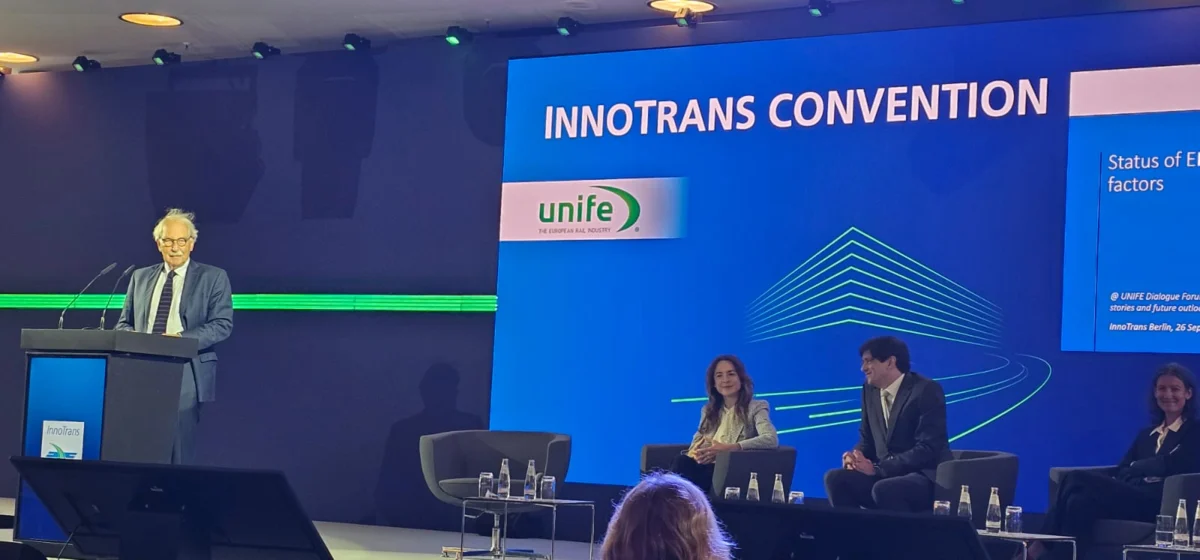
Speaking at an industry panel organized by UNIFE at the recent InnoTrans trade fair, Matthias Ruete, the European ERTMS Coordinator, addressed the systemic inertia hindering progress. Ruete identified the root of the problem: while safety is a powerful, non-negotiable catalyst for political and financial action, the broader goal of “interoperability” often fails to create the same level of urgency.
“When safety is the driving factor, you manage to bring together political and technical stakeholders,” Ruete explained. “But when the driving factor is simply interoperability, the ‘we can wait a bit longer’ mentality certainly creeps in.”
To combat this, Ruete unveiled a strategic framework known as the “5S” approach, supplemented by a “C” for coordination:

- Standardisation: Phasing out legacy Class B systems is contingent on a unified technical language. Ruete announced that the industry would engage in intensive “ERTMS Deal” discussions over the coming months to forge a common understanding.
- Synchronisation: A persistent issue has been the mismatch between track-side investment and on-board rolling stock upgrades. Synchronisation ensures that both infrastructure and trains are upgraded in lockstep to avoid a "useless investment" scenario.
- Stabilisation: The transition requires a predictable, long-term funding framework that allows operators to commit to multi-year procurement cycles without fear of shifting requirements.
- Simplification: The current regulatory landscape is choked by red tape. Simplifying administrative processes is essential to lower the barrier to entry for smaller operators and regional authorities.
- Scale-up: Moving from pilot projects to large-scale, industrial-level deployment is the only way to meet the 2030 timeline.
- Cooperation (The “C”): Building the collective knowledge base required to manage a complex, digitized rail system across diverse national jurisdictions.
The Legacy Burden: Why Class B Systems Persist
The challenge of transitioning to ETCS is compounded by the existence of “Class B” signaling systems—the diverse, aging, and often proprietary technologies currently in use. Oana Gherghinescu, Executive Director of the European Union Agency for Railways (ERA), notes that the industry cannot simply discard these systems overnight.
“We cannot blame Member States for having Class B systems,” Gherghinescu noted. “It is our duty to put pressure on Member States, starting with the larger ones, to phase these out, but we must do so with respect for the operational realities of the past two decades.”
The problem is one of path dependency. Twenty years ago, the regulatory framework for ERTMS was developed based on the technical capabilities of that era. As the technology matured, legislative updates were introduced, often forcing operators to reinvest in systems that were already becoming obsolete. This has resulted in a fragmented landscape where operators must frequently run trains with dual-equipment—carrying both the legacy system and the new ETCS hardware—which increases both weight and maintenance costs.
Technical and Operational Alignment: The “Copy-Paste” Solution
A major point of friction, according to ERA’s Gherghinescu, is the lack of uniformity in procurement. Because engineering and operational rules have varied from country to country, every tender for ETCS implementation essentially requires a bespoke, complex negotiation.
Gherghinescu advocates for a shift toward standardized, “copy-paste” procurement documentation. By creating a unified repository of operational, engineering, and organizational rules, the EU could provide a blueprint that Member States can adopt directly into their tender processes. “Once this ‘copy-paste’ approach is standardized, the industry will have the clarity it needs to deliver at scale,” she argued.
Furthermore, the lack of continuity across borders remains a massive economic burden. When a cross-border rail line is fully equipped on one side of a border but relies on a legacy system on the other, the rail operator bears the full cost of that discontinuity. This serves as a significant deterrent to cross-border freight and passenger logistics, effectively handicapping the efficiency of the European single market.

Chronology of the ERTMS Transition
- Early 2000s: Initial development and legislative drafting for ERTMS/ETCS based on the technical infrastructure of the time.
- 2010s: Widespread testing and pilot implementations; emergence of the "patchwork" problem where different versions of ETCS lead to compatibility issues.
- 2020-2024: Heightened political focus on the 2030 TEN-T core network deadline; realization that current progress is insufficient.
- 2025-2026 (Projected): Implementation of the "ERTMS Deal" and focus on the 5S+C strategy to industrialize roll-out.
- 2030: Target year for the completion of the core TEN-T network migration to ETCS.
Implications for the Future
The implications of failing to meet the 2030 target extend far beyond the rail industry. ERTMS is not just a signaling upgrade; it is the backbone of a green, efficient European transport policy. Without it, the capacity of the European rail network is artificially limited, making it difficult for rail to compete with air or road transport in terms of speed and frequency.
Moreover, the aging of existing signaling systems creates a "ticking clock" scenario. As legacy systems reach the end of their operational lifespan, they become increasingly difficult to maintain. As Matthias Ruete pointed out, "ERTMS is the best thing we have right now." The question is no longer whether to implement it, but how to move from a fragmented, defensive stance to a coordinated, offensive strategy.
The success of the 2030 vision now rests on the ability of the ERA, the European Commission, and individual Member States to move past the finger-pointing of the last two decades. By focusing on the “5S+C” framework—standardization, synchronization, stabilization, simplification, scale-up, and coordination—the EU hopes to transform a series of isolated national projects into a truly unified, safe, and interoperable European rail network.
As the industry looks toward the next 18 to 24 months, the “ERTMS Deal” will be the litmus test. If the stakeholders can agree on a standardized technical and regulatory baseline, the path to 2030 becomes a logistical challenge rather than a structural impossibility. If they fail to align, the dream of a seamless European rail network may remain a distant, fragmented ambition for another decade.

