

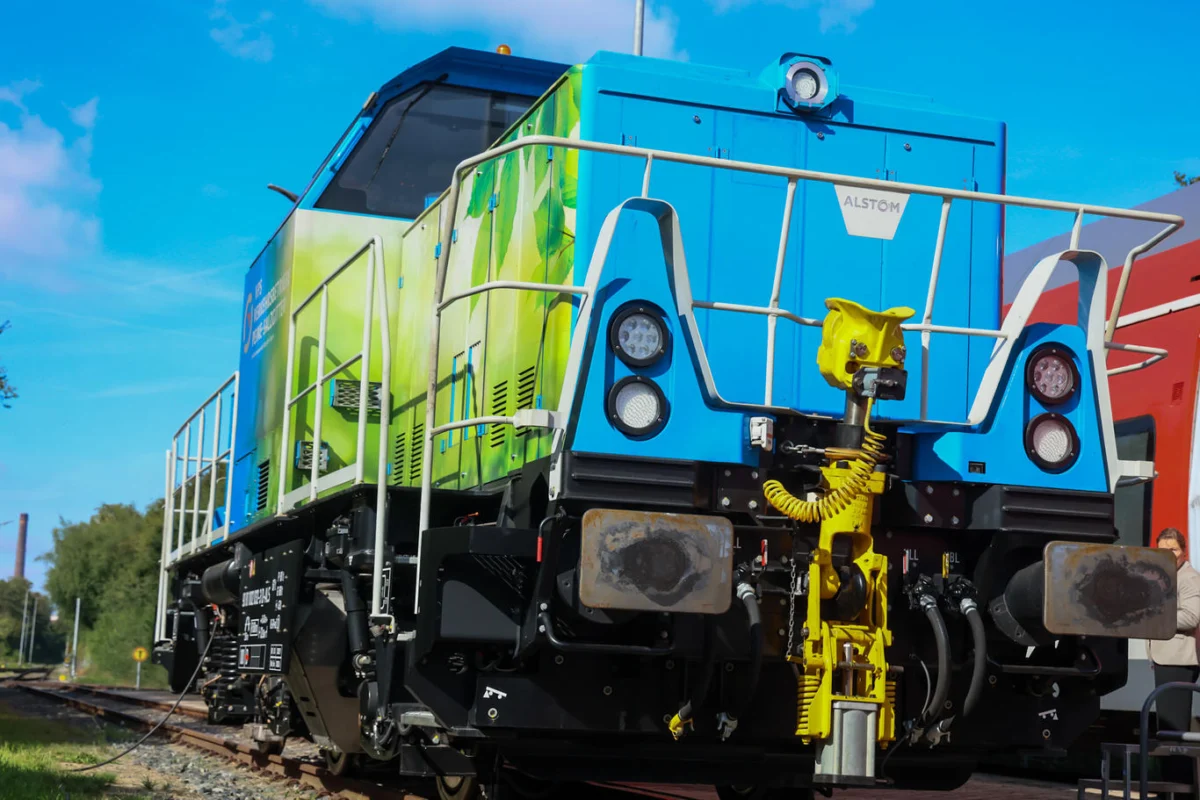
SALZGITTER, GERMANY — In a landmark development for sustainable heavy transport, global rail leader Alstom has successfully completed the world’s first test run of a shunting locomotive retrofitted from traditional diesel propulsion to direct hydrogen combustion. The milestone trial, conducted at Alstom’s facility in Salzgitter, Lower Saxony, marks a pivotal breakthrough in the decarbonisation of yard operations, heavy logistics, and industrial rail networks.
By breathing new life into older, fossil-fuel-dependent machinery through innovative green technology, the project offers a compelling blueprint for the future of rail transit—proving that achieving net-zero operations does not always require the prohibitive capital expenditure of purchasing entirely new fleets.
Main Facts: The Milestone and the Technology
The newly converted shunting locomotive successfully executed its maiden operational run following a rigorous engineering campaign. Unlike passenger trains that typically employ hydrogen fuel cells to generate electricity for electric motors, this heavy-duty shumper utilizes direct hydrogen combustion.
The project is the result of a collaborative consortium bringing together industry heavyweights and academic institutions, including:
- Alstom: Project lead and global rail systems integration expert.
- VPS Verkehrsbetriebe Peine-Salzgitter: The logistics and rail subsidiary of Salzgitter AG.
- WTZ Roßlau gGmbH: Engine research and development specialist.
- TU Braunschweig (Technische Universität Braunschweig): Providing critical academic and engineering research.
- Fraunhofer Institute for Surface Engineering and Thin Films (IST): Contributing advanced material and coating sciences.
Financial backing has been instrumental in bringing the concept from the laboratory to the rails. The initiative received a vital EUR 1.5 million injection from the city of Salzgitter, drawn from Lower Saxony’s broader EUR 50 million structural transformation aid package.
Following its successful initial run, the locomotive is entering a demanding phase of industrial testing. It will operate within the heavy-duty steel production facilities of the Salzgitter Group through October 2025. Upon the conclusion of these real-world trials, the locomotive is scheduled to be returned to its original baseline condition, having served its purpose as an invaluable rolling laboratory.
Chronology of the Transformation: From Lab Bench to Real Track
The path to this historic first run represents years of multi-institutional research, engineering refinement, and regional cooperation.
- Initial Conception and Design (2021–2023): Facing tightening climate regulations and the high carbon intensity of internal logistics, project partners identified shunting locomotives—often neglected in favor of mainline passenger electrification—as prime candidates for heavy retrofit solutions. Engineers at WTZ Roßlau and TU Braunschweig began intensive bench-testing of hydrogen combustion systems, focusing heavily on thermodynamic efficiency and turbocharging challenges unique to hydrogen fuel properties.
- Securing Funding and Partnerships (2023–2024): With the technical framework established, Alstom partnered with VPS and secured regional backing. The city of Salzgitter committed EUR 1.5 million from Lower Saxony’s structural aid funds, recognizing the project as a cornerstone for local green innovation.
- Retrofitting and Assembly (Late 2024–Early 2025): The conversion took place at Alstom’s Salzgitter site. Engineers stripped out the legacy diesel combustion components, replacing and modifying them to safely handle and combust hydrogen without emitting carbon dioxide.
- The Maiden Run and Public Unveiling (September 2025): The converted locomotive achieved its first successful operational run on test tracks in Salzgitter, signaling the official transition from theoretical engineering to practical application.
- Industrial Trials (September 2025 – October 2025): The locomotive is deployed directly into the grueling industrial environment of Salzgitter AG’s steelworks, where it must prove its reliability, pulling power, and durability under harsh, continuous-duty conditions.
- Project Conclusion (Autumn 2025): Final data collection, assessment of wear-and-tear, and evaluation of emissions performance will determine whether the technology can be commercialized into a scalable series-retrofit solution for European rail operators.
Supporting Data: Environmental Impact and Fleet Potential
The arithmetic of rail decarbonisation makes the Salzgitter project profoundly significant for European industrial logistics. While mainline rail electrification has progressed steadily across Europe, industrial sidings, freight yards, and private manufacturing tracks remain heavily reliant on diesel power.
- The Fleet Scale: Germany alone currently operates approximately 1,000 diesel shunting locomotives, with an estimated 4,000 additional units active across the wider European market. Most of these vehicles have decades of operational life left, making immediate retirement economically unviable for most operators.
- Carbon Reductions: According to Alstom’s environmental impact models, replacing a diesel engine with a direct hydrogen combustion system yields staggering carbon savings. A single retrofitted shunter can eliminate up to 150 tonnes of CO₂ annually. Over a projected remaining service life of 15 to 20 years, one locomotive can prevent up to 3,000 tonnes of carbon emissions from entering the atmosphere.
- Equivalencies: To put a 3,000-tonne lifetime reduction into perspective, it equates to taking roughly 650 passenger cars off the road permanently or planting approximately 200,000 mature trees.
These metrics illustrate why retrofit technology is viewed by economists and environmentalists alike as a vital "bridge" technology, allowing carbon-intensive industries to slash emissions rapidly without waiting for entirely new green fleets to be manufactured and delivered.
Official Responses and Stakeholder Perspectives
The successful maiden run drew high praise from political leaders, industrial executives, and academic pioneers alike, underscoring the collaborative nature of the achievement.
François Muller, Vice President Services for Central and Northern Europe at Alstom:
"With this research project, we are once again pioneering the use of hydrogen in rail transport. We are expanding the spectrum of vehicle modernisation with a doubly sustainable approach—thanks to this solution, our customers can switch to emission-free operation without having to replace their existing fleet."
Frank Klingebiel, Mayor of Salzgitter:
"At our Hydrogen Campus, we are developing the technologies of tomorrow in the areas of factory transformation, green hydrogen, and hydrogen storage. In the joint project to decarbonise shunting traffic, the city is not only on the sidelines but is also an active player with a financial contribution of EUR 1.5 million."
Dr. Johannes Dreier, Managing Director of VPS Verkehrsbetriebe Peine-Salzgitter:
"Integrating this hydrogen-powered locomotive directly into our demanding steelworks logistics network represents the ultimate stress test. This trial fits perfectly into our group-wide transition plans to eliminate carbon across our entire supply chain."
Dr. Christian Reiser, Managing Director of WTZ Roßlau:
"Our primary engineering hurdle was successfully executing the transfer of hydrogen combustion technology from the controlled environment of the test bench to the dynamic, real-world conditions of the track. Seeing it run smoothly today validates years of intensive collaboration."
Prof. Dr. Peter Eilts, TU Braunschweig:
"Hydrogen possesses unique combustion properties that allow for superior thermodynamic efficiency, but it also presents distinct technical challenges. We worked intensively on the design of the exhaust gas turbocharging system, as the high excess air ratio posed a severe design challenge. We managed to overcome it with resounding success."
Astrid Paus, Braunschweig Regional Development Office:
"This project represents textbook smart funding. The investment directly translates into measurable innovation, substantial CO₂ reductions, and long-term climate protection for Lower Saxony and beyond."
Implications: A Blueprint for the Future of European Rail
The implications of Alstom’s Salzgitter experiment extend far beyond a single industrial yard in Lower Saxony. As European Union regulations on industrial emissions continue to tighten under the European Green Deal, heavy industry is under immense pressure to decarbonize every tier of its operations—including internal logistics and freight handling.
1. The Power of Retrofitting over Replacement
Purchasing new hydrogen-powered or battery-electric locomotives requires massive capital investments. For small-to-mid-sized rail operators and private industrial sidings, buying new rolling stock is often financially prohibitive. By proving that existing diesel locomotives can be retrofitted with clean-burning hydrogen engines, Alstom and its partners have opened up an economical pathway to fleet decarbonisation.
2. Synergy with Green Steel Production (SALCOS)
The project is deeply intertwined with the broader industrial ecosystem of Salzgitter AG. The steelmaker is currently executing its massive SALCOS (Salzgitter Low CO₂ Steelmaking) program, which aims to transition blast furnace steel production to hydrogen-based direct reduction. By utilizing hydrogen to power the very locomotives that transport raw materials around the plant, Salzgitter is moving closer to creating a closed-loop, entirely carbon-neutral manufacturing ecosystem.
3. Overcoming Technical Hurdles of Hydrogen Combustion
While hydrogen fuel cells have dominated clean-rail headlines (such as Alstom’s Coradia iLint passenger trains), direct hydrogen combustion offers a distinct advantage for heavy machinery: it preserves the robust mechanical characteristics and raw torque profiles of traditional internal combustion engines. The success of TU Braunschweig and WTZ Roßlau in solving turbocharging and air-mixture challenges proves that hydrogen combustion is a viable, scalable technology for heavy-duty applications.
4. Road Map to Commercialisation
As the locomotive undergoes its final weeks of industrial stress-testing through October 2025, all eyes will be on the performance data. Should the trial confirm the durability and cost-effectiveness of the conversion, Alstom intends to use the findings to develop a commercial, scalable series-retrofit solution.
If adopted widely across Europe’s estimated 5,000 diesel shunting yards, this innovation could eliminate millions of tonnes of carbon emissions, transforming legacy infrastructure into modern green workhorses and securing a sustainable future for rail freight.

