

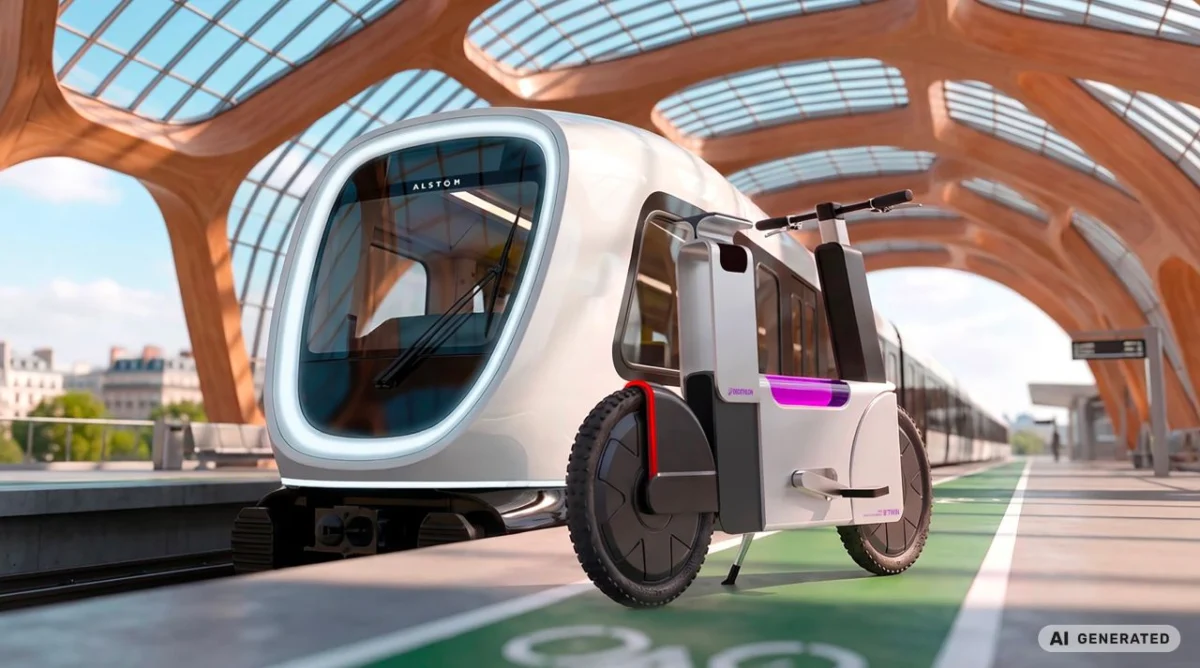
BERLIN – In a landmark collaboration that bridges the gap between mass transit and personal mobility, global rail leader Alstom and sporting goods giant Decathlon unveiled a revolutionary joint concept at InnoTrans 2026. This initiative aims to solve one of the most persistent "pain points" of modern commuting: the cumbersome integration of bicycles and electric scooters into the rail network. By treating the journey from doorstep to final destination as a single, uninterrupted experience, the two companies are setting a new benchmark for urban intermodality.
The Convergence of Rail and Micro-Mobility
As urban centers grow denser and the demand for greener, more efficient transit solutions spikes, the "last-mile" problem has become a focal point for city planners. While cycling and scooting are ideal for navigating the final leg of a commute, they often clash with the operational realities of rail travel. Crowded aisles, blocked vestibules, and insufficient storage space have long turned the simple act of taking a bike on a train into a logistical headache for passengers and a capacity constraint for operators.
The Alstom-Decathlon project, showcased at the InnoTrans exhibition in Berlin, moves beyond retrofitting existing train cars. Instead, it proposes a holistic ecosystem involving purpose-built hardware, digital integration, and dedicated infrastructure. By synchronizing the physical design of micro-mobility devices with the internal architecture of trains, the partnership seeks to eliminate the friction that currently prevents commuters from choosing multi-modal transport.
Chronology of a Collaborative Vision
The seeds for this partnership were sown nearly two years prior to the 2026 unveiling. Recognizing that both companies were pursuing parallel goals—Alstom focusing on passenger flow efficiency and Decathlon on versatile, high-utility urban transport—leadership teams began exploring how their respective R&D departments could intersect.
- Q3 2024: Initial feasibility studies were conducted, analyzing passenger feedback regarding bike storage on regional and commuter rail lines across Europe.
- Q1 2025: Alstom and Decathlon signed a formal memorandum of understanding to co-develop a design language that would unify personal mobility equipment with train carriage interior design.
- Q4 2025: Prototype testing of compact, foldable, and connected mobility devices began in controlled environments to ensure they met safety and durability standards for high-speed and commuter rail transport.
- September 2026: The official unveiling at InnoTrans, where the concept was presented to industry stakeholders, transit authorities, and the public as a blueprint for the "future of the integrated commute."
The Hardware: A New Class of Connected Mobility
The cornerstone of the proposal is a new generation of bicycles and electric scooters designed specifically for the "train-and-go" user. Standard bicycles are often too bulky, and while folding bikes exist, they frequently lack the ergonomic stability required for daily, intensive use.
Decathlon’s design team has introduced a prototype vehicle that prioritizes a "rail-ready" footprint. These units are highly compact, utilizing proprietary materials that reduce weight without compromising structural integrity. More importantly, these vehicles are "connected." Through integrated IoT (Internet of Things) sensors, the bike or scooter communicates with the rail station’s infrastructure.
This connectivity allows for seamless identification. As the passenger approaches the platform, their vehicle is recognized by the station’s digital ecosystem, facilitating a frictionless boarding process. This technology ensures that the vehicle’s specific dimensions are known to the system, allowing for optimized storage configurations.
Digital Integration: The Booking Revolution
One of the most innovative aspects of the Alstom-Decathlon concept is the digital orchestration of space. Currently, most rail operators function on a "first-come, first-served" basis for bicycle storage, leading to anxiety for commuters who are never sure if there will be space for their bike.
The proposed solution introduces an advance booking system integrated into a unified mobile application. Passengers can reserve a specific storage slot in the train’s dedicated compartment at the same time they purchase their rail ticket. The app serves as a digital guide, directing the user to the precise section of the platform where the designated carriage will stop.
This level of precision serves two purposes: it guarantees the passenger a spot, and it significantly reduces "dwell time"—the time a train spends at a station. By knowing exactly where to board, the passenger flow is streamlined, preventing the chaos often associated with boarding high-capacity commuter trains.

Infrastructure: The Dedicated Compartment
Perhaps the most significant departure from traditional train design is the removal of bikes and scooters from the passenger seating area. Alstom, leveraging its expertise in rolling stock architecture, has designed a secure, automated compartment module.
In this concept, the carriage layout is reconfigured to include a dedicated, locked zone. Once the passenger boards, they place their vehicle into a secure racking system within this compartment. The area is electronically locked, meaning the passenger is not required to supervise their equipment during the journey. This not only enhances passenger comfort by clearing the aisles but also improves safety, as bicycles and scooters are no longer potential hazards in the event of an emergency evacuation.
Official Responses: Redefining the Commuter Experience
The presentation in Berlin was met with keen interest from transit authorities and urban planners. Alexis Bonnet, Design Director at Alstom, articulated the core philosophy behind the project during the unveiling.
"We have tried to remove the obstacles that still make travelling by bike or scooter difficult," Bonnet stated. "Mobility should no longer be thought of as a succession of separate modes of transport, but as a continuous experience. By integrating the design of the vehicle with the design of the train, we are essentially extending the station’s capacity and the commuter’s comfort simultaneously."
Representatives from Decathlon echoed this sentiment, emphasizing that the focus is on utility. "Our goal was to create a tool that is as comfortable on a train as it is on the street," a Decathlon spokesperson noted. "When you remove the physical and psychological barriers of ‘how do I get my bike on this train?’, you see a massive surge in the adoption of green transport. We aren’t just selling a bike; we are enabling a lifestyle."
Supporting Data: Addressing the Capacity Crisis
The rationale for this project is backed by growing data on urban transit bottlenecks. Industry reports indicate that on some European commuter lines, up to 15% of potential passengers opt out of taking their bicycles due to the lack of dedicated, guaranteed space.
Furthermore, the "dwell time" problem is a significant operational cost. Studies suggest that when passengers struggle to board with bulky luggage or bicycles, the time a train remains at a platform can increase by 30 to 45 seconds. Across a multi-stop line, these delays accumulate, disrupting the entire network schedule. The Alstom-Decathlon concept, by standardizing the loading process through app-guided platform positioning, estimates a potential reduction in dwell time by up to 20%, thereby increasing the overall frequency capacity of existing rail lines without needing to lay new tracks.
Implications for Future Urban Planning
While the project currently exists as a design and research concept, its implications for the future of urban mobility are profound. It represents a shift from "transportation" to "mobility as a service."
- Sustainable Urbanism: By making multi-modal travel easier, cities can reduce their reliance on private vehicles for the "first and last mile," directly contributing to carbon neutrality goals.
- Rolling Stock Evolution: Train manufacturers like Alstom are now signaling that future tenders will likely prioritize modularity. The ability to quickly adapt train interiors to accommodate varying ratios of passengers to micro-mobility units will become a competitive advantage.
- Cross-Sector Partnerships: The collaboration highlights a trend where rail manufacturers must partner with consumer goods companies to address the full spectrum of the passenger experience.
Conclusion: A Blueprint for Tomorrow
The Alstom-Decathlon concept presented at InnoTrans 2026 is not merely a collection of features; it is a vision for a more fluid urban future. By aligning the interests of the rail industry with the needs of the modern cyclist and scooter user, the partnership has created a roadmap for how cities can reclaim their streets and maximize the efficiency of their rail networks.
While mass production of these specific integrated trains and devices remains a future milestone, the demonstration in Berlin has firmly shifted the conversation. It has proven that the obstacles to intermodal travel are not insurmountable—they are simply design challenges waiting for the right collaborative spark. As urban density continues to climb, the ability to seamlessly bridge the gap between the train and the bike path will define the success of 21st-century mobility.

