

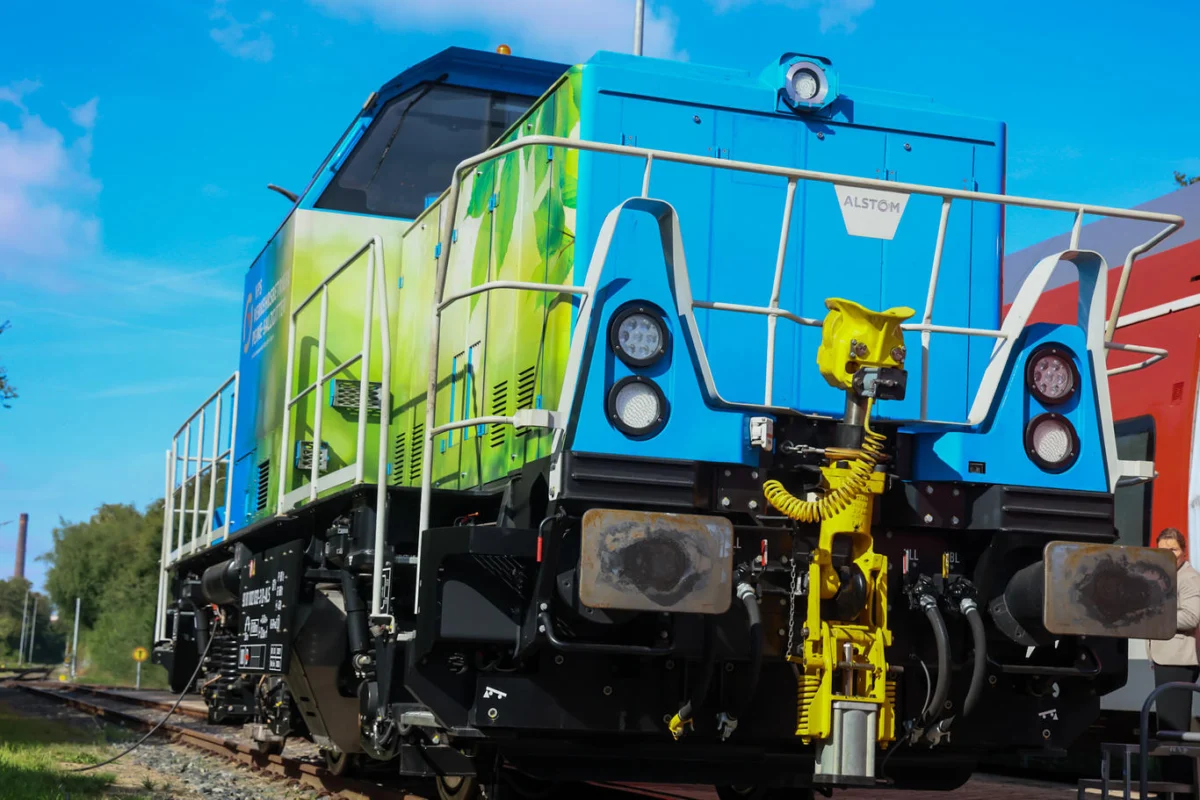
SALZGITTER, GERMANY — In a landmark development for sustainable heavy transport, Alstom has successfully completed the world’s inaugural test run of a shunting locomotive retrofitted from diesel propulsion to direct hydrogen combustion. Conducted at Alstom’s facility in Salzgitter, Germany, this technological milestone represents a major leap forward in the decarbonization of rail yards, freight terminals, and industrial logistics networks globally.
The successful trial bridges a critical gap in green transportation engineering. While passenger rail has seen steady electrification and the introduction of hydrogen fuel cell multiple units, heavy industrial shunting—the process of sorting, assembling, and moving railcars within yards—has remained heavily reliant on conventional diesel engines. By proving that existing diesel powerplants can be retrofitted rather than scrapped, this collaborative project opens a viable, cost-effective pathway to eliminate emissions in an otherwise hard-to-abate sector.
Main Facts
The pioneering project centers on the conversion of a standard industrial shunting locomotive to operate on direct, $textCO_2$-free hydrogen combustion. Rather than employing a hydrogen fuel cell to generate electricity, the retrofitted engine utilizes hydrogen directly as a combustion fuel, a technical feat that required sophisticated redesigns of internal combustion mechanics, fuel injection, and turbocharging systems.
The collaborative initiative is backed by a robust consortium of industrial leaders, academic institutions, and regional government bodies. Key project partners include:
- Alstom: Providing overarching project leadership, engineering expertise, and retrofitting capabilities.
- VPS Verkehrsbetriebe Peine-Salzgitter (VPS): The rail logistics subsidiary of Salzgitter AG, operating the trial environment and utilizing the locomotive within its steel production network.
- WTZ Roßlau gGmbH: Contributing specialized research and engine development expertise.
- TU Braunschweig: Providing academic research, particularly concerning exhaust gas turbocharging and combustion optimization.
- Fraunhofer Institute for Surface Engineering and Thin Films: Offering advanced material and surface science insights.
- The City of Salzgitter: Providing financial support through regional structural aid frameworks.
Funding for the endeavor includes a EUR 1.5 million grant from the city of Salzgitter, drawn from Lower Saxony’s broader EUR 50 million structural transformation fund. Following its maiden voyage, the converted locomotive is undergoing intensive industrial testing at the Salzgitter Group’s steel manufacturing facilities. This operational trial will run through October 2025, after which the locomotive will be restored to its original baseline condition, having provided invaluable real-world performance data.
Chronology of the Project
The realization of the world’s first hydrogen-combustion shunting locomotive is the culmination of years of targeted research, engineering design, and inter-institutional collaboration.
- Phase 1: Conceptualization and Funding (2021–2023): As European industrial sectors accelerated their alignment with the European Green Deal, stakeholders in Lower Saxony identified shunting operations as a prime target for emissions reduction. Planning began to explore whether hydrogen could be adapted for direct combustion in existing heavy-duty rail engines, avoiding the prohibitive capital costs of purchasing entirely new fleets.
- Phase 2: Engineering and Test Bench Development (2023–2024): Engineers from Alstom, WTZ Roßlau, and TU Braunschweig tackled the complex thermodynamic challenges of hydrogen combustion. Because hydrogen burns differently than diesel—possessing a wide flammability range and high flame velocities—specialized tuning of the air-fuel mixture and exhaust gas turbocharging was required. Initial testing was confined to laboratory test benches.
- Phase 3: Retrofitting and Factory Integration (Late 2024–Early 2025): The physical locomotive selected for the trial was brought into Alstom’s Salzgitter facility. Technicians replaced the conventional diesel fuel systems, storage setups, and engine management electronics with hydrogen-compatible components, safety valves, and high-pressure storage tanks.
- Phase 4: Maiden Test Run (September 2025): Alstom officially completed the world’s first live run of the converted shunting locomotive on tracks at the Salzgitter site, validating the transition of the technology from laboratory theory to operational reality.
- Phase 5: Industrial Field Trials (September 2025–October 2025): The locomotive entered rigorous on-site operational testing within the Salzgitter Group’s steel plant rail network, managed by VPS.
- Phase 6: Evaluation and Future Scaling (Late 2025 Onward): Data gathered from the autumn 2025 trials will be analyzed to determine the feasibility of establishing a standardized, commercial retrofitting service for rail operators across Europe.
Supporting Data and Environmental Impact
The potential environmental benefits of scaling the Salzgitter hydrogen retrofitting project are immense. According to industry figures, Germany currently operates approximately 1,000 diesel shunting locomotives, with an estimated 4,000 additional units active in rail freight networks across the wider European Union.
Because shunting locomotives operate continuously under high-load, stop-start conditions, their fuel consumption and emissions profiles are disproportionately high relative to their travel distances. Alstom’s environmental impact calculations reveal striking metrics for a single converted locomotive:
- Annual $textCO_2$ Savings: Up to 150 tonnes per locomotive, per year.
- Lifetime $textCO_2$ Savings: Up to 3,000 tonnes over an anticipated remaining service life of 15 to 20 years.
- Equivalency: The lifetime savings of a single retrofitted engine equal taking roughly 650 passenger cars off the road or planting approximately 200,000 trees.
Beyond greenhouse gas emissions, direct hydrogen combustion drastically reduces particulate matter and sulfur oxide emissions, improving local air quality around rail yards, ports, and heavy industrial plants situated close to urban areas.
Official Responses and Stakeholder Perspectives
The successful rollout of the hydrogen shunting locomotive elicited strong praise from industrial leaders, academic researchers, and municipal government officials alike, highlighting the multifaceted nature of the collaboration.
François Muller, Vice President Services for Central and Northern Europe at Alstom:
"With this research project, we are once again pioneering the use of hydrogen in rail transport. We are expanding the spectrum of vehicle modernisation with a doubly sustainable approach—thanks to this solution, our customers can switch to emission-free operation without having to replace their existing fleet."
Frank Klingebiel, Mayor of the City of Salzgitter:
"At our Hydrogen Campus, we are developing the technologies of tomorrow in the areas of factory transformation, green hydrogen and hydrogen storage. In the joint project to decarbonise shunting traffic, the city is not only on the sidelines but is also an active player with a financial contribution of EUR 1.5 million."
Dr. Johannes Dreier, Managing Director of VPS Verkehrsbetriebe Peine-Salzgitter:
"Integrating this trial into our daily logistics operations at the steel production site allows us to stress-test hydrogen technology in real-world industrial environments. It fits perfectly into our overarching transition plans to eliminate carbon footprints across our entire supply chain."
Dr. Christian Reiser, Managing Director of WTZ Roßlau gGmbH:
"Our primary focus has been ensuring that the transition from test bench metrics to physical tracks succeeds seamlessly. The successful maiden run proves that hydrogen combustion is no longer just a theoretical alternative, but a functional reality for heavy-duty engines."
Prof. Dr. Peter Eilts, Technische Universität Braunschweig:
"We have worked intensively on the design of the exhaust gas turbocharging, as the high excess air poses a particular challenge here. With success! Hydrogen’s unique combustion properties, when properly managed, allow us to achieve high thermal efficiency while dramatically curbing harmful emissions."
Astrid Paus, Braunschweig Regional Development Office:
"This project represents exceptionally well-invested funding in innovation, $textCO_2$ savings, and long-term climate protection. It underscores Lower Saxony’s position as a powerhouse for industrial green tech."
Broader Implications for the European Rail Sector
The successful testing of Alstom’s converted shunting locomotive arrives at a crucial juncture for European transportation policy. With the European Union mandating aggressive carbon reduction targets under the European Green Deal and the "Fit for 55" legislative package, traditional diesel-dependent sectors face mounting pressure to decarbonize rapidly.
However, the complete renewal of rail fleets through the procurement of brand-new alternative-propulsion locomotives is financially prohibitive for many freight operators and private industrial networks. The retrofitting model pioneered in Salzgitter offers a transformative economic and ecological alternative.
1. Circular Economy and Asset Longevity
By modifying existing locomotive frames and mechanical chassis, operators avoid the capital expenditure and embodied carbon costs associated with manufacturing entirely new rolling stock. This circular economy approach extends the operational lifespan of reliable, heavy-duty chassis while purging them of fossil-fuel dependency.
2. Synergy with Industrial Green Hydrogen Hubs
The project is deeply intertwined with Salzgitter AG’s broader decarbonization roadmap, notably the SALCOS (Salzgitter Low $textCO_2$ Steelmaking) initiative. SALCOS aims to fundamentally transform steel production by replacing carbon-intensive blast furnaces with hydrogen-based direct reduction plants. By utilizing locally produced green hydrogen within the plant’s own shunting locomotives (operated by VPS and its fleet of 42 shunting units), the Salzgitter site is demonstrating a fully integrated, circular hydrogen ecosystem where clean energy is generated, stored, and consumed on-site.
3. Pathway to Scalable Commercialization
As the locomotive undergoes continuous industrial testing through October 2025, data regarding maintenance intervals, thermal efficiency, hydrogen storage durability, and refueling logistics will be compiled. If these trials meet expectations, Alstom and its partners plan to lay the groundwork for a scalable, commercial retrofitting service. Such a service could quickly be deployed across Europe’s vast network of industrial sidings, freight yards, and port facilities, providing a rapid, pragmatic bridge toward a fully decarbonized European rail network.

