

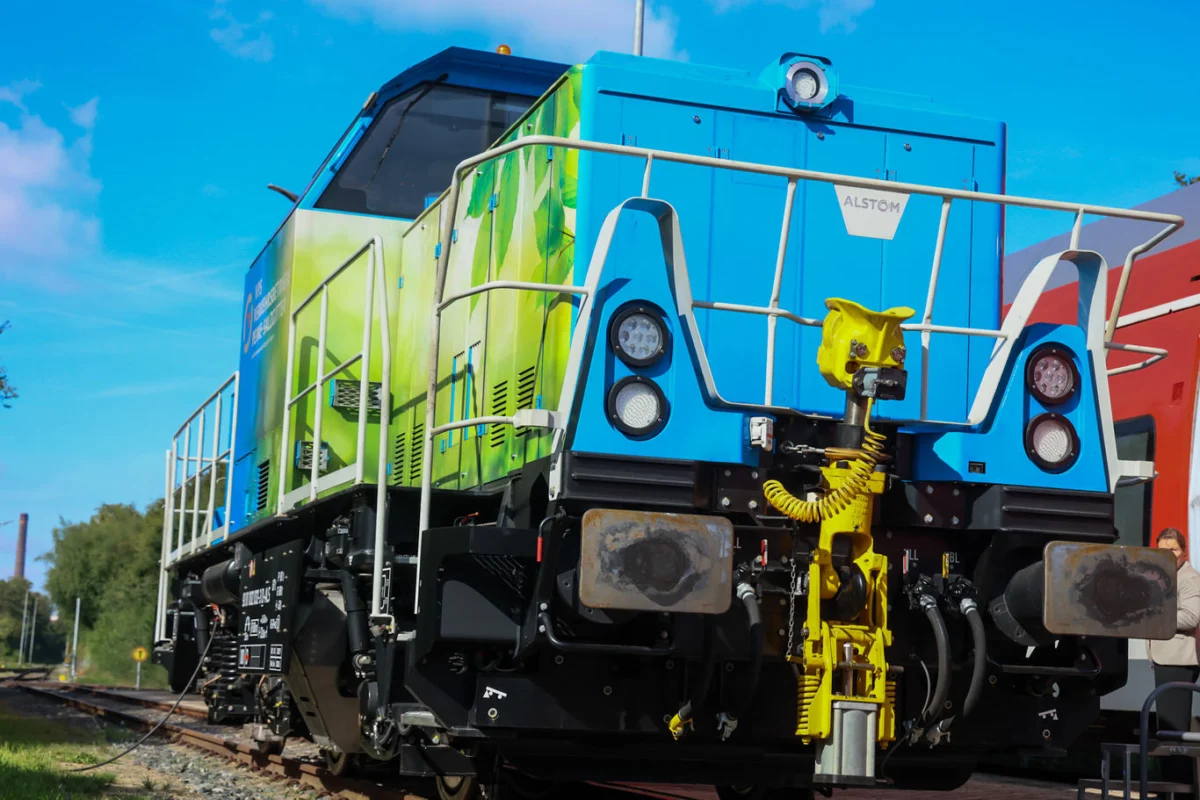
SALZGITTER, GERMANY — In a landmark development for the future of sustainable heavy transport, global rail leader Alstom has successfully completed the world’s inaugural test run of a shunting locomotive retrofitted from diesel to hydrogen power. Conducted at Alstom’s state-of-the-art facility in Salzgitter, Germany, this milestone represents a monumental leap forward in the decarbonisation of rail logistics. By breathing new life into older infrastructure through direct hydrogen combustion, the project offers a pragmatic, cost-effective pathway to eliminate emissions in freight yards and industrial rail networks without requiring operators to procure entirely new fleets.
The initiative is the culmination of a robust, multi-sector collaborative effort uniting industry giants, academic institutions, and municipal government. Partners in the pioneering project include VPS Verkehrsbetriebe Peine-Salzgitter (VPS)—the logistics and rail subsidiary of the Salzgitter Group—engine developer WTZ Roßlau gGmbH, the prestigious Technische Universität Braunschweig (TU Braunschweig), and the Fraunhofer Institute for Surface Engineering and Thin Films.
Financial backing has been equally collaborative. The city of Salzgitter provided a vital EUR 1.5 million injection, drawn directly from the federal state of Lower Saxony’s EUR 50 million structural aid package designated for regional industrial transformation.
Following its triumphant maiden run, the retrofitted shunting locomotive is entering a rigorous phase of industrial testing. Operating directly within the heavy-duty confines of the Salzgitter Group’s steel production facilities, the locomotive will undergo real-world stress tests through October 2025. Data and performance insights gathered during this trial period will dictate the commercial viability and scalability of the technology, after which the locomotive is scheduled to be returned to its baseline configuration.
Main Facts and Technological Breakthroughs
At the core of this engineering triumph is a shift from traditional fossil-fuel internal combustion to direct, CO2-free hydrogen combustion. Unlike fuel cell setups—which convert hydrogen into electricity to drive electric motors—this retrofitting approach preserves the foundational mechanical architecture of the existing locomotive, swapping out the diesel-hungry engine block for one engineered to run purely on green hydrogen.
The technological hurdles overcome by the engineering consortium were substantial. According to Prof. Dr. Peter Eilts of TU Braunschweig, one of the most demanding engineering challenges lay in optimizing exhaust gas turbocharging.
"We have worked intensively on the design of the exhaust gas turbocharging, as the high excess air poses a particular challenge here," Prof. Dr. Eilts explained. "With success!" By mastering these thermodynamic intricacies, the team ensured that hydrogen’s unique combustion properties were harnessed to deliver high thermal efficiency while completely eradicating carbon dioxide, sulfur oxides, and particulate matter from the exhaust stream.
Key Project Specifications:
- Location: Alstom site and Salzgitter AG steelworks, Lower Saxony, Germany.
- Core Technology: Direct hydrogen combustion retrofitted into an existing diesel locomotive chassis.
- Funding: EUR 1.5 million from the city of Salzgitter (via Lower Saxony’s structural aid package).
- Trial Period: Operational testing through October 2025.
- Key Industrial Partner: VPS Verkehrsbetriebe Peine-Salzgitter.
- Academic & Research Partners: TU Braunschweig, WTZ Roßlau gGmbH, Fraunhofer Institute.
Chronology of the Project
The journey from concept to track-ready reality reflects years of meticulous planning, cross-disciplinary research, and regional economic strategy:
- Initial Conception & Grant Allocation: Recognizing the urgent need to decarbonize heavy industrial shunting—where locomotives operate under stop-start, high-torque conditions unsuited for standard electrification—Alstom and its partners conceptualized the retrofit solution. The securing of EUR 1.5 million in municipal and regional structural funding laid the financial foundation for research and development.
- Laboratory Engineering & Bench Testing: Throughout the early development phases, institutions like WTZ Roßlau and TU Braunschweig spearheaded the modification of the internal combustion engine. Rigorous bench testing ensured that hydrogen combustion could be safely managed under the fluctuating loads characteristic of shunting operations.
- Integration and Assembly: The modified engine and hydrogen storage systems were successfully integrated into the locomotive chassis at Alstom’s Salzgitter competence center, merging heavy rail engineering with cutting-edge alternative fuel systems.
- The Maiden Run (Late 2025 Milestone): Alstom officially executed the world’s first successful test run of the hydrogen-converted shunting locomotive on designated tracks in Salzgitter, marking the transition from theoretical engineering to tangible, on-track reality.
- Industrial Field Trials (Current Phase — October 2025): The locomotive has been deployed directly into the bustling rail logistics network of the Salzgitter AG steel plant, where it is being evaluated under harsh, real-world industrial conditions.
- Project Conclusion and Future Scale-Up (Late 2025 Onward): Data aggregation, performance analysis, and evaluation of a potential commercial series-production rollout across European rail networks.
Supporting Data and Environmental Impact
While mainline passenger rail has seen significant electrification and hydrogen adoption, industrial shunting yards and freight operations have traditionally lagged behind due to the prohibitive cost of replacing entire fleets. The environmental calculus of Alstom’s retrofit approach demonstrates why this innovation could disrupt the status quo.
Statistical insights underscore the massive decarbonization potential:
- The Current Fleet: Germany alone operates approximately 1,000 diesel shunting locomotives. Across the wider European continent, that number swells to roughly 4,000 active units.
- Annual Savings per Unit: A single converted hydrogen shunting locomotive can eliminate up to 150 tonnes of CO2 annually.
- Lifecycle Savings: Over a remaining operational service life of 15 to 20 years, one retrofitted locomotive can prevent the emission of up to 3,000 tonnes of CO2.
- Equivalent Impact: The carbon offset achieved by a single converted locomotive is equivalent to removing 650 passenger cars from the road or planting approximately 200,000 trees.
For heavy industries where complete electrification via overhead catenary wires is economically or physically unfeasible inside sprawling logistics yards, hydrogen combustion offers an immediate, highly scalable bridge to net-zero operations.
Official Responses and Stakeholder Perspectives
The significance of the Salzgitter trial resonated deeply across corporate boardrooms, municipal offices, and academic institutions, highlighting a shared commitment to regional transformation and climate resilience.
François Muller, Vice President Services for Central and Northern Europe at Alstom:
"With this research project, we are once again pioneering the use of hydrogen in rail transport. We are expanding the spectrum of vehicle modernisation with a doubly sustainable approach—thanks to this solution, our customers can switch to emission-free operation without having to replace their existing fleet."
Frank Klingebiel, Mayor of the City of Salzgitter:
"At our Hydrogen Campus, we are developing the technologies of tomorrow in the areas of factory transformation, green hydrogen and hydrogen storage. In the joint project to decarbonise shunting traffic, the city is not only on the sidelines but is also an active player with a financial contribution of EUR 1.5 million."
Dr. Johannes Dreier, Managing Director of VPS:
As the logistics arm operating 42 shunting locomotives within the Salzgitter steel network, Dr. Dreier emphasized that the trials align seamlessly with the company’s operational roadmap, proving that heavy industrial logistics can be greened without sacrificing reliability or torque performance.
Dr. Christian Reiser, Managing Director of WTZ Roßlau:
Praising the collaborative engineering effort, Dr. Reiser highlighted the momentous transition of complex alternative fuel mechanics "from the test bench to the real track."
Astrid Paus, Braunschweig Regional Development Office:
Paus noted that the regional investment has proven to be "well-invested funding in innovation, CO2 savings and climate protection," validating Lower Saxony’s structural aid strategy.
Broader Implications for European Rail and Heavy Industry
The implications of Alstom’s Salzgitter project extend far beyond a single locomotive trial. The initiative is deeply intertwined with SALCOS (Salzgitter Low CO₂ Steelmaking), an ambitious overarching corporate program designed to systematically transition steel production away from traditional coal-fired blast furnaces toward hydrogen-based direct reduction. By greening the internal rail logistics that feed raw materials into the steel mills, VPS and Salzgitter AG are closing the loop on a fully integrated, zero-emission industrial ecosystem.
Furthermore, the retrofit model addresses a critical economic barrier in the green transition: asset longevity. Rail operators are often reluctant to prematurely retire diesel locomotives that possess millions of dollars in structural value. By offering a modular conversion kit that swaps fossil-fuel combustion for hydrogen combustion, Alstom has engineered a circular-economy solution. Operators can upgrade their existing capital assets, extend their operational lifespans by decades, and instantly comply with tightening European environmental regulations.
As the locomotive continues its intensive trials at the Salzgitter steelworks through October 2025, industry watchers across the globe will be monitoring the telemetry data. If the industrial tests replicate the success of the maiden run, Alstom and its partners will have laid the groundwork for a commercially viable, scalable series solution—heralding a new era where the workhorses of European rail yards run entirely on clean, green hydrogen.

