

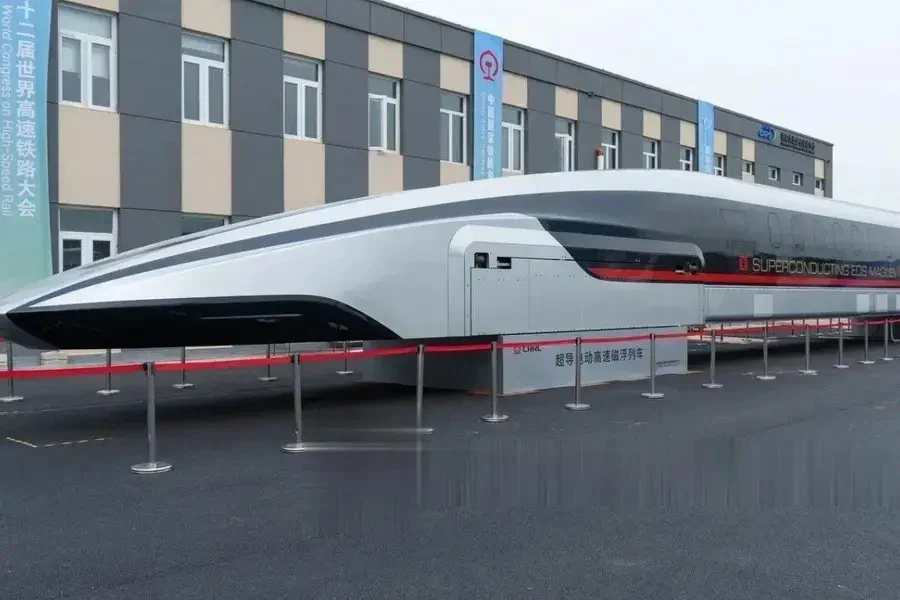
WUHAN, CHINA — In the relentless global pursuit of ultra-high-speed transportation, a quiet revolution is taking place inside a specialized research facility in central China. On a crisp autumn morning, deep within the Hubei East Lake Laboratory—commonly known as the Donghu Laboratory—an experimental magnetic levitation vehicle shattered boundaries by accelerating from a standstill to an astonishing 800 kilometers per hour in just 5.3 seconds.
Covering a distance of merely one kilometer, the trial not only established a world record for this specific class of high-speed magnetic platform, but it also underscored the profound potential of electromagnetic propulsion systems. While the technology is currently restricted to controlled research environments and is not yet slated for commercial passenger use, the achievement marks a watershed moment in the evolution of high-speed transit, aerospace engineering, and linear motor applications.
Main Facts
The record-breaking test, conducted on November 24, 2025, involved an unmanned, experimental maglev vehicle weighing approximately 1.11 tonnes. Unlike traditional trains that rely on steel wheels rolling on steel tracks, this platform operates on an advanced fusion of permanent magnet levitation, electromagnetic guidance, and powerful linear synchronous motor propulsion.
The trial took place on a purpose-built, highly specialized 1,000-meter test track. The vehicle’s performance during the run defied conventional automotive and rail benchmarks:
- Explosive Acceleration: The craft rocketed from zero to 100 km/h in less than 0.7 seconds, applying G-forces that would be completely incompatible with human passenger comfort.
- Peak Velocity: The vehicle hit its maximum speed of 800 km/h at the 600-meter mark of the track.
- Controlled Deceleration: Following its brief, high-velocity sprint, the braking system engaged smoothly, bringing the 1.11-tonne vehicle to a complete and controlled stop within the remaining 400 meters of the track.
- Duration: The entire dynamic phase of the test—from launch to full stop—lasted approximately eight seconds.
Engineers at the Donghu Laboratory emphasized that the vehicle’s components, including its onboard electronics, power-supply architecture, and magnetic levitation arrays, operated within expected safety and design margins. The success of the trial validates years of theoretical modeling regarding extreme acceleration in friction-free environments.
Chronology of Innovation: The Road to 800 km/h
The historic run in late November was not an isolated stroke of luck, but rather the culmination of an aggressive, highly focused multi-month testing campaign. In fact, it represented the third major speed record set by the same research team at the Hubei East Lake Laboratory within a remarkably tight window of six months.
The Springboard: June 2025
The foundational phase of this record-breaking sequence occurred in June 2025. Researchers deployed a slightly lighter prototype, weighing approximately one tonne, onto the nascent test bed. During these initial trials, the team successfully pushed the envelope to 650 km/h. This initial run was primarily designed to test the viability of the permanent magnet levitation system at medium-high speeds and to evaluate baseline data concerning aerodynamic drag and thermal management.
Raising the Bar: July 2025
Encouraged by the data gathered in June, the research team implemented minor adjustments to the vehicle’s propulsion coils and fine-tuned the linear motor timing. On July 14, 2025, just weeks after their initial milestone, the engineers tested the vehicle again, successfully raising the top speed to 700 km/h. This test proved that the infrastructure could handle increased kinetic energy without suffering catastrophic harmonic vibrations or severe magnetic decoupling.
The Milestone: November 2025
Following the July success, the engineering team spent several months scaling up the vehicle’s mass slightly to 1.11 tonnes to test the limits of the electromagnetic propulsion system under heavier loads. On November 24, 2025, the vehicle achieved the landmark 800 km/h velocity.
Crucially, the testing did not stop on the day of the record. Throughout the remainder of November and into December, the Donghu Laboratory conducted a rigorous month-long validation phase. Engineers systematically examined:
- Levitation Stability: Ensuring the vehicle maintained a consistent air gap at extreme velocities despite minor atmospheric and mechanical disturbances.
- Speed Control Precision: Verifying that the electromagnetic propulsion system could execute hyper-accurate acceleration and deceleration profiles.
- System Reliability: Monitoring wear patterns, thermal dissipation in the stator windings, and the structural integrity of the vehicle chassis.
According to laboratory reports, every single performance indicator met or exceeded the initial design requirements, clearing the path for the next phase of advanced research.
Supporting Data & Engineering Marvels
To achieve speeds approaching commercial jetliner velocity within the span of a football field, the engineering constraints were nothing short of draconian. The project demanded unprecedented levels of precision across both vehicle design and track infrastructure.
Eliminating Friction
In conventional high-speed rail, mechanical friction and air turbulence around the wheels place a strict ceiling on acceleration and top speeds. The Donghu test vehicle eliminates mechanical contact entirely. Magnetic fields lift the vehicle slightly above the track, while linear motors propel it forward via magnetic waves. Without friction, the only primary resistance at low-to-mid distances is aerodynamic drag—a formidable obstacle when accelerating to 800 km/h in mere seconds.
Infrastructure Tolerance
Perhaps the most staggering aspect of the Donghu test track is its physical construction. Over the course of the 1,000-meter length, the engineering tolerances required to prevent high-speed derailment or catastrophic magnetic stripping were microscopic:

- Straightness Deviation: The track’s deviation from a perfectly straight line was maintained at a tolerance of just ±1 millimeter over the entire kilometer.
- Leveling Precision: The difference in elevation between track fastenings was strictly limited to less than 0.5 millimeters.
Overcoming High-Speed Challenges
At 800 km/h, even the smallest imperfection in the track or a sudden gust of wind can create massive aerodynamic instabilities. To combat this, Chinese researchers developed sophisticated auxiliary systems:
- Aerodynamic Stabilization: Specialized aerodynamic fairings and shape profiles were engineered to manage shockwaves and boundary-layer separation at hyper-velocities.
- Advanced Linear Motor Control: The pulse timing of the electromagnetic propulsion fields had to be managed down to the millisecond to ensure smooth acceleration without jerking the vehicle off its magnetic axis.
- Real-Time Positioning: High-precision sensors were integrated to track the vehicle’s exact position on the track down to sub-millimeter increments, feeding data back to the central control grid for instantaneous adjustments.
- Ultra-Fast Communication: Low-latency wireless and wired communication protocols were established to bridge the gap between the speeding vehicle and the ground infrastructure, ensuring failsafes could be deployed instantly if necessary.
Official Responses and Expert Perspectives
The breakthrough at the Hubei East Lake Laboratory has reverberated through international engineering and scientific communities, drawing commentary from leading transportation experts and institutional leaders.
Dr. Chen Jianguo, senior advisor to the rail research division at the Chinese Academy of Sciences, highlighted the systemic value of the experiment. "While the public often views these projects through the lens of passenger travel, the true value of the Donghu Laboratory’s work lies in the foundational physics," Dr. Chen stated. "We are pushing the boundaries of magnetic levitation, power electronics, and material science. The data we are gathering here will inform the next generation of heavy-duty industrial systems, aerospace applications, and hyper-velocity transit grids."
Meanwhile, representatives from the Hubei East Lake Laboratory released an official statement emphasizing the dual nature of their research mandate. Donghu officials noted that the facility was specifically chartered to explore the outer limits of high-tech manufacturing and propulsion.
"The successful acceleration of a 1.11-tonne vehicle to 800 km/h in 5.3 seconds is a testament to the dedication of our multidisciplinary teams," read the laboratory’s official dispatch. "By conquering the challenges of ultra-fast linear propulsion and micro-tolerance infrastructure, we have laid a robust technical foundation for future innovations that extend far beyond traditional rail transport."
International observers have also weighed in. European rail infrastructure analysts noted that while Europe currently focuses heavily on upgrading conventional high-speed rail networks (such as France’s TGV and Germany’s ICE networks), China’s willingness to fund exploratory, high-risk research facilities like the Donghu Laboratory gives its engineers an undeniable edge in mastering fundamental maglev physics for the 21st century and beyond.
Implications and Future Outlook
It is vital to contextualize the Hubei East Lake Laboratory’s achievement: this technology is not currently intended for passenger transport.
The physical reality of the experiment dictates its current limitations. Accelerating from zero to 800 km/h in 5.3 seconds generates roughly 4.3Gs of continuous acceleration—a force equivalent to what fighter pilots experience during aggressive tactical maneuvers. For the average commuter, such an explosive launch would be deeply uncomfortable, if not physically dangerous. Commercial passenger maglev systems, such as China’s operational 600 km/h high-speed maglev train unveiled by CRRC, utilize much gentler, gradual acceleration curves to ensure passenger safety and comfort.
However, the implications of the Donghu experiment extend far beyond the realm of commuter trains. The laboratory and its industrial partners have outlined several key application vectors for the technologies developed during these trials:
1. Future Very-High-Speed Maglev Systems
While passenger trains will not accelerate at 4Gs, the underlying technologies—such as permanent magnet levitation stability, advanced thermal management for high-output linear motors, and high-speed braking architectures—will directly feed into the development of ultra-long-distance evacuated-tube or low-pressure maglev networks (often conceptualized as hyperloop systems). These future networks aim to connect distant megacities at near-airline speeds while maintaining passenger comfort through elongated acceleration zones.
2. Electromagnetic Launch Systems for Aerospace
One of the most exciting potential spin-offs of the Donghu research is in the field of aerospace technology. Space agencies and private aerospace firms globally have long dreamed of utilizing electromagnetic catapults to launch payloads or spaceplanes into the upper atmosphere, drastically reducing the fuel requirements and costs associated with traditional rocket launches. The ability to accelerate heavy payloads (such as the 1.11-tonne test vehicle) to 800 km/h in mere seconds provides a vital proof-of-concept for ground-based electromagnetic assist systems.
3. Industrial and Defense Applications
The precision linear motor technologies and high-speed data communication systems perfected during the trials have immediate utility in advanced manufacturing, high-speed materials testing, and defense logistics. Testing materials against simulated high-speed impacts or extreme atmospheric stress can now be conducted with greater reliability and repeatability using electromagnetic test beds.
Conclusion
The screech of electromagnetic propulsion silencing the Donghu test track on November 24, 2025, represents more than just a footnote in a record book. It is a glimpse into a future where mechanical friction is obsolete, and velocity is governed only by our mastery of magnetic fields. As researchers continue to analyze the data from this historic series of tests, the boundary between rail transport and aerospace engineering continues to blur, promising a transformative leap in how humanity moves objects across the Earth.

