

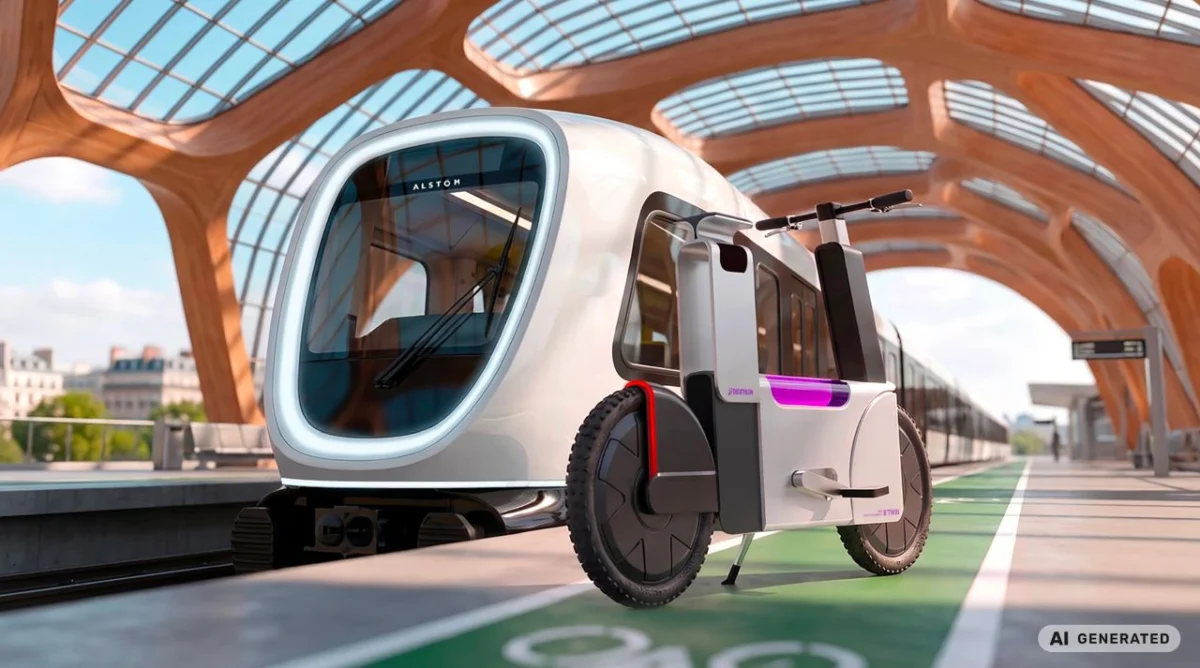
BERLIN – In a move set to reshape the future of urban and regional mobility, global rail leader Alstom and sports retail giant Decathlon unveiled a groundbreaking intermodal concept at InnoTrans 2026. The joint venture, which bridges the gap between cycling and high-speed rail, aims to eliminate the friction that currently plagues "last-mile" travel. By integrating specialized hardware with digital reservation systems and optimized interior train design, the partners are proposing a future where the bicycle or scooter is no longer an inconvenience to passengers, but a seamless extension of the train journey.
Main Facts: The Blueprint for "Continuous Mobility"
The concept, presented in Berlin, addresses a growing pain point in modern transportation: the physical incompatibility between standard bicycles and public rail systems. As urban centers strive to reach net-zero emissions, the reliance on bikes and electric scooters has skyrocketed. However, train carriages—often designed decades ago—struggle to accommodate the influx of non-folding bikes and heavy scooters, leading to blocked aisles, platform congestion, and frustrated commuters.
The Alstom-Decathlon solution rests on three pillars:
- Hardware Optimization: A new generation of compact, connected bicycles and scooters specifically engineered to fit within standardized rail storage parameters.
- Digital Integration: A unified booking application that allows passengers to reserve a dedicated stowage space simultaneously with their train ticket.
- Infrastructure Reconfiguration: The implementation of secure, dedicated compartments on board, separating the cargo from the passenger seating areas to enhance safety and comfort.
By treating the commute as a single, uninterrupted route, the companies hope to move away from the "fragmented journey" model that currently deters many car-dependent commuters from switching to public transit.
Chronology: The Evolution of a Concept
The collaboration, which reached a public milestone at InnoTrans 2026, was not an overnight development. It represents a multi-year research initiative aimed at aligning industrial design with public policy.
- Q1 2025: Initial feasibility studies were conducted by Alstom’s design teams in partnership with Decathlon’s R&D hub in France. The focus was on identifying the friction points: boarding times, vehicle weight, and the lack of secure storage.
- Q3 2025: The project moved into the prototyping phase. Alstom engineers analyzed passenger flow patterns on high-density regional lines, while Decathlon began testing foldable, lightweight frame geometries that maintained durability.
- Q1 2026: Digital integration testing commenced. The teams worked to link existing railway booking back-ends with a custom mobility app interface, ensuring that the "digital ticket" could account for both the human passenger and their physical vehicle.
- September 2026: The unveiling at InnoTrans 2026 serves as the global showcase. The event allowed both companies to gather feedback from transport authorities, urban planners, and the public to refine the concept before potential pilot programs in 2027.
Supporting Data: Why Intermodality is the Future
The urgency of this project is backed by a shift in consumer behavior and urban demographics. According to recent European transport data, over 65% of commuters living within 10 kilometers of a rail hub rely on personal micro-mobility to reach the station. However, nearly 40% of these users express "anxiety" regarding the availability of space on their train, often leading them to drive to the station instead.
Alstom’s own internal studies conducted during the research phase showed that during peak hours, "unmanaged" bicycle boarding adds an average of 45 seconds to dwell times at each station stop due to overcrowding in boarding vestibules. The proposed system, by directing passengers to pre-reserved zones, aims to reduce this boarding time by up to 60%, significantly improving the efficiency of the entire rail network.
Furthermore, Decathlon’s research into the ergonomics of folding bikes indicates that a 15% reduction in frame footprint—without sacrificing wheel diameter—can lead to a 30% increase in the number of units that can be stowed within a standard storage rack. This data served as the foundation for the "compact, connected vehicle" introduced at the exhibition.
Official Responses: Aligning the Vision
The partnership represents a unique intersection of heavy rail engineering and consumer product design. Executives from both companies emphasized that this is not merely a product launch, but a fundamental change in how transportation is perceived.

Alexis Bonnet, Design Director at Alstom, explained the shift in philosophy: "We have spent decades focusing on the train as a vessel. We are now pivoting to focus on the ‘continuous experience.’ By removing the physical barriers that make traveling with a bike or scooter a chore, we are essentially making the entire rail network more accessible. Mobility should no longer be a succession of separate modes; it should be a fluid, single event."
From the Decathlon side, the project reflects a strategic expansion into the service-oriented mobility sector. A spokesperson for the company noted: "Our role goes beyond manufacturing. By collaborating with Alstom, we are ensuring that our equipment is not just high-quality, but ‘rail-ready.’ We are designing for the reality of the commuter’s life, which involves stairs, train doors, and limited shelf space."
Implications: The Road Ahead
While the concept presented at InnoTrans is currently a design study, its implications for the rail industry are profound.
1. Retrofitting the Existing Fleet
One of the most significant hurdles identified is the current rail fleet. Most trains currently in operation lack the space for dedicated storage compartments. The Alstom-Decathlon concept suggests modular interior configurations—essentially "plug-and-play" storage units that could replace rows of standard seating in existing cars. This would allow operators to customize trains based on the route—offering more bike storage on rural, leisure-heavy routes and more seating on high-density commuter lines.
2. The Rise of the "Mobility-as-a-Service" (MaaS) App
The success of this concept hinges on the digital interface. The vision is for a universal app where a user can book a ticket from their home to their final office destination. The app would not only track the train but manage the "last mile" by reserving a secure slot on the train and, potentially, unlocking a station-based rental unit if the passenger chooses not to bring their own vehicle.
3. Safety and Security
A major concern for many cyclists is theft or damage. The proposal for a "locked, separate compartment" is a game-changer. By removing the need for passengers to stand guard over their bikes, the concept increases the comfort of the entire carriage, reducing congestion and improving the overall passenger experience.
4. Urban Planning and Policy
Finally, the concept forces a conversation among policymakers. To truly succeed, railway stations must be redesigned to handle the flow of bicycles from the street to the platform. This involves wider ramps, bike-friendly elevators, and clear signage—infrastructure investments that go hand-in-hand with the technology proposed by Alstom and Decathlon.
Conclusion: A New Standard for Transit
The collaboration between Alstom and Decathlon at InnoTrans 2026 marks a pivotal moment for public transport. By acknowledging that the modern commuter does not travel solely by train, but rather by a combination of transit and micro-mobility, the two giants are setting a new standard for the industry.
While the concept requires further testing, regulatory approval, and significant investment in infrastructure, the direction is clear. The "continuous journey" is no longer a theoretical goal; it is a tangible, engineered reality that promises to make rail travel more efficient, more personal, and far more attractive to a generation of commuters who prioritize sustainability and ease of movement. As the industry looks toward the next decade, the Alstom-Decathlon model serves as a vital blueprint for a more connected, integrated world.

