

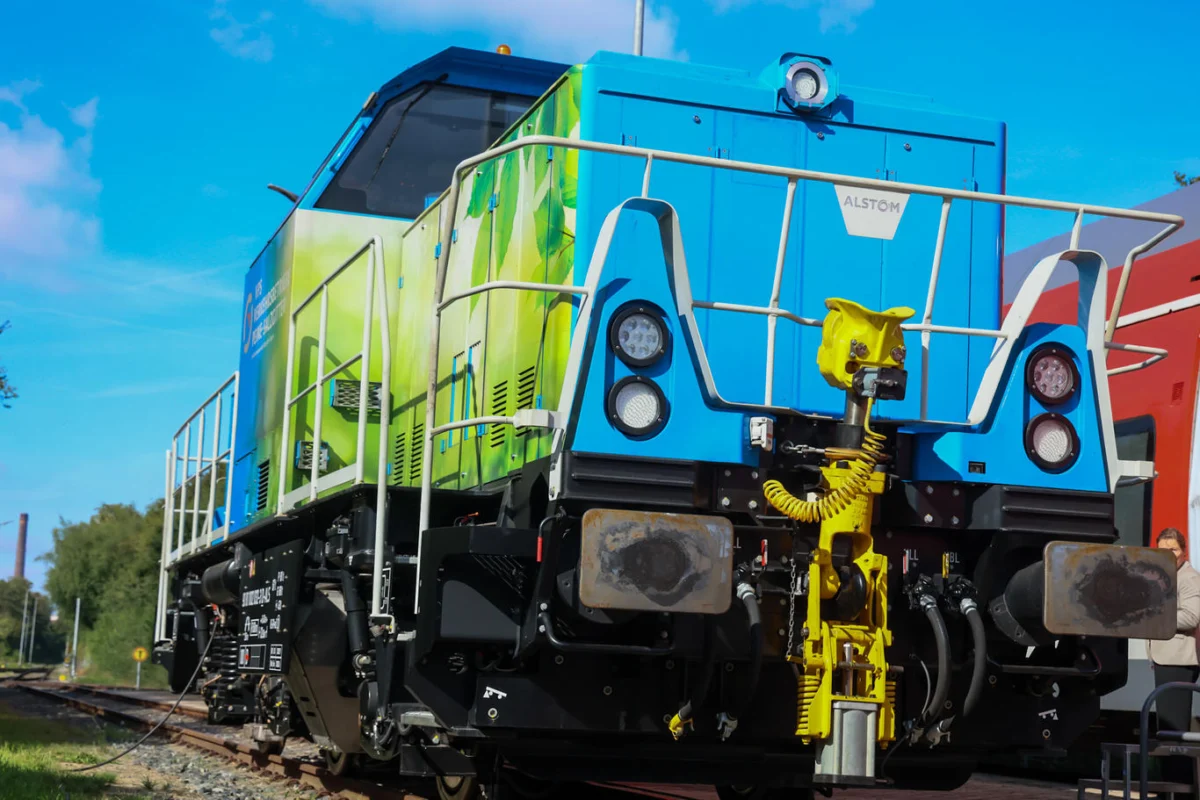
SALZGITTER, GERMANY — In a landmark development for sustainable heavy industry and European rail logistics, multinational rail technology leader Alstom has successfully executed the world’s first operational run of a shunting locomotive retrofitted from diesel to direct hydrogen combustion. The milestone test, conducted at Alstom’s facility in Salzgitter, Lower Saxony, signals a potentially transformative leap forward for the decarbonisation of yard operations and industrial rail freight across Europe.
The successful trial moves hydrogen propulsion beyond passenger rail and mainline trials, introducing a highly scalable, retrofittable solution for the heavy-duty shunting locomotives that are traditionally among the most stubborn sectors of rail transport to electrify.
Main Facts
The pioneering initiative centers on the successful conversion of an existing diesel shunting locomotive into an emission-free hydrogen combustion machine. Rather than relying on traditional fuel cells—which use electrochemical reactions to generate electricity—this project utilizes direct hydrogen combustion, modifying the internal combustion engine to run cleanly on hydrogen.
Key parameters of the project include:
- The Pioneer: Developed collaboratively by Alstom in partnership with VPS Verkehrsbetriebe Peine-Salzgitter (VPS), WTZ Roßlau gGmbH, the Technical University of Braunschweig (TU Braunschweig), and the Fraunhofer Institute for Surface Engineering and Thin Films.
- Financial Backing: The city of Salzgitter provided a EUR 1.5 million funding injection, sourced from Lower Saxony’s broader EUR 50 million structural aid and regional transformation package.
- Current Phase: Following its successful maiden run, the locomotive has entered an intensive industrial testing phase at the Salzgitter Group’s steel production facilities, where it will operate under real-world conditions until October 2025.
- Environmental Impact: Industry estimates suggest a single converted shunting locomotive can eliminate up to 150 tonnes of $textCO_2$ annually. Over a remaining operational lifespan of 15 to 20 years, this translates to savings of up to 3,000 tonnes of carbon per vehicle.
- Scope and Scale: Germany currently hosts an active fleet of approximately 1,000 diesel shunting locomotives, with an estimated 4,000 units deployed across the wider European continent.
Chronology of the Project
The realization of the world’s first hydrogen-combustion shunting locomotive is the culmination of years of targeted research, engineering breakthroughs, and regional institutional cooperation.
- Early Development & R&D Phase: Facing the urgent mandate to cut greenhouse gas emissions across all industrial sectors, Alstom, alongside academic and research partners including TU Braunschweig and WTZ Roßlau, began evaluating methods to adapt existing internal combustion engines for zero-emission hydrogen operations. The focus was placed heavily on retrofitting rather than entirely new builds, preserving capital and reducing waste.
- Regional Partnership & Funding Secured: The project found a natural home in Salzgitter, a traditional industrial hub undergoing a massive green transformation. The municipal government stepped forward with EUR 1.5 million in structural aid funding to help bridge the gap between laboratory research and practical application.
- Engineering and Bench Testing: Engineering teams worked intensively on technical hurdles, particularly surrounding exhaust gas turbocharging. Because hydrogen combustion requires high air-to-fuel ratios, managing excess air presented a formidable challenge. WTZ Roßlau and TU Braunschweig successfully optimized the engine design on test benches before final integration into the locomotive chassis.
- The Maiden Run (September 2025): Alstom officially completed the world’s first trial run of the converted shunting locomotive at its Salzgitter site, validating the mechanical, electrical, and propulsion integration in a live railway environment.
- Industrial Trial Phase (Late 2025): The locomotive was transferred to VPS, the logistics arm of Salzgitter AG, where it is undergoing rigorous, real-world industrial testing within the steel mills until October 2025.
- Project Conclusion and Future Outlook: Following the conclusion of the data-gathering trials in autumn 2025, the locomotive is scheduled to be returned to its original state, leaving behind a wealth of empirical data designed to pave the way for a commercial, series-production retrofitting solution.
Supporting Data and Environmental Impact
The true genius of Alstom’s retrofit model lies in its fleet-wide scalability. While building new hydrogen- or battery-electric locomotives requires massive capital investments and forces operators prematurely to retire functioning assets, retrofitting existing machinery offers a circular-economy approach to fleet decarbonisation.
Emissions and Carbon Offsets
According to technical data compiled by the project consortium, the environmental implications of scaling this technology are profound:
- Per Locomotive: Up to 150 tonnes of $textCO_2$ saved annually.
- Lifecycle Savings: Up to 3,000 tonnes of $textCO_2$ saved over a 15-to-20-year service extension.
- Equivalencies: The carbon savings of a single retrofitted engine over its lifespan equate to taking roughly 650 passenger cars off the road or planting approximately 200,000 trees.
Market Potential
The European rail network relies heavily on diesel-powered shunting engines for yard movements, cargo sorting, and industrial manufacturing logistics. With roughly 1,000 units in Germany and 4,000 across Europe, the addressable market for a drop-in or conversion-based hydrogen combustion engine is vast. By avoiding the manufacturing emissions associated with building entirely new locomotives, the retrofit approach delivers a "doubly sustainable" lifecycle footprint.
Official Responses and Stakeholder Insights
The milestone achievement drew widespread praise from industrial leaders, municipal officials, and academic partners alike, highlighting the collaborative spirit underpinning Lower Saxony’s green transition.
François Muller, Vice President Services for Central and Northern Europe at Alstom:
"With this research project, we are once again pioneering the use of hydrogen in rail transport. We are expanding the spectrum of vehicle modernisation with a doubly sustainable approach—thanks to this solution, our customers can switch to emission-free operation without having to replace their existing fleet."
Frank Klingebiel, Mayor of the City of Salzgitter:
"At our Hydrogen Campus, we are developing the technologies of tomorrow in the areas of factory transformation, green hydrogen and hydrogen storage. In the joint project to decarbonise shunting traffic, the city is not only on the sidelines but is also an active player with a financial contribution of EUR 1.5 million."
Dr. Johannes Dreier, Managing Director of VPS Verkehrsbetriebe Peine-Salzgitter:
"Integrating this hydrogen-powered locomotive into our daily industrial shunting operations marks a pivotal moment for our logistics network. It fits seamlessly into our corporate transition roadmap toward total climate neutrality."
Dr. Christian Reiser, Managing Director of WTZ Roßlau gGmbH:
"Our primary engineering objective was the successful transfer of hydrogen combustion technology from the test bench to the real track. Seeing it move under its own power in Salzgitter proves that hydrogen internal combustion is a viable, robust reality for heavy rail applications."
Prof. Dr. Peter Eilts, Technical University of Braunschweig:
"We have worked intensively on the design of the exhaust gas turbocharging, as the high excess air poses a particular challenge here. With success! Hydrogen’s unique combustion properties allow us to achieve high thermal efficiencies while drastically curbing harmful emissions."
Astrid Paus, Braunschweig Regional Development Office:
"This initiative is a textbook example of well-invested regional funding. It unites academic rigor, corporate innovation, and public policy to deliver measurable CO2 savings and tangible climate protection."
Implications for the Future of European Rail and Heavy Industry
The successful Salzgitter trial carries sweeping implications that extend far beyond a single railway yard.
Synergy with Green Steelmaking
For Salzgitter AG, the locomotive trial is not an isolated project; it is deeply interwoven with the company’s broader corporate transformation. The initiative directly complements the SALCOS (Salzgitter Low $textCO_2$ Steelmaking) programme, which aims to systematically transition steel production away from traditional, carbon-intensive blast furnaces toward hydrogen-based direct reduction. By running zero-emission hydrogen locomotives within a green steel manufacturing campus, the supply chain edges closer to end-to-end carbon neutrality.
The Hydrogen Combustion vs. Fuel Cell Debate
While proton-exchange membrane (PEM) fuel cells have dominated discussions surrounding hydrogen passenger trains (such as Alstom’s renowned Coradia iLint), direct hydrogen combustion engines offer a distinct advantage for heavy industrial retrofit applications. Combustion engines can handle the rugged, high-torque, stop-start demands of heavy shunting duty cycles while utilizing traditional mechanical powertrains that mechanics and rail operators already know how to maintain. This significantly lowers the barrier to entry for industrial rail operators who might otherwise be hesitant to adopt complex, costly electrochemical fuel-cell systems.
A Path to Commercialization
As the locomotive undergoes its final months of industrial validation through October 2025, all eyes will be on the durability, reliability, and economic feasibility of the conversion kit. If the trial continues to yield positive metrics, Alstom and its partners will have laid the groundwork for a standardized, commercial series-conversion package.
For Europe’s rail sector—under increasing regulatory pressure to eliminate fossil fuels by 2050—this world-first milestone in Salzgitter offers a pragmatic, cost-effective lifeline: transforming the dirty diesel workhorses of today into the clean, hydrogen-powered assets of tomorrow.

