


For corporate leaders and market analysts, the global semiconductor sector serves as the "canary in the coal mine" for the broader technology industry. Because chip design and fabrication are capital-intensive, high-stakes endeavors, shifts in hiring activity often precede major capital expenditure (CapEx) pivots or supply chain realignments by several months.
As of April 2026, the global semiconductor labor market is exhibiting signs of a structural cooling phase following the frenetic pace of Q1. However, a deeper dive into the data reveals that this is not a retreat from innovation, but rather a strategic recalibration toward high-value domains like artificial intelligence (AI) and cloud infrastructure.
The State of Play: April 2026 Hiring Contraction
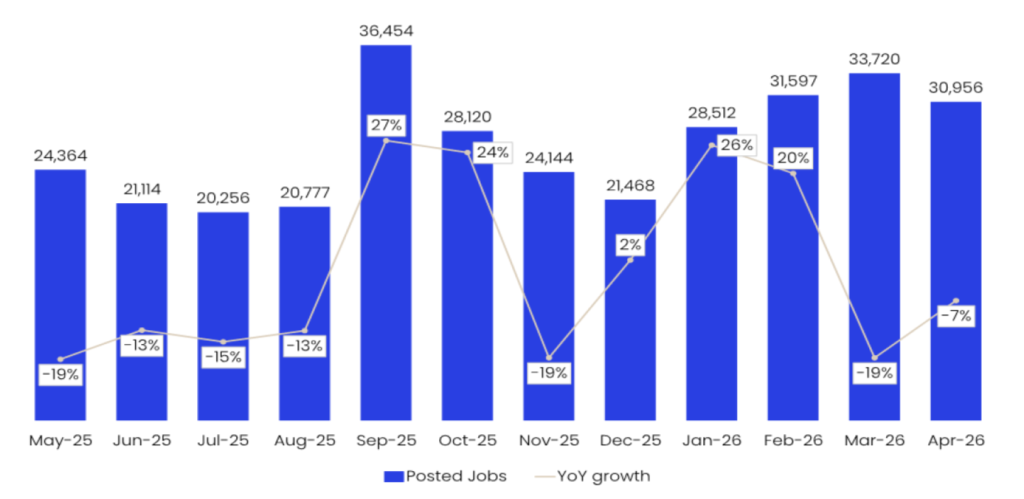
The latest data from GlobalData Jobs Analytics indicates a month-on-month decline of 6.58% in job postings for the semiconductor sector, totaling 30,956 active listings in April 2026. This marks the second consecutive month of decline, following a robust, acceleration-led January and February.

While the "cooling" narrative dominates the headlines, the current volume remains comfortably above the December 2025 baseline. This suggests that while the sector has moved past its early-year peak, it has not surrendered the gains made in the latter half of 2025. Rather, the industry appears to be entering a period of "steady-state" hiring, where firms are becoming more surgical in their talent acquisition rather than engaging in the broad-based expansion seen earlier in the quarter.
Chronology of the 2026 Semiconductor Labor Market
To understand the current cooling, one must look at the volatile trajectory of the past twelve months:
- May 2025 – August 2025: The sector navigated a period of consolidation, with hiring patterns reflecting modest demand for legacy chip architectures.
- September 2025: A notable "step-up" in hiring activity occurred as companies began preparing for the next wave of AI-accelerated hardware requirements.
- January – February 2026: A sharp acceleration in job postings signaled a massive push toward product development, likely driven by intense competition in the generative AI and high-performance computing (HPC) space.
- March – April 2026: A period of retrenchment began. This phase is characterized by a "wait and see" approach as companies evaluate the ROI of their Q1 recruitment drives.
The Strategic Shift: AI, Cloud, and the "Future of Work"
When analyzing which roles are being prioritized, a clear hierarchy of investment emerges. The hiring data suggests that semiconductor firms are no longer just hiring hardware engineers; they are evolving into software-centric organizations.

The Dominance of AI and Cloud
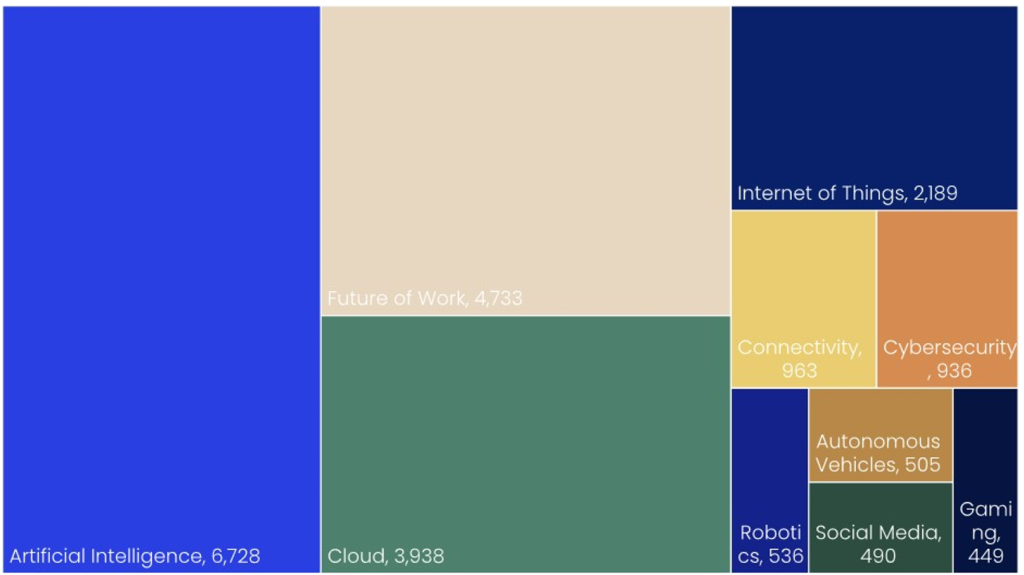
Artificial Intelligence (AI) leads the thematic hiring list with 6,728 postings, followed by the "Future of Work" (FOW) at 4,733, and Cloud infrastructure at 3,938. This triad of themes accounts for a significant portion of the total hiring volume, signaling that the industry’s growth engine is firmly rooted in digital modernization and software-adjacent capability building.
The Long Tail of Innovation
While IoT (2,189) and connectivity (963) remain critical, they occupy a secondary tier. Further down the list, themes such as robotics, autonomous vehicles, and gaming occupy a "long tail" of specialized hiring. This concentration implies that semiconductor leaders are prioritizing the immediate, scalable needs of the AI/Cloud stack over more experimental, long-horizon technologies.
Geographic Realignment: Stability and Emerging Hubs
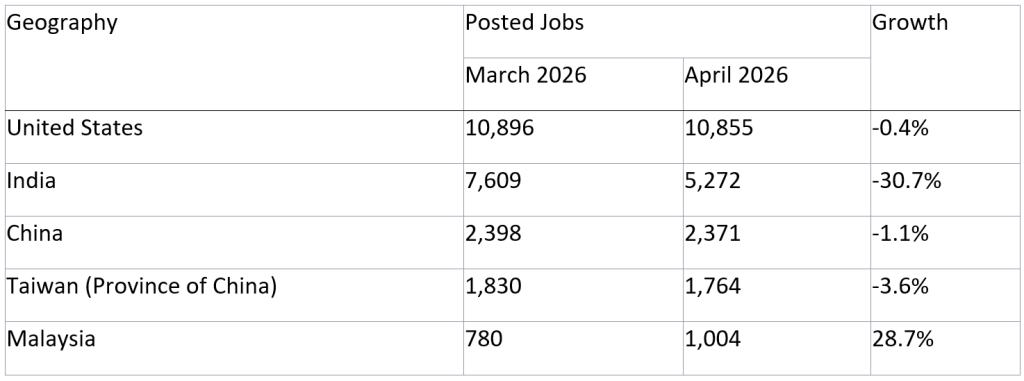
The global map of semiconductor talent is undergoing a quiet, yet significant, transformation. While the United States maintains its position as the undisputed center of gravity for the industry—posting a near-flat performance in April (-0.4%)—other regions are showing divergent trends.
The Rise of Malaysia
Perhaps the most striking outlier in the April data is Malaysia, which recorded a 28.7% growth in hiring, reaching 1,004 postings. This surge reinforces the narrative of "China Plus One" and regional diversification in the semiconductor supply chain. As companies look to hedge against geopolitical risk and rising costs in traditional manufacturing hubs, Southeast Asia is emerging as a critical beneficiary of redirected investment.
Contractions in Traditional Powerhouses
Conversely, India saw the most significant contraction, with hiring activity dipping by 30.7%. China (-1.1%) and Taiwan (-3.6%) also experienced minor pullbacks, reflecting a broader regional cooling. This suggests that while these regions remain vital to global production, the immediate demand for new headcount has stabilized after the Q1 surge.
Corporate Behavior: A Mixed Bag of Momentum
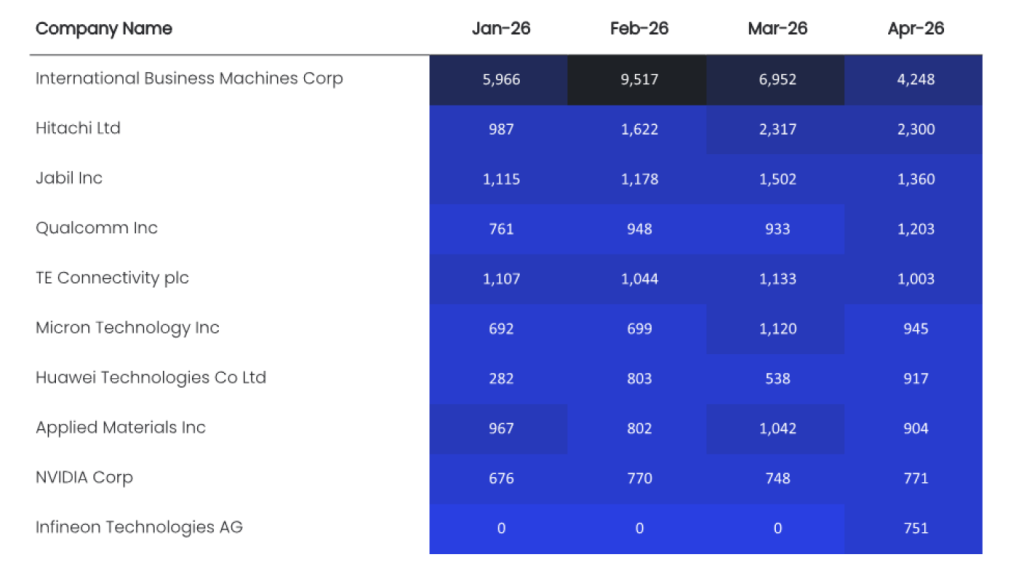
Individual company strategies provide the final layer of the puzzle. IBM continues to lead as the largest recruiter in the sector (4,248 postings), yet its numbers have fallen significantly from the February peak of 9,517. This suggests that IBM, like many industry titans, has largely completed its primary staffing objectives for the current cycle.
Other notable movements include:
- Hitachi: Maintaining stability with 2,300 postings, suggesting a consistent, long-term commitment to infrastructure capacity.
- Qualcomm and Huawei: Displaying moderate growth, indicating a continued push into specific product categories.
- Infineon: A surprising re-entry into the top-tier list with 751 postings after months of near-zero activity, highlighting how quickly a company’s strategic priority can shift from cost-containment to aggressive talent acquisition.
Technical Skill Sets: The Anatomy of a Modern Semiconductor Role
What does it take to get hired in this landscape? The data indicates that the demand is heavily weighted toward infrastructure and integration.
- Application Platforms and Containers (4,960): This is the top-demanded skill, pointing to a need for experts who can manage and deploy large-scale software environments.
- Systems Design and Integration (3,637): This highlights the industry’s focus on bridging the gap between hardware architecture and enterprise software.
- Operating Systems (3,408): A core requirement that underscores the fundamental necessity of infrastructure-level expertise.
The prevalence of these skills suggests that semiconductor firms are increasingly acting like software-as-a-service (SaaS) providers, requiring talent that understands the full stack, from silicon architecture to cloud-based delivery.
Implications for Corporate Leadership
For executives and investors, the message is clear: hiring data is an early warning system.
Because job postings lead earnings reports by a window of one to three months, the recent cooling in semiconductor hiring serves as a preview of potential margin pressures or strategic pivots in the coming quarter. By the time consensus market analysts catch up to these trends, the "hiring window" will have already shifted.
Strategic Takeaways:
- Monitor the "Hiring Velocity": A slowdown in hiring doesn’t necessarily mean a loss of confidence; it often signals a transition to a more efficient, high-margin execution phase.
- Watch for Geographic Dispersion: The growth in Malaysia vs. the decline in India underscores that firms are not just cutting costs—they are actively rebalancing their geographic footprint to manage geopolitical and operational risks.
- Prioritize Software Fluency: As the sector shifts toward AI and Cloud-integrated products, companies that struggle to bridge the gap between hardware engineering and platform development will likely lose their competitive edge.
In conclusion, the semiconductor sector is currently in a state of recalibration. While the headline numbers indicate a cooling in momentum, the underlying data points to a deeper, more disciplined investment in the technologies that will define the next decade of digital infrastructure. For leaders, the ability to interpret these hiring patterns—long before they show up in quarterly earnings—will be the defining factor in staying ahead of the competitive curve.
For further analysis or to request a bespoke data sample, stakeholders are encouraged to engage with labor market intelligence platforms like GlobalData to translate complex recruitment patterns into actionable business strategy.

