


In the high-stakes world of semiconductor manufacturing, the race for supremacy is not just fought in fabrication plants or R&D labs—it is fought in the human capital market. For industry leaders, hiring data acts as an essential, high-frequency barometer for future performance. By analyzing job postings, stakeholders can identify where competitors are pivoting, which technological themes are gaining traction, and where regional talent pools are being optimized long before these shifts materialize in quarterly earnings calls.
As of April 2026, the global semiconductor sector has entered a period of recalibration. Following a robust start to the year, hiring activity has cooled, revealing a complex landscape of geographic shifts and a laser-like focus on software-adjacent skill sets.
The Chronology of Cooling: A Q2 Retrenchment
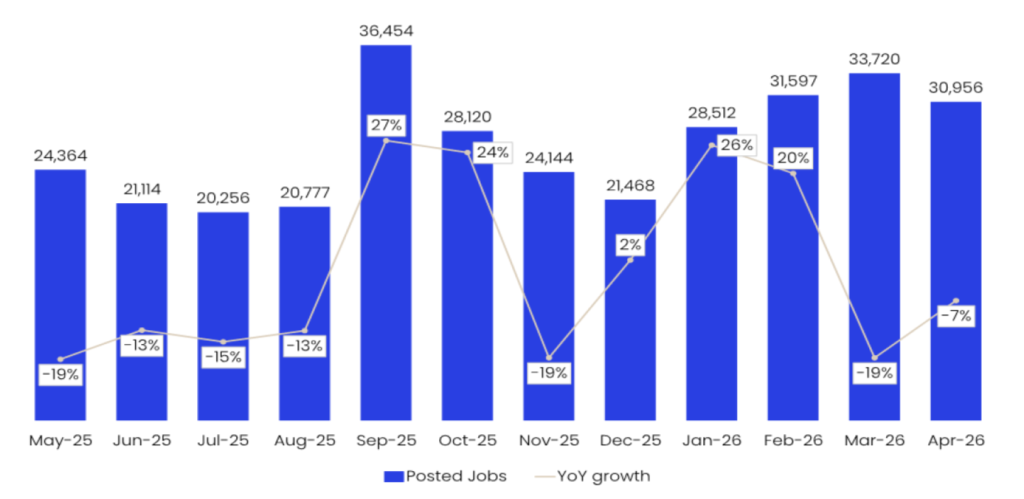
The semiconductor sector experienced a notable contraction in April 2026, with total job postings falling by 6.58% to 30,956. This decline marks the second consecutive month of cooling, following a vigorous surge of hiring activity between January and February 2026.

The 12-Month Trajectory
- Mid-2025: Hiring reached a period of relative stagnation, establishing a low-point baseline.
- September 2025: An initial autumn uptick suggested renewed confidence in supply chain expansion.
- January–February 2026: A period of aggressive hiring momentum, characterized by a massive influx of new roles, likely in anticipation of mid-year production scaling.
- March–April 2026: A phase of retrenchment and strategic consolidation.
Despite the recent pullback, it is critical to note that the current run-rate remains significantly higher than the troughs observed in late 2025. This suggests that the industry is not facing a collapse in demand, but rather a strategic adjustment—a “cooling” of the overheated hiring pace seen in the first two months of the year.
The Strategic Shift: Why Hiring Data Predicts Performance
For executive leadership, the "positioning window" for reacting to labor market signals is narrow—typically one to three months. By the time market consensus catches up to trends in job postings, the opportunity to pivot has often evaporated.
GlobalData Jobs Analytics provides a "point-in-time" view that allows leaders to see past the noise of financial statements. When a company suddenly pivots from hiring hardware engineers to recruiting software architects, it is a clear indicator of a shift in product strategy, often preceding a new market entry or a pivot toward AI-integrated services.

Dominant Themes: The AI and Cloud Imperative
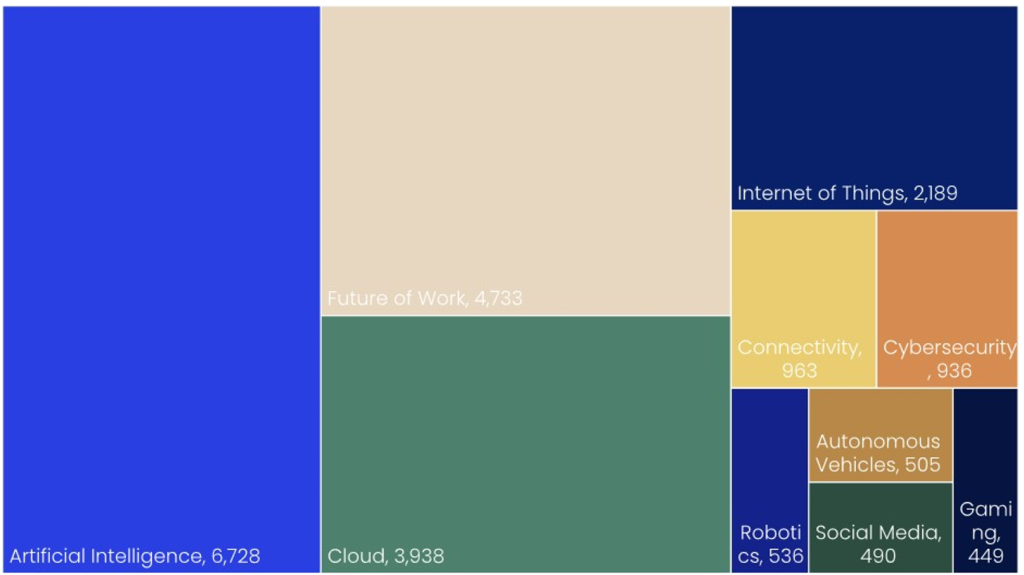
The thematic composition of semiconductor job postings provides a map of the industry’s future. In April 2026, the data showed an overwhelming concentration in software-centric themes, signaling that modern semiconductor firms are becoming increasingly "software-first" organizations.
The Top Three Drivers:
- Artificial Intelligence (6,728 postings): AI remains the undisputed king of semiconductor hiring, reflecting the massive demand for chips designed specifically for large language models and machine learning infrastructure.
- Future of Work (4,733 postings): This theme highlights the ongoing structural shift in how firms operate, prioritizing flexible, digitized workflows and collaborative engineering environments.
- Cloud (3,938 postings): The reliance on cloud-based design and manufacturing tools continues to grow, necessitating talent that can manage hybrid infrastructure.
Notably, secondary themes such as the Internet of Things (IoT) and advanced connectivity have seen a sharper decline in relative priority. This indicates that the "long tail" of technology—including robotics and autonomous vehicle systems—while critical, is currently receiving less aggressive capital allocation compared to the immediate, high-growth demands of the AI/Cloud ecosystem.
Geographic Dispersion: Stability vs. Volatility
The geographic distribution of hiring activity in April 2026 highlights a divergence between established hubs and emerging manufacturing frontiers.
- The United States: Remaining the undisputed global hub for semiconductor talent, the US market showed remarkable resilience, with hiring activity remaining virtually flat (-0.4%). This stability suggests that despite the broader cooling, US-based firms remain committed to their core R&D and design pipelines.
- The Indian Contraction: India saw the most significant volatility, with a 30.7% month-on-month decline. This sharp correction suggests that the rapid hiring expansion seen in early 2026 may have been overextended, leading to a swift adjustment.
- The Rise of Malaysia: Bucking the downward trend, Malaysia recorded a 28.7% increase in postings, reaching 1,004. This surge positions Malaysia as a critical, emerging beneficiary of the global "China Plus One" strategy, as firms seek to diversify their footprint away from more volatile or geopolitically sensitive regions.
- East Asian Hubs: China (-1.1%) and Taiwan (-3.6%) experienced moderate declines, reflecting a period of cautious optimism rather than a structural withdrawal from these critical manufacturing nodes.
Employer Trends: The Case of Infineon
The roster of top employers also revealed shifting priorities. IBM, while remaining the largest overall poster (4,248), has retreated significantly from its February highs of over 9,500 roles. This is a clear indicator of the "hiring exhaustion" that can follow an aggressive growth phase.
In contrast, the entry of Infineon into the top-employer list in April—after posting near-zero activity in the preceding quarter—is a significant "early warning" signal. Such a sudden, large-scale recruitment effort often indicates the commencement of a major new project, a breakthrough in manufacturing capability, or a significant expansion into a new vertical market.
Technical Skill Requirements
The technical skills currently being sought tell a story of platform-level engineering. The dominance of Application Platforms and Containers (4,960) and Systems Design and Integration (3,637) suggests that semiconductor firms are increasingly hiring talent capable of building end-to-end ecosystems rather than just discrete hardware components.
The emphasis on Operating Systems (3,408) reinforces the idea that the hardware-software divide is rapidly dissolving. To compete in the current market, semiconductor companies are looking for engineers who understand the entire stack—from the silicon architecture up to the containerized deployment of AI models.
Implications for Strategic Planning
For leaders, the current data offers a clear takeaway: the market is moving toward integration and software-centric hardware. The cooling in overall numbers should not be mistaken for a lack of opportunity; rather, it represents a transition from "growth at any cost" to "strategic, high-value hiring."
Three Strategic Imperatives for Leaders:
- Monitor the "Long Tail" of Talent: As competitors pull back from secondary themes like IoT, a counter-cyclical opportunity may exist for firms that choose to double down on these niche, high-potential areas while the rest of the market is distracted by AI.
- Optimize for Agility: The rapid fluctuations in countries like India and Malaysia prove that supply chain and talent geography are highly fluid. Leaders must ensure their hiring strategies are decoupled from static, long-term geographic assumptions.
- Harness Predictive Analytics: As noted, hiring data leads financial reporting by 90 days. If your organization is still relying solely on quarterly earnings to assess competitor strength, you are already behind. Leveraging real-time data from career portals is no longer a luxury—it is a competitive necessity.
The semiconductor landscape in April 2026 is one of controlled, strategic cooling. By focusing on the core themes of AI, Cloud, and platform engineering, while keeping a watchful eye on emerging hubs like Malaysia, firms can ensure they remain not just participants, but leaders in the next phase of technological evolution. As the industry moves into the second half of the year, the winners will be those who can best interpret these subtle, high-frequency signals to adjust their course before the rest of the market realizes the wind has changed.

