


For corporate leadership, the traditional reliance on quarterly financial reports—while essential—is increasingly viewed as a "rear-view mirror" approach to strategy. In the hyper-competitive semiconductor industry, where the race for AI dominance dictates the fortune of nations and enterprises alike, the most potent intelligence is found in the labor market. Hiring data acts as a sophisticated early-warning system, revealing where companies are placing their "real bets" on new products, emerging markets, and technological pivots long before those investments manifest in balance sheets.
As of April 2026, the global semiconductor landscape is exhibiting a period of cooling momentum following a frenetic first quarter. By analyzing granular job posting data provided by GlobalData Jobs Analytics, we can map the current trajectory of the industry, identify the technological themes capturing the most capital, and understand the shifting geographic priorities of the world’s most influential tech titans.
The State of Play: Why Semiconductor Hiring Has Eased
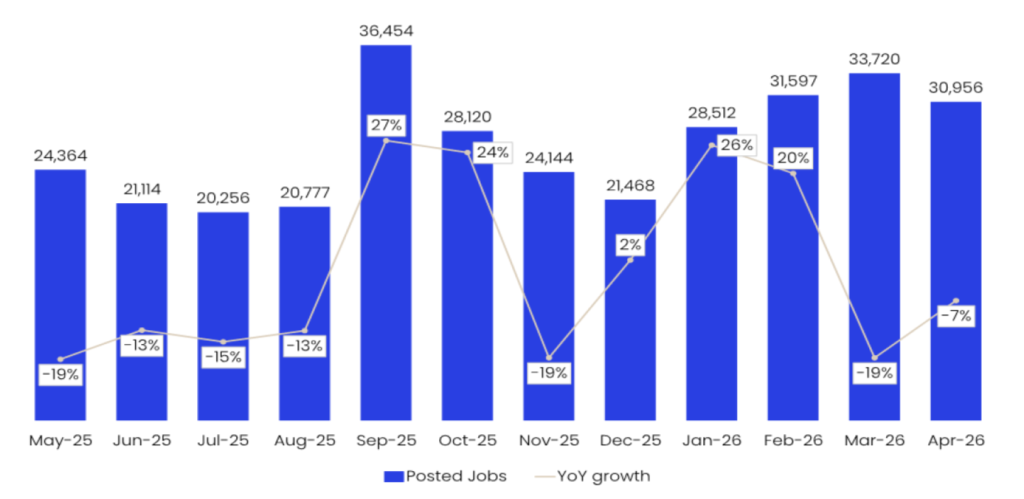
The data for April 2026 presents a clear narrative of consolidation. Global semiconductor job postings declined by 6.58% month-on-month, settling at 30,956. This contraction marks the second consecutive month of cooling, effectively ending the rapid acceleration observed during the January-February window.

A Chronology of Recent Turbulence
- Late 2025 (The Baseline): The industry entered the winter of 2025 with tempered hiring expectations, reaching a baseline trough that served as the jumping-off point for the new year.
- Q1 2026 (The Surge): January and February saw a aggressive spike in recruitment, fueled by optimistic projections for AI-driven hardware demand and renewed capacity expansion efforts.
- March-April 2026 (The Retrenchment): Following the Q1 surge, the market has undergone a two-month cooling period. While the volume of postings remains significantly higher than the December 2025 floor—suggesting that this is a strategic recalibration rather than a systemic downturn—it highlights a more cautious approach to headcount expansion among major players.
Thematic Dominance: The AI and Cloud Imperative
If hiring is a proxy for corporate investment, the message from the semiconductor sector is unequivocal: the future is software-adjacent. The thematic distribution of job postings reveals a heavy concentration in three core pillars that are reshaping the digital landscape.
1. Artificial Intelligence (AI)
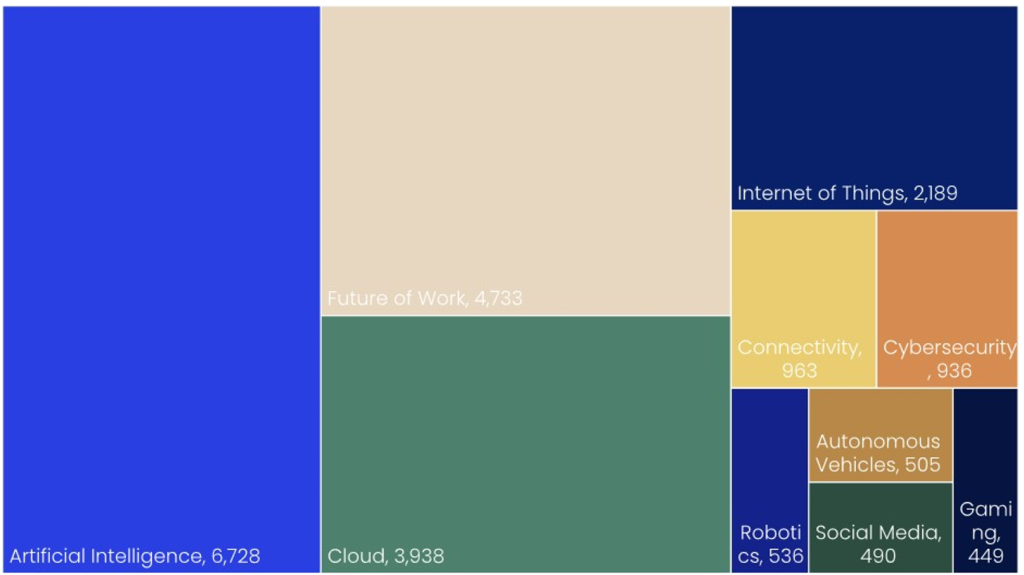
Leading the pack with 6,728 postings, AI remains the primary engine of industry growth. Companies are not merely hiring for general manufacturing; they are aggressively hunting for talent capable of architecting the next generation of neural processing units and edge-AI chips.
2. Future of Work (FOW)
With 4,733 postings, the "Future of Work" theme suggests that semiconductor firms are internally transforming their operational models. This includes investments in remote-collaboration infrastructure, digital workspaces, and automated workflows designed to maximize productivity in an increasingly globalized, distributed workforce.

3. Cloud Computing
Cloud-linked themes accounted for 3,938 postings. As data centers continue to be the primary consumers of high-performance silicon, the integration of cloud-native development within the semiconductor lifecycle has become a prerequisite for competitiveness.
Secondary themes—such as the Internet of Things (IoT) at 2,189 postings and connectivity solutions at 963—trail significantly. This "long tail" of themes, including robotics and autonomous vehicle technology, indicates that while these sectors remain crucial, they are currently seeing less aggressive hiring momentum compared to the foundational digital infrastructure of AI and Cloud.
Geographic Shifts: Stability and Dispersion
The geography of semiconductor hiring in April 2026 tells a story of a bifurcated market: stability in the primary hubs and rapid, localized shifts in emerging growth regions.
The US Hegemony
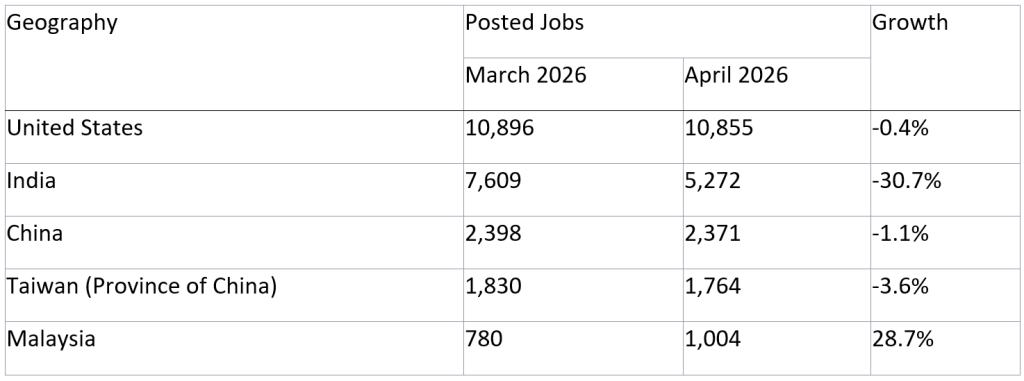
The United States remains the uncontested center of gravity for semiconductor recruitment. With hiring levels holding essentially flat (-0.4%) in April, the US market acts as the anchor for the global sector, reflecting a consistent, albeit stabilized, demand for high-end engineering talent.
The Asian Contraction and the Malaysia Outlier
The broader Asian market, however, saw significant volatility. India recorded a sharp contraction, with postings down 30.7% month-on-month. China (-1.1%) and Taiwan (Province of China) (-3.6%) also experienced modest declines, reflecting a period of pause for many regional manufacturing hubs.
Conversely, Malaysia surged with a 28.7% increase, reaching 1,004 postings. This leap highlights Malaysia’s growing importance as a strategic destination for semiconductor back-end processing and assembly, signaling a potential shift in supply chain diversification strategies among multinational corporations.
Corporate Analysis: A Mixed Bag for Top Employers
The hiring strategies of the industry’s top employers reveal a complex picture of resource allocation.
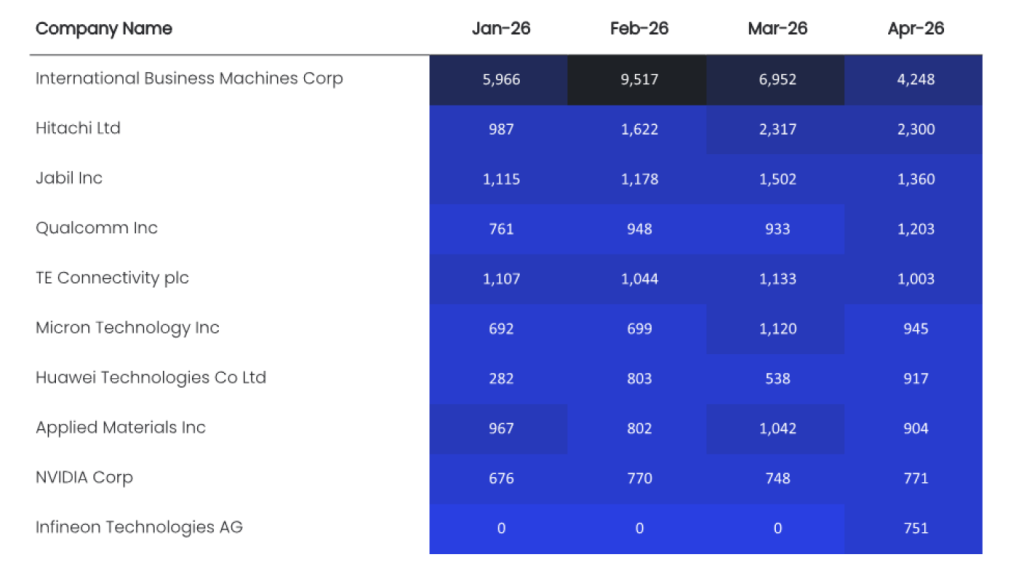
- IBM: Remaining the largest individual job poster (4,248), IBM nonetheless showed a material decline from its February peak of 9,517. This suggests a shift from an aggressive, broad-based recruitment phase to a more targeted, efficiency-focused strategy.
- Hitachi: Standing as a model of consistency, Hitachi maintained a steady hiring volume of 2,300 postings, signaling long-term commitment to its current industrial and semiconductor projects.
- Qualcomm & Huawei: Both firms demonstrated moderate increases in April, suggesting that despite the general sector cooling, specific competitive pressures are driving continued talent acquisition in wireless and mobile processing sectors.
- The Infineon Factor: Perhaps the most notable shift in the employer mix was the emergence of Infineon, which entered the top-employer list with 751 postings after recording zero activity in the previous three months. Such sudden shifts are "canary in the coal mine" indicators of new product cycles or expansion into new market segments.
Technical Skills: The Engine Room of Innovation
Hiring data provides a unique window into the specific technical capabilities currently in highest demand. The April 2026 data emphasizes "platform engineering" over pure-play hardware design.
- Application Platforms and Containers (4,960): The top-ranked skill set underscores the industry’s transition toward modular, cloud-native development environments.
- Systems Design and Integration (3,637): This focus highlights the need for engineers who can bridge the gap between high-level software architecture and physical silicon performance.
- Operating Systems (3,408): As silicon becomes increasingly specialized, the demand for deep kernel-level and OS-level integration skills remains a critical bottleneck for many firms.
The prevalence of these skills suggests that the semiconductor industry is increasingly hiring "systems thinkers" who can design chips that exist within a broader, cloud-centric software ecosystem, rather than viewing hardware as a standalone commodity.
Strategic Implications: What Leaders Must Do
For executives, the message from the Q2 2026 data is clear: Hiring signals precede financial outcomes. Because job postings typically lead earnings revisions by one to three months, they provide a distinct competitive advantage to those who know how to read the patterns.
1. Anticipate Competitor Moves
By monitoring the specific skills and regional hubs competitors are targeting, leaders can infer shifts in product strategy. A sudden surge in hiring for "Edge-AI" talent in a specific geography by a rival is not merely a staffing choice—it is a roadmap of their R&D priority.
2. Identify Operational Risks
A decline in hiring in a key region—like the sharp drop seen in India—might indicate that a competitor is facing supply chain hurdles or cost-cutting pressures in that territory. Leaders should use these insights to stress-test their own geographic exposure.
3. Build a "Point-in-Time" Intelligence Culture
The "positioning window" for hiring signals is brief. By the time the market reaches a consensus, the advantage of the insight has evaporated. Successful organizations are those that integrate real-time job analytics directly into their board-level reporting, treating workforce trends with the same analytical rigor as revenue growth or EBITDA.
In the current volatile climate, the ability to translate the "noise" of job postings into the "signal" of strategic intent is no longer a luxury—it is the baseline for competitive survival. Companies that master this intelligence will be the ones that navigate the cooling of the semiconductor market with the agility to pivot toward the next growth cycle.

