

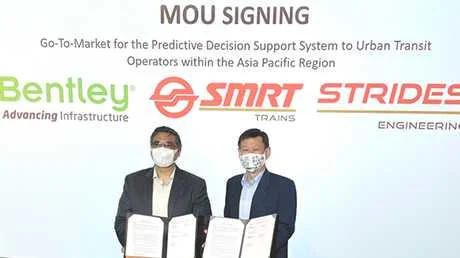
In a significant move to reshape the future of urban mobility across the Asia Pacific region, Bentley Systems, the global leader in infrastructure engineering software, has entered into a strategic Memorandum of Understanding (MoU) with Strides Engineering, a commercial arm of Singapore’s multi-modal public transport giant, SMRT Corporation. This partnership is designed to bring a sophisticated, data-driven predictive maintenance solution to rail operators, promising to transition the industry from reactive repairs to proactive asset management.
The Core Partnership: Fusing Technology with Operational Expertise
The collaboration marks a convergence of two distinct but complementary strengths. Bentley Systems brings its world-class digital twin technology and its robust AssetWise platform to the table. Conversely, Strides Engineering contributes deep, localized domain expertise and a portfolio of specialized, add-on applications specifically engineered for track maintenance.
Under the terms of this agreement, the two entities will jointly market a comprehensive rail predictive maintenance solution. This platform is designed to provide operators with a "single source of truth," enabling them to visualize complex asset information, manage workflows, monitor real-time health, and conduct deep-dive analyses into rail conditions. By integrating these systems, the partnership aims to mitigate the risks of service disruptions, extend the lifespan of critical infrastructure, and ultimately enhance the daily commute for millions of passengers.
Chronology of Innovation: From Pilot to Regional Standard
The alliance between Bentley and SMRT is not a sudden development but the culmination of a multi-year journey of technical validation and operational success.
The Foundation: The North-South and East-West Lines
The partnership’s roots lie in the successful implementation of the Predictive Decision Support System (PDSS) on Singapore’s oldest and most heavily utilized transit arteries: the North-South (NSL) and East-West (EWL) lines. Before the integration of advanced analytics, rail maintenance was largely driven by scheduled intervals or post-incident response. By deploying Bentley’s AssetWise Linear Analytics, SMRT Trains was able to shift toward a condition-based model.
The Milestones
- Initial Deployment: The PDSS was deployed as a pilot to address the challenges of maintaining 282 km of track.
- Operational Validation: The system proved its efficacy by identifying degradation patterns before they resulted in failure, leading to a quantifiable spike in network reliability.
- Scaling Up: Following the success on the NSL and EWL, SMRT Trains has initiated the rollout of the PDSS on the Circle Line (CCL).
- Regional Expansion: The current MoU represents the final step in this evolution—taking a proven, battle-tested Singaporean solution and offering it to the broader Asia Pacific rail market.
Supporting Data: The Metric of Success
In the world of rail engineering, "Mean Kilometers Between Failure" (MKBF) is the gold standard for measuring operational success. Before the integration of the PDSS, maintaining consistent uptime on high-traffic lines like the NSL and EWL was a perpetual challenge.
The implementation of Bentley’s AssetWise solution has fundamentally altered the performance profile of these lines. By utilizing linear analytics to scan and monitor the physical state of tracks, the system provides engineers with precise data on wear and tear. This has empowered SMRT Trains to reach a milestone of more than 1 million kilometers between failure (MKBF). This statistic is not merely a number; it represents a drastic reduction in track-related service delays, significantly improving the passenger experience and reducing the high costs associated with emergency maintenance.
Official Perspectives: Aligning Vision and Execution
The leadership teams behind this partnership view the MoU as a milestone for both firms and the wider transit industry.

Bentley Systems’ Vision
Kaushik Chakraborty, Vice President of Bentley Asia South, emphasized that the partnership is rooted in the shared goal of empowering infrastructure operators. "With our combined strengths and industry experience, we will empower rail and metro operators in the region to improve the reliability of the infrastructure that serves citizens and residents," Chakraborty stated. For Bentley, this is a strategic move to cement their position as the preferred technology partner for smart city and transit infrastructure in one of the world’s fastest-growing regions.
SMRT’s Operational Philosophy
The leadership at SMRT Trains views the PDSS as an essential pillar of their long-term modernization strategy. A spokesperson for SMRT Trains noted that the transition to a predictive model was driven by a necessity for preemptive action. "Leveraging technology and taking pre-emptive actions are two very important components in the plan to help us improve and maintain rail reliability. PDSS represents both components, and its successful implementation for the North-South and East-West lines has given us much confidence to scale it for the rest of our lines."
Implications for the Asia Pacific Rail Landscape
The implications of this partnership extend far beyond the borders of Singapore. As urban centers across the Asia Pacific region—from Bangkok and Jakarta to Sydney and Manila—grapple with aging transit infrastructure and rising passenger volumes, the demand for "smart" rail solutions has never been higher.
A Blueprint for "Smart" Urban Transit
This partnership provides a proven blueprint for other cities. Many urban rail systems in the region operate on legacy infrastructure that is increasingly expensive to maintain. By adopting the Bentley-Strides model, operators can move away from the "fix it when it breaks" mentality. This transition offers three primary benefits:
- Cost Efficiency: By predicting failures, operators can perform targeted maintenance only where it is needed, preventing the wastage of resources on healthy infrastructure.
- Safety and Reliability: Predictive maintenance reduces the likelihood of unexpected equipment failures, which are the primary cause of service disruptions and safety concerns.
- Sustainability: Efficient maintenance means longer infrastructure lifespans, reducing the carbon footprint associated with the premature replacement of rail components.
Shaping the Future of Digital Twins
The use of Bentley’s AssetWise platform in this context highlights the growing importance of "digital twins" in urban management. By maintaining a digital representation of the physical rail network, operators can run simulations, predict the impact of different traffic loads, and plan maintenance schedules without disrupting actual service. As the partnership moves forward, the integration of real-time sensor data with these digital twins is expected to become the industry standard for "intelligent" rail operations.
Conclusion: A New Era of Predictive Maintenance
The signing of the MoU between Bentley Systems and Strides Engineering is a clear signal that the future of transit lies in the intersection of data and engineering. By proving the efficacy of the PDSS on Singapore’s complex transit network, the two partners have effectively removed the uncertainty from the adoption of predictive maintenance.
As they begin to market this solution to other operators in the Asia Pacific region, they are not just selling software or consulting services; they are exporting a standard of reliability. In an era where public trust in mass transit is paramount, the ability to ensure consistent, reliable, and safe service is the most valuable commodity an operator can offer. Through this collaboration, Bentley and Strides are well-positioned to help the region’s transit authorities meet the demands of the 21st century, ensuring that the rail networks of tomorrow are as resilient as they are efficient.

