

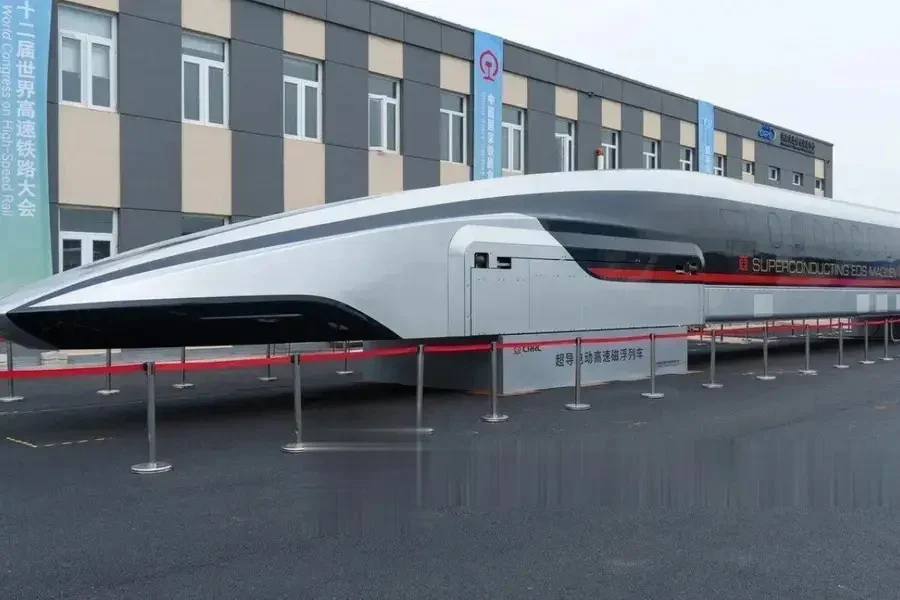
WUHAN, CHINA — In a milestone that pushes the boundaries of modern transportation and aerospace engineering, an experimental magnetic levitation (maglev) vehicle developed in China has shattered previous benchmarks by accelerating from a complete standstill to an astonishing 800 km/h (approx. 497 mph) in just 5.3 seconds.
Conducted on a specialized one-kilometre test track, the trial was masterminded by the Hubei East Lake Laboratory—widely known as the Donghu Laboratory—located in China’s central Hubei province. Weighing in at approximately 1.11 tonnes, the unmanned test pod utilized a sophisticated amalgamation of permanent magnet levitation and cutting-edge electromagnetic propulsion.
While the headline-grabbing speed is sure to draw comparisons to commercial high-speed rail, researchers emphasize that the technology is not currently intended for passenger transport. Instead, the breakthrough serves as a monumental leap forward for fundamental physics, high-speed rail subsystem development, and prospective aerospace launch technologies.
1. Main Facts: Engineering the Impossible
The November 24, 2025, trial was not merely a demonstration of raw speed; it was a masterclass in extreme physics, precision manufacturing, and electrical engineering.
To achieve 800 km/h within the tight constraints of a 1,000-metre (approx. 3,280 feet) track, the Donghu Laboratory vehicle had to undergo immense kinetic loading. The vehicle reached its maximum velocity at precisely the 0.6-kilometre mark, before initiating a highly synchronized, controlled braking sequence to safely decelerate to a halt at the end of the line. The entire high-speed drama unfolded in roughly eight seconds from launch to complete stop.
To contextualize the vehicle’s raw acceleration capabilities:
- 0 to 100 km/h (62 mph): Achieved in less than 0.7 seconds.
- 0 to 800 km/h (497 mph): Achieved in 5.3 seconds.
- Peak Velocity: Reached at the 600-metre mark.
- Deceleration Phase: Executed safely over the remaining 400 metres of track.
The Science of Contactless Motion
Unlike conventional high-speed trains that rely on steel wheels rolling along steel tracks—ultimately limited by mechanical friction, wheel wear, and thermal degradation at ultra-high velocities—the Donghu test platform relies entirely on electromagnetic fields.
The vehicle floats entirely free of physical contact with the guideway through a permanent magnet levitation system. Propulsion is provided by linear synchronous motors (LSMs), which use electromagnetic forces to push and pull the vehicle along the track much like the stator of an unwrapped electric motor.
By eliminating mechanical friction, the system avoids the catastrophic wear-and-tear that would normally disintegrate conventional moving parts at such speeds. However, removing physical contact introduces a host of other engineering nightmares: aerodynamic instability, vibration resonance, millimeter-level tracking precision, and massive instantaneous power draws.
Sub-Millimeter Tolerances
The infrastructure required to support an 800 km/h vehicle over a short distance must be engineered to tolerances normally reserved for optical instruments or semiconductor manufacturing.
According to technical briefs released by the laboratory, the one-kilometre track required microscopic precision. The horizontal deviation from a perfectly straight line over the entire length of the track had to be maintained within ±1 millimetre. Furthermore, the differential level variance between track fastenings was strictly limited to less than 0.5 millimetres. Any microscopic bump or misalignment at 800 km/h would introduce catastrophic aerodynamic lift or destabilizing vibrations, potentially causing the vehicle to derail or tear itself apart mid-run.
2. Chronology of a Record-Breaking Year
The landmark achievement on November 24 did not occur in a vacuum. It was the culmination of an aggressive, highly successful six-month campaign of rapid prototyping, iterative testing, and incremental velocity increases led by the Hubei East Lake Laboratory.
The Spring Foundation: June 2025
The groundwork for the autumn breakthroughs was laid in June 2025. During initial trials on the same testing corridor, the research team deployed a slightly lighter experimental vehicle—weighing roughly one tonne.
In this foundational test, engineers successfully validated the baseline stability of the permanent magnet levitation array coupled with the linear propulsion system. The vehicle was accelerated to 650 km/h (approx. 404 mph). While modest compared to the year-end goals, the June test provided vital telemetry regarding high-speed aerodynamic drag, thermal dissipation in the stator coils, and real-time vehicle-to-infrastructure communication lag.
Summer Escalation: July 14, 2025
Buoyed by the success of the June trials, the Donghu team swiftly modified their control algorithms and fine-tuned the electromagnetic propulsion thrust profiles. Just weeks later, on July 14, 2025, the research team pushed the envelope further.
During this mid-summer test, the one-tonne experimental platform was driven to a top speed of 700 km/h (approx. 435 mph). Crucially, the team successfully managed the severe aerodynamic shockwaves generated as the vehicle approached transonic conditions within a confined outdoor track environment. The data gathered during this test highlighted minor structural oscillations, allowing engineers to reinforce the chassis and upgrade the onboard position-sensing arrays for the final push toward the 800 km/h barrier.
The Autumn Triumph: November 24, 2025
With lessons integrated from both summer trials, the research team unveiled a slightly heavier, more robust iteration of the vehicle—weighing 1.11 tonnes—designed to handle the extreme G-forces and mechanical stresses of an 800 km/h sprint.
On November 24, the vehicle executed its historic run, hitting the 800 km/h mark in just 5.3 seconds. Following this record-shattering event, the laboratory did not immediately dismantle or idle the test bed. Instead, they embarked on an intensive, month-long operational audit.
Throughout December, the research team subjected the infrastructure and vehicle to dozens of secondary tests, rigorously evaluating:
- Levitation stability margins under fluctuating high-speed wind loads.
- The absolute precision of closed-loop speed control systems.
- The efficiency and thermal durability of the power supply grid and linear motors.
At the conclusion of these extended trials, the Donghu Laboratory officially announced that all operational performance indicators had met or exceeded their theoretical design requirements.

3. Supporting Data and Technical Architecture
To fully appreciate the magnitude of the Hubei East Lake Laboratory’s achievement, one must examine the multidisciplinary technologies required to keep a 1.11-tonne metallic pod stable while hurtling faster than a commercial turboprop aircraft over a distance shorter than the runway of a small airport.
Comparative Performance Metrics
| Metric | June 2025 Test | July 2025 Test | November 2025 Test |
|---|---|---|---|
| Vehicle Weight | ~1.00 tonne | ~1.00 tonne | 1.11 tonnes |
| Track Length | 1,000 metres | 1,000 metres | 1,000 metres |
| Top Speed | 650 km/h | 700 km/h | 800 km/h |
| Time to Max Speed | N/A | N/A | 5.3 seconds |
| 0–100 km/h Time | N/A | N/A | < 0.7 seconds |
| Total Run Duration | ~7 seconds | ~7.5 seconds | ~8 seconds |
Tackling Aerodynamic and Control Challenges
At 800 km/h, air ceases to act as a passive medium and instead behaves almost like a viscous fluid. As the vehicle slices through the atmosphere on the open-air test track, it creates massive bow shocks and turbulent wake eddies.
The Donghu research team had to engineer sophisticated active aerodynamic management systems. Because conventional control surfaces (such as flaps or rudders) lose effectiveness or introduce unwanted yaw and pitch moments at ultra-high speeds on a fixed guideway, stability was maintained entirely through instantaneous electromagnetic corrections.
Furthermore, precise positioning is critical. At nearly 222 metres per second, a timing error of even a single millisecond means the vehicle moves nearly a quarter of a metre off its calculated profile. The team developed high-frequency optical and magnetic sensors capable of relaying positional telemetry to the control room in micro-seconds, allowing the linear motor drives to dynamically adjust power delivery to the stator coils on the fly.
4. Official Responses and Institutional Perspective
The breakthroughs at the Hubei East Lake Laboratory have sent ripples of excitement through China’s scientific community, garnering attention from academic institutions, state planners, and industrial conglomerates alike.
In official statements released following the verification of the November 24 results, representatives of the Donghu Laboratory underscored the methodical, scientific nature of the project.
"This is not a stunt; it is a systematic stress-test of the absolute limits of electromagnetic propulsion and permanent magnet levitation physics," noted a senior lead researcher at the facility. "By compressing extreme acceleration into a micro-corridor of one thousand metres, we have unlocked unprecedented data regarding how materials, magnetic fields, and control algorithms interact under extreme duress."
Chinese state media and academic journals have widely praised the project as a testament to indigenous innovation in advanced manufacturing and high-tech infrastructure development. The Hubei provincial government has long positioned the East Lake Laboratory as a premier hub for optoelectronic information, quantum science, and advanced transportation technologies.
Industry analysts point out that while China already operates the world’s fastest commercial maglev lines—such as the Shanghai Transrapid, which cruises at 430 km/h (267 mph), and developmental lines designed for 600 km/h—the research emerging from Donghu is exploring an entirely different tier of velocity.
5. Implications: Beyond the Horizon of Passenger Rail
Perhaps the most crucial nuance of the Hubei East Lake Laboratory’s recent triumph is managing public expectations regarding its application.
Why This Is Not a Passenger Train
To the casual observer, a vehicle hitting 800 km/h conjures images of futuristic bullet trains whisking commuters between mega-cities in minutes. However, transportation experts are quick to pour cold water on this notion—at least for the foreseeable future.
The acceleration profile required to reach 800 km/h in just 5.3 seconds generates gravitational forces (G-forces) that would be profoundly dangerous, deeply uncomfortable, and potentially lethal to unconditioned human passengers.
- Accelerating from 0 to 800 km/h in 5.3 seconds exerts an average acceleration of roughly 4.2 Gs, with instantaneous peaks significantly higher.
- For context, fighter pilots wear specialized G-suits and undergo rigorous centrifuge training to withstand such forces without blacking out. Standard commercial rail passengers expect acceleration rates that feel gentle and unobtrusive, typically well under 0.1 G.
Therefore, building a passenger-carrying line with this level of acceleration is neither practical nor desirable. Commercial very-high-speed maglev systems must ramp up their speed gradually over dozens or hundreds of kilometres to ensure passenger comfort.
Future Applications: Aerospace and Ultra-High-Speed Transit
If the technology is not meant for passenger trains, what is it good for? The Donghu Laboratory has outlined several groundbreaking use-cases where extreme, instantaneous electromagnetic acceleration is a game-changer:
-
Next-Generation Commercial Maglev Research:
The data collected from these extreme stress tests provides foundational parameters for future commercial high-speed rail systems. Understanding how materials behave at 800 km/h allows engineers to build safer, more resilient 600 km/h commercial trains with vastly superior safety margins. -
Electromagnetic Launch Systems (EMLS) for Aerospace:
One of the most promising applications of high-payload electromagnetic acceleration is in space exploration. Traditional rocket launches require massive amounts of chemical propellant just to clear the dense lower layers of Earth’s atmosphere. By utilizing a heavy-duty maglev track to electromagnetically launch aerospace craft or cargo pods to hypersonic speeds (potentially matching systems like the U.S. Navy’s electromagnetic aircraft launch systems or proposed space-gun concepts), space agencies could slash the fuel weight required for orbital missions, dramatically reducing launch costs. -
Hypersonic Wind Tunnel Simulation and Dynamic Testing:
Testing materials for hypersonic flight—such as thermal protection tiles for re-entry vehicles or scramjet engine components—usually requires massive, expensive hypersonic wind tunnels. An outdoor or evacuated tube maglev test track capable of sustaining extreme velocities offers an alternative or complementary method for subjecting test articles to high dynamic pressure and kinetic friction.
Conclusion
The achievement of the Hubei East Lake Laboratory on November 24, 2025, marks a watershed moment in the history of linear electromagnetic propulsion. By safely accelerating a 1.11-tonne vehicle to 800 km/h in a fraction of a minute on a modest one-kilometre stretch of precision track, Chinese researchers have pushed past conventional engineering horizons.
As the world looks toward the future of ultra-fast mobility and space access, the technological building blocks forged in Hubei province will undoubtedly serve as foundational pillars for the next generation of high-speed innovation.

