

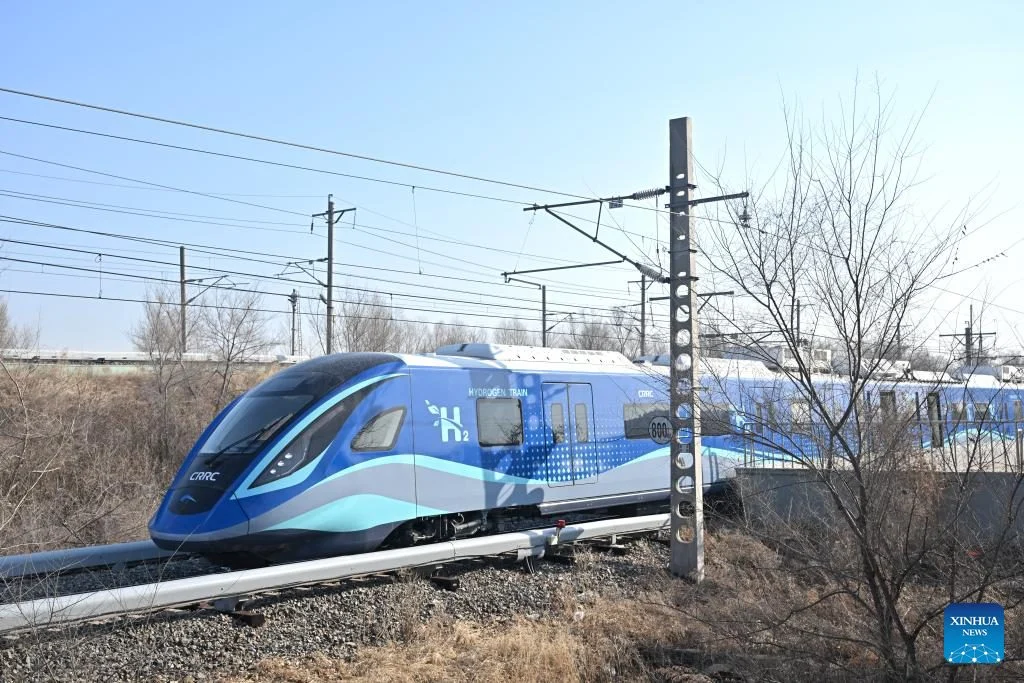
CHANGCHUN, CHINA — In a landmark development for sustainable mass transit, China has successfully completed high-speed operational trials for its first domestically developed hydrogen-powered urban train. Capable of reaching speeds up to 160 kilometers per hour (approximately 100 miles per hour), the advanced commuter train represents a profound leap forward in the application of alternative energy within the global railway sector.
The successful test, conducted on Thursday on a dedicated corporate testing track in Changchun, northeast China’s Jilin province, signals a major turning point in how rail networks may power themselves in the decades to come. Developed by CRRC Changchun Railway Vehicles—a subsidiary of the state-owned rolling stock manufacturing giant CRRC Corporation—the train merges cutting-edge hydrogen fuel cell technology with high-speed urban transit engineering.
According to reports from China’s official Xinhua news agency and industry stakeholders, this achievement validates the feasibility of zero-emission rail transport at speeds previously dominated by electrified overhead catenary systems or diesel locomotives. As nations worldwide grapple with the pressing imperative to decarbonize heavy industry and transport, China’s newest hydrogen train offers a compelling glimpse into the future of eco-friendly mobility.
Main Facts
The newly tested hydrogen-powered urban train is a masterpiece of modern railway engineering, designed to address the environmental shortcomings of conventional transit without compromising on speed, efficiency, or range.
- Top Speed and Performance: During Thursday’s trials, the train successfully achieved a maximum operating speed of 160 km/h. This places it among the fastest hydrogen-powered passenger trains currently in development worldwide, proving that clean-energy rail transport does not require sacrifices in velocity.
- Power Source and Propulsion: Unlike traditional diesel-electric trains that emit greenhouse gases, or electric multiple units (EMUs) that require costly overhead power lines (catenaries) and sub-stations, this train utilizes an onboard hydrogen fuel cell system. Hydrogen gas reacts with oxygen to generate electricity, with water vapor as the sole byproduct.
- Extended Range: The train boasts a maximum operational range of over 1,000 kilometers on a single fueling. This impressive endurance places it on par with global benchmarks, such as Alstom’s Coradia iLint, and makes it exceptionally viable for regional and intercity routes where electrification is economically unfeasible.
- Energy Efficiency: Telemetry and test data released following the trial indicate that the train achieves an average energy consumption of 5 kilowatt-hours per kilometer. Industry experts note that this efficiency metric places the CRRC Changchun vehicle directly in line with the world’s leading hydrogen rail technologies.
- Comprehensive Validation: The trials were not merely high-speed dashes; they involved a meticulous, system-wide performance evaluation across a diverse array of simulated operational scenarios, stress tests, and environmental contexts.
Chronology of Development
The successful high-speed test on Thursday is the culmination of years of intensive research, design, engineering, and iterative testing by Chinese rail manufacturers. The journey toward this milestone highlights the methodical pace at which China is scaling up its green transportation infrastructure.
The Foundation Years (2019–2021)
As China solidified its national commitment to achieving peak carbon dioxide emissions before 2030 and carbon neutrality before 2060 (the "Dual Carbon" goals), state planners identified the railway sector as a prime target for disruption. While high-speed rail lines were rapidly electrifying, regional, freight, and secondary urban lines still heavily relied on diesel fuel. CRRC Changchun began laying the theoretical and material groundwork for hydrogen propulsion, focusing heavily on fuel cell durability, hydrogen storage safety, and lightweight train body construction.
Prototype Unveiling and Initial Rollout (2022–2023)
By late 2022 and early 2023, the conceptual designs materialized into physical hardware. CRRC rolled out prototype iterations designed to test low-temperature performance—a critical requirement for rolling stock operating in northeast China’s freezing winters. Engineers focused on integrating large-capacity hydrogen storage tanks directly into the underframe of the passenger cars without sacrificing passenger capacity or interior comfort. Initial low-to-medium-speed test runs commenced on private tracks, gathering baseline telemetry regarding fuel cell efficiency and thermal management.
The 160 km/h Breakthrough (March 2024)
The project reached a crescendo on Thursday, March 21, 2024. Following months of system calibrations, the train underwent its definitive high-speed validation trials. Pushed to its design limit of 160 km/h, the hydrogen city train navigated various testing scenarios designed to replicate real-world commuter conditions. The successful completion of these trials marked the transition of the technology from experimental engineering to a market-ready commercial product.
Supporting Data and Technical Architecture
To fully appreciate the significance of CRRC Changchun’s achievement, one must examine the underlying mechanics and comparative metrics of the train. Hydrogen rail technology is rapidly evolving, and the data emerging from the Chinese trials provides a fascinating benchmark for international comparison.
Technical Specifications Matrix
| Metric | CRRC Changchun Hydrogen City Train | Global Standard / Benchmark (e.g., Alstom iLint) |
|---|---|---|
| Maximum Speed | 160 km/h | 140 km/h |
| Maximum Range | > 1,000 km | Up to 1,000 km |
| Energy Consumption | 5 kWh/km | Comparable industry averages |
| Power Architecture | Hydrogen Fuel Cells + Supercapacitors | Hydrogen Fuel Cells + Lithium-ion Batteries |
| Emissions | Zero (Water vapor only) | Zero (Water vapor only) |
Overcoming Infrastructure Hurdles
One of the primary economic barriers to expanding passenger rail networks is the capital expenditure (CapEx) required to build and maintain overhead catenary systems. Electrifying a single kilometer of railway track requires millions of dollars in copper wiring, pylons, substations, and ongoing maintenance.
By utilizing hydrogen fuel, the CRRC train effectively bypasses this infrastructure requirement. It can operate on existing, unelectrified regional tracks without requiring railway operators to invest in costly grid upgrades. This makes the train an ideal solution for developing regions, rural connections, and secondary metropolitan lines seeking to modernize without incurring massive debt.
Smart Integration and Safety
CRRC engineers implemented advanced smart-control systems throughout the train. The vehicle features multi-redundant safety protocols specifically tailored for hydrogen handling, including high-pressure carbon-fiber storage tanks equipped with pressure-relief devices, real-time hydrogen leak detection sensors, and automated ventilation systems. Furthermore, the train integrates intelligent energy management software that dynamically balances power output between the hydrogen fuel cells and onboard energy storage units (such as supercapacitors) during acceleration, braking, and coasting phases.

Official Responses and Industry Reactions
The successful test has drawn enthusiastic responses from government officials, corporate leaders, and international rail analysts, highlighting the global importance of the event.
Speaking on behalf of the manufacturing consortium, lead engineers at CRRC Changchun emphasized that the milestone proves China’s capability to master the entire industrial chain of hydrogen rail transport—from core fuel cell components and hydrogen storage to vehicle integration and intelligent control systems.
"This successful test marks a fundamental shift in our approach to urban and regional rail transit," noted a senior project manager involved in the trials. "We have demonstrated that clean energy can deliver high-speed, long-range performance without compromising reliability or passenger safety. This opens up entirely new markets for sustainable rail travel both domestically and internationally."
International rail analysts have also taken note. Western competitors, who have pioneered hydrogen trains in Europe through projects like Germany’s Alstom Coradia iLint, view China’s entry into the high-speed hydrogen arena as both a competitive challenge and a validation of the technology’s viability. With China possessing one of the largest domestic rail networks in the world, the large-scale commercialization of hydrogen trains within its borders could rapidly drive down global manufacturing costs for fuel cells and storage tanks through economies of scale.
Energy sector observers point out that this milestone aligns seamlessly with China’s broader ambitions to become a dominant player in the global hydrogen economy. By ramping up domestic production of "green hydrogen" (produced via water electrolysis using renewable energy sources like wind and solar), China is creating an integrated ecosystem where clean fuel powers clean transport.
Implications for Global Rail Transport and the Green Transition
The successful 160 km/h trial of China’s hydrogen city train carries profound implications for the future of global transportation, urban planning, and climate policy.
1. Accelerating Decarbonization in Hard-to-Abate Sectors
While electric passenger cars have dominated headlines in the green mobility revolution, heavy transport—including shipping, aviation, and rail—remains notoriously difficult to electrify entirely via batteries due to weight and charging time constraints. Hydrogen offers a high energy-density alternative that can power heavy commercial vehicles and trains over long distances with rapid refueling times (refueling a hydrogen train takes a fraction of the time required to charge a massive battery pack).
2. Transforming Regional and Intercity Commuting
Many regional rail lines around the world continue to rely on aging diesel fleets because electrification is financially prohibitive. The introduction of high-speed, long-range hydrogen trains provides transit authorities with a plug-and-play solution. Cities can upgrade their environmental credentials and passenger experience overnight simply by swapping out diesel locomotives for hydrogen units, utilizing existing tracks.
3. Fostering International Green Partnerships
As nations seek proven technologies to meet their Paris Agreement commitments, Chinese rolling stock manufacturers are well-positioned to export hydrogen rail technology to emerging markets and developing economies across Asia, Africa, and Latin America. Countries looking to expand their rail infrastructure sustainably may find turnkey hydrogen solutions far more attractive than building expensive electrified rail grids from scratch.
4. Catalyst for Hydrogen Infrastructure Development
A major chicken-and-egg problem has plagued the hydrogen economy: operators hesitate to buy hydrogen trains because of a lack of fueling stations, while energy companies hesitate to build stations without guaranteed fleets. Breakthroughs like CRRC’s high-speed test provide the commercial momentum needed to incentivize governments and energy conglomerates to invest heavily in hydrogen production, distribution, and refuelling infrastructure.
Conclusion
China’s successful test of its first 160 km/h hydrogen city train is much more than a routine corporate milestone; it is a clear signal that the future of rail transport is rapidly pivoting toward zero-emission alternatives. By successfully combining high-speed performance, an impressive 1,000-kilometer range, and top-tier energy efficiency, CRRC Changchun has raised the bar for sustainable engineering worldwide.
As these trains transition from test tracks to commercial passenger lines in the coming years, they promise to reshape urban landscapes, reduce carbon footprints, and offer a compelling blueprint for how human mobility can harmoniously coexist with the health of the planet.

