

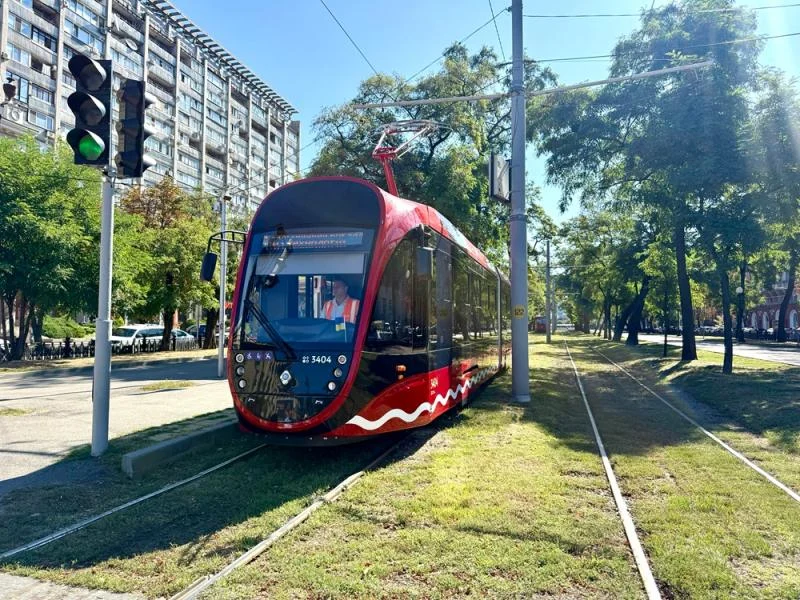
In a powerful testament to urban resilience and industrial endurance, the Ukrainian city of Dnipro has officially inaugurated its first fleet of modern, low-floor trams. This milestone, achieved while the nation continues to navigate the complexities and hardships of an ongoing war, represents a pivotal shift in the city’s public transit infrastructure. Funded through a EUR 21.4 million investment from the European Investment Bank (EIB), the project not only modernizes the city’s aging transport network but also serves as a beacon of economic sustainability by sourcing the majority of its manufacturing needs from within Ukraine.
Main Facts: A New Era for Dnipro’s Transit
For a city of approximately 800,000 residents, the introduction of these five new vehicles is more than a mere fleet upgrade; it is a fundamental transformation of accessibility. Historically, Dnipro’s tram network has been characterized by aging rolling stock, with the average age of the fleet exceeding four decades. This legacy infrastructure presented significant hurdles for the elderly, individuals with disabilities, and parents navigating the city with pushchairs.
The new trams, manufactured by the local rolling stock specialist Tatra-Yug, have been deployed on Line 1—the city’s arterial route connecting the central railway station to the State University of Science and Technology of Ukraine. This route serves as a lifeline for the city, moving thousands of students, workers, and visitors daily. Unlike their predecessors, these trams feature a 100% low-floor design, eliminating the need for steps and providing seamless, barrier-free boarding. Furthermore, the vehicles are equipped with modern passenger information systems, improved energy efficiency, and a quieter propulsion system, significantly enhancing the overall rider experience.
Chronology: The Path to Modernization
The journey toward this modernization effort has been a multi-year endeavor, accelerated by the urgency of the times.
- Pre-2022: Initial planning for the "Ukraine Urban Public Transport Project II" began, with the EIB identifying the urgent need to overhaul municipal transit systems across the country.
- February 2022: The full-scale Russian invasion necessitated a pivot in the project’s scope, focusing on both modernization and the preservation of essential public services during wartime.
- 2023–2024: Procurement processes and local manufacturing contracts were finalized. Tatra-Yug, leveraging its existing facilities in Dnipro, ramped up production to meet the specific requirements of the city.
- September 2026: The first five low-floor trams are officially commissioned and put into service, marking the completion of the project’s first major phase.
- 2027 and Beyond: The second phase of the project is scheduled to unfold, involving the delivery of an additional fleet of low-floor trolleybuses and the integration of new maintenance equipment to ensure long-term operational sustainability.
Supporting Data: Domestic Production and Economic Impact
A unique and vital aspect of this project is its commitment to the Ukrainian economy. Despite the pressures of the war, the initiative has successfully localized production. According to reports from the Ministry of Reconstruction, Infrastructure and Transport, up to 70% of the components used in the new trams are sourced from within Ukraine.
This decentralized production chain involves over 100 Ukrainian companies, effectively creating a ripple effect of economic support. By manufacturing the trams within Dnipro, the project secures jobs, sustains industrial capacity, and reduces reliance on foreign supply chains. This "dual-purpose" strategy—upgrading infrastructure while bolstering the national industrial base—has been lauded by government officials as a blueprint for post-war recovery.
The financial framework is anchored by the EUR 21.4 million allocation for Dnipro, which is a segment of the larger EUR 200 million Ukraine Urban Public Transport Project II. Since 2007, the EIB has been a critical partner in Ukraine’s development, but since the 2022 invasion, its role has expanded significantly. The bank has injected approximately EUR 4.5 billion into the country to maintain critical infrastructure, proving that even under the threat of bombardment, urban development remains a priority for the Ukrainian government and its European partners.
Official Responses: Voices of Commitment
The inauguration of the new trams has drawn significant attention from both local municipal leaders and international representatives.
Volodimir Lehkii, Chief Engineer at the municipal company Dnipro Electrotransport, underscored the immediate human impact of the project: "The difference for passengers is very simple: for the first time in Dnipro, they can board a tram without having to climb any steps. This is a dignity-based approach to public transport that our citizens have long deserved."
From the government perspective, Mykola Kalashnyk, the Ukrainian Minister for Reconstruction, Infrastructure and Transport, highlighted the strategic importance of local manufacturing: "It is essential for us that this project supports Ukrainian manufacturers. By choosing to build these trams in Dnipro with 70% local components, we are not just buying vehicles; we are investing in the resilience of our own industry."

International stakeholders have emphasized that these investments are critical to the "wartime normalcy" required to keep the country functioning. Karl Nehammer, Vice-President of the European Investment Bank, stated: "Ensuring people can get around—to their workplaces, schools, and within the city—is important every day, and all the more so during the war. This project is a testament to the fact that Ukraine’s infrastructure is not just being maintained, it is being improved."
Joost Mohlmann, Head of the European Union Delegation to Ukraine, added that the project serves as a concrete link between EU financial support and the daily lives of Ukrainians: "This investment contributes both to the city’s functional efficiency and to the stabilization of local jobs and businesses, reinforcing the bond between Ukraine and its European partners."
Implications: The Future of Urban Mobility in Ukraine
The deployment of these trams in Dnipro carries several long-term implications for the nation’s urban planning and transit policy.
1. The "Barrier-Free" Standard
The success of this pilot program sets a new benchmark for accessibility. The government’s goal is to transition all major cities toward "barrier-free" transport. By proving that low-floor technology can be manufactured domestically and maintained during a period of conflict, Dnipro is providing a model for other municipalities, such as Kyiv, Kharkiv, and Lviv, to replicate as they update their own aging fleets.
2. Strategic Industrial Resilience
The project demonstrates that Ukraine possesses the industrial expertise to produce high-tech transit solutions. By fostering a domestic supply chain for tram components, the government is effectively de-risking its future transit procurement. If a city can manufacture its own trams, it is less vulnerable to disruptions in global trade or sudden changes in foreign vendor availability.
3. Energy Efficiency and Sustainability
Beyond accessibility, the shift to newer rolling stock has significant environmental and economic benefits. The new trams are more energy-efficient than the 40-year-old units they replace. In a country where energy stability is a constant concern, reducing the power consumption of public transit is a strategic win for the municipal grid.
4. A Symbol of Defiance
Perhaps most importantly, the project serves as a symbol of the country’s refusal to let its development stagnate. While the front lines are often the focus of international headlines, the "home front" is equally vital. By continuing to invest in civil infrastructure, Ukraine sends a message to both its citizens and its allies that the country is not only surviving but is actively planning for a modern, European future.
Conclusion: A Work in Progress
While these five trams are a significant start, they represent only the beginning of a broader transformation. The upcoming delivery of 15 new low-floor trolleybuses, along with further upgrades to maintenance facilities, suggests that the EIB-funded project will remain a fixture in Dnipro’s development landscape through at least 2027.
As the city navigates the dual pressures of wartime survival and the desire for European-standard urban living, this initiative stands as a clear signal. Public transport is not merely a utility; it is the backbone of social cohesion and economic activity. For the people of Dnipro, the quiet, low-floor hum of the new trams on Line 1 is a reminder that progress remains possible, even in the most challenging of times. The project remains a central pillar of the wider Ukraine Urban Public Transport Project II, confirming that the path to a modern, accessible, and resilient Ukraine is being paved—and tracked—one step at a time.

