

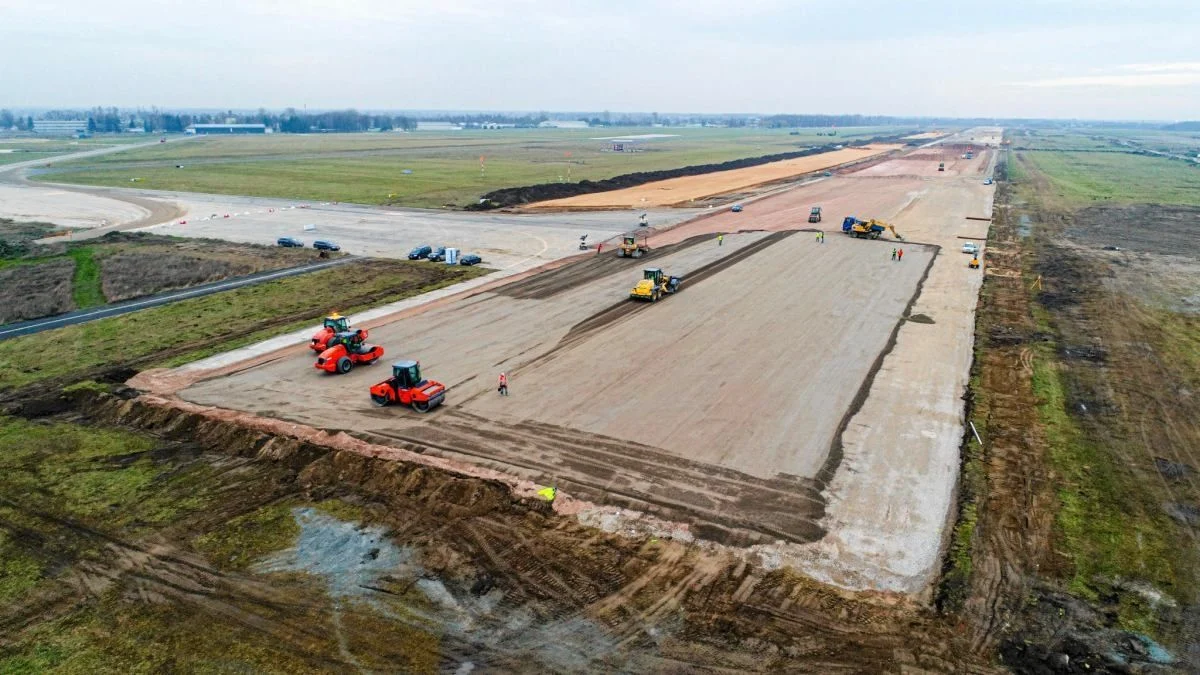
WARSAW — Poland’s grand vision to reshape the geopolitical and economic connectivity of Central and Eastern Europe has crossed a major operational threshold. A total of 26 international and domestic enterprises—spanning Poland, Spain, Turkey, and beyond—have officially submitted tenders for preparatory construction works at the flagship Centralny Port Komunikacyjny (CPK) Solidarity Transport Hub (STH).
The multi-billion-zloty project, designed to serve as a revolutionary mega-airport and integrated multimodal transit nexus, has attracted premier heavy-infrastructure and civil engineering firms. With an estimated contract value exceeding PLN 1.7 billion (approximately EUR 377 million), the tender marks a decisive transition from conceptual planning to concrete, on-the-ground execution.
Main Facts: The Scope of the Preparatory Works Tender
The open-market tendering procedure was launched by STH to select an elite roster of eight companies or corporate consortia. These chosen entities will enter into flexible framework agreements, allowing the project developer to assign individual tasks through streamlined, simplified executory procedures as the mega-investment accelerates.
The response from the global construction market has been robust. STH confirmed that a total of 19 distinct bids were submitted:
- 6 Consortia: Comprising a collaborative pooling of resources from 13 distinct corporate entities.
- 13 Independent Companies: Major enterprises acting as standalone bidders.
The participant pool features some of Poland’s largest domestic construction titans alongside internationally recognized heavyweights from Europe and Asia with proven track records in executing complex, mega-scale civil infrastructure projects. A comprehensive registry of all bidding entities has been made publicly available on the STH SmartPZP Platform.
What Does the Contract Entail?
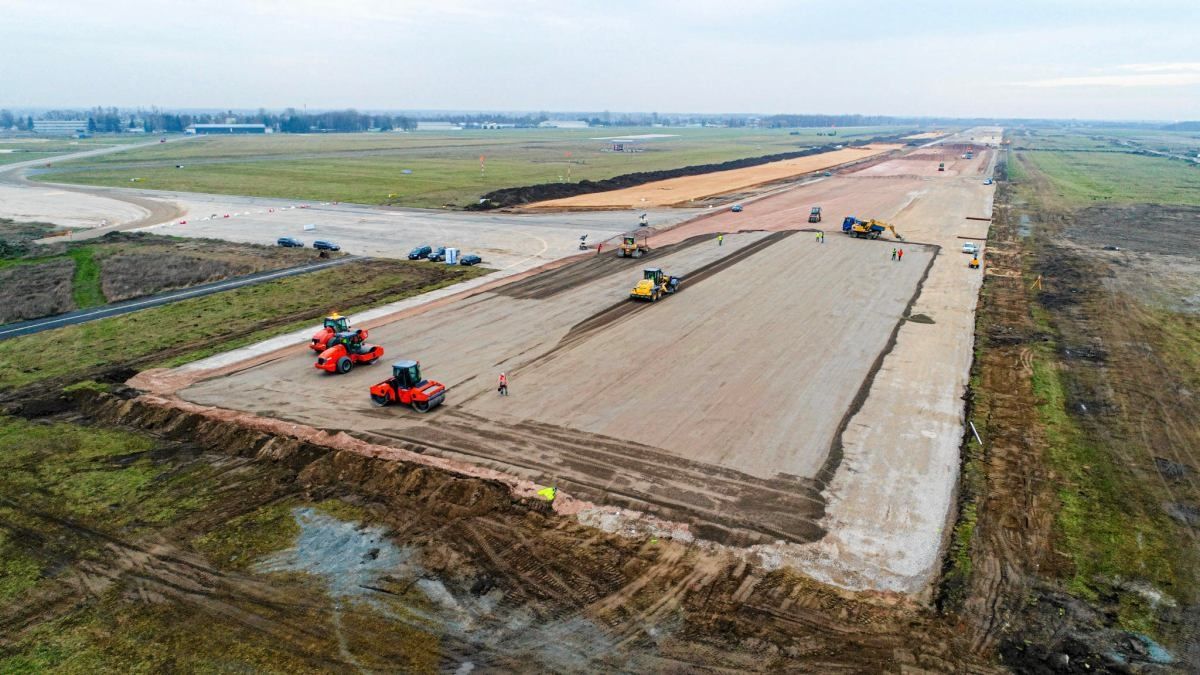
The massive PLN 1.7 billion package covers vital preparatory and enabling works required before vertical construction of the main terminal can begin. The scope includes:
- Comprehensive ground levelling and comprehensive construction site development.
- The erection of temporary site facilities and administrative infrastructure.
- Large-scale structural demolitions within the designated footprint.
- Installation of crucial connections to regional civil engineering infrastructure networks to support ongoing construction needs.
- General preparatory modifications and terrain conditioning that do not strictly require prior issuance of complex building permits.
Furthermore, victorious contractors will be tasked with submitting official construction work notifications, executing high-precision geodetic and surveying operations, drafting comprehensive as-built documentation, and engineering detailed design specs and technical execution standards.
Chronology: Milestones in the Evolution of the CPK Project
The Solidarity Transport Hub is not a sudden policy shift but the culmination of years of strategic geographic planning, legislative frameworks, and targeted land acquisition. Understanding its timeline contextualizes the weight of the current tender.
- December 2021: STH officially announced the preferred geographical location for the mega-airport. The site encompasses approximately 41 square kilometers spread strategically across three distinct Masovian communes: Baranów, Teresin, and Wiskitki.
- October 2021: Demonstrating the multimodal nature of the initiative, STH launched what is widely considered Europe’s largest design tender, a massive procurement procedure earmarked for railway network expansion valued at over PLN 7 billion (EUR 1.55 billion).
- January 2022: A high-stakes tender procedure was initiated to secure a contract engineer—an independent entity tasked with acting on behalf of STH to oversee and audit individual milestones across the entire sprawling railway construction program, valued at PLN 2.5 billion (EUR 554.5 million).
- Current Phase (2023 Onward): STH leadership projects that physical preparatory works on the airport grounds will break ground, running concurrently with the early mobilization of main construction works. This overlapping strategy is deliberately calculated to compress delivery timelines and maintain relentless momentum.
Supporting Data: Infrastructure, Scale, and Financials
The CPK project is underpinned by astronomical figures and exhaustive technical parameters, positioning it as one of the most ambitious greenfield transport projects currently underway globally.
Airport Infrastructure and Airside Specs
In its initial operational phase, the Solidarity Transport Hub will feature two parallel instrument runways, each engineered to an impressive length of 4,000 meters, capable of accommodating the world’s largest commercial aircraft under diverse meteorological conditions.
Currently, the aviation component is moving through advanced environmental impact assessments, detailed terrain and geotechnical studies, the formulation of the master project Master Plan, and the systematic acquisition of necessary real estate parcels from private and municipal landowners.
Rail Component and Corridors
The transport hub is fundamentally designed around the "hub-and-spoke" rail model, ensuring that the aviation terminal is deeply integrated with Poland’s national rail grid.
- Feasibility Studies: Comprehensive planning is underway for roughly 1,300 kilometers of brand-new high-speed rail lines.
- Flagship Routes: Key segments include the Warsaw–STH–Łódź–Wrocław–Czech border mainline.
- Urban Tunnelling: Advanced engineering is progressing on the building permit design for a complex long-distance subterranean rail tunnel passing directly through the city of Łódź, directly supporting the hub’s overarching logistics capability.
Financial Overview Table
| Project Component / Tender Category | Estimated Value (PLN) | Estimated Value (EUR) | Status / Milestone |
|---|---|---|---|
| Airport Preparatory Works Framework | > PLN 1.7 Billion | ~ EUR 377 Million | 26 global companies/consortia tendered |
| Railway Investment Design Package | > PLN 7.0 Billion | ~ EUR 1.55 Billion | Launched in October 2021 |
| Railway Program Contract Engineering | PLN 2.5 Billion | ~ EUR 554.5 Million | Tender launched in early 2022 |
| Total Core Initial Framework Scope | > PLN 11.2 Billion | ~ EUR 2.48 Billion | Active Implementation Phase |
Official Responses and Stakeholder Perspectives
The enthusiastic response from the international engineering market has validated the procurement strategies adopted by the Polish government and STH executives.
Mikołaj Wild, Chief Executive Officer of STH, expressed immense satisfaction regarding the volume and caliber of market participation:
"The market has responded positively to our concept of working with contractors under framework agreements," Wild stated.
Highlighting the rigorous evaluation methodology embedded in the procurement process, Wild added:
"As with other framework agreements, in the first stage of the procedure, after checking the formal criteria, we will mainly take into account the experience, financial and economic capacity, and resources of the tenderers. However, the price and delivery time will play an important role in the executory contract procurement procedures."
Industry analysts point out that utilizing framework agreements minimizes bureaucratic friction. By pre-qualifying elite construction entities now, STH can bypass lengthy individual bidding cycles for subsequent phases of the groundworks, protecting the massive capital outlay from inflationary delays and bureaucratic stagnation.
Implications: Economic Transformation and Geopolitical Significance
The implications of constructing the CPK Solidarity Transport Hub extend far beyond civil engineering marvels; they touch upon European supply chain resilience, national security, economic decentralization, and the future of European passenger mobility.
1. Catalyzing Economic Growth and Employment
The mobilization of PLN 1.7 billion in initial preparatory works will trigger a massive wave of localized and regional economic activity. Equipment suppliers, sub-contractors, logistics providers, and hospitality services across the Masovian Voivodeship and surrounding regions are preparing for an influx of capital and labor demand. Once operational, the hub is projected to generate tens of thousands of direct and indirect jobs, transforming central Poland into a premier European logistics and aviation powerhouse.
2. Bridging East-West and North-South Divides
By weaving together 1,300 kilometers of high-speed rail with a state-of-the-art international airport, Poland is actively addressing historical transport deficits. The rail corridors—especially the connection toward the Czech border and the integration with the Łódź urban tunnel—will drastically cut travel times between major Polish urban centers and seamlessly link them to the wider Trans-European Transport Network (TEN-T).
3. Redefining Central European Aviation
Currently, many travelers in Central and Eastern Europe rely heavily on congested Western European mega-hubs like Frankfurt, Paris-Charles de Gaulle, or Amsterdam Schiphol for long-haul international transit. The CPK is strategically positioned to capture a significant share of this traffic, offering a modern, efficient, and technologically advanced alternative designed from scratch to handle post-pandemic passenger flows, cargo demands, and sustainable aviation requirements.
Looking Ahead
With the evaluation of the 26 global bidders now underway, STH is poised to announce the selected framework partners. As heavy machinery prepares to move onto the 41-square-kilometer site spanning Baranów, Teresin, and Wiskitki, Poland inches ever closer to realizing a transport infrastructure project that will define the nation’s economic landscape for generations to come.

