

By Editorial Staff
September 2026
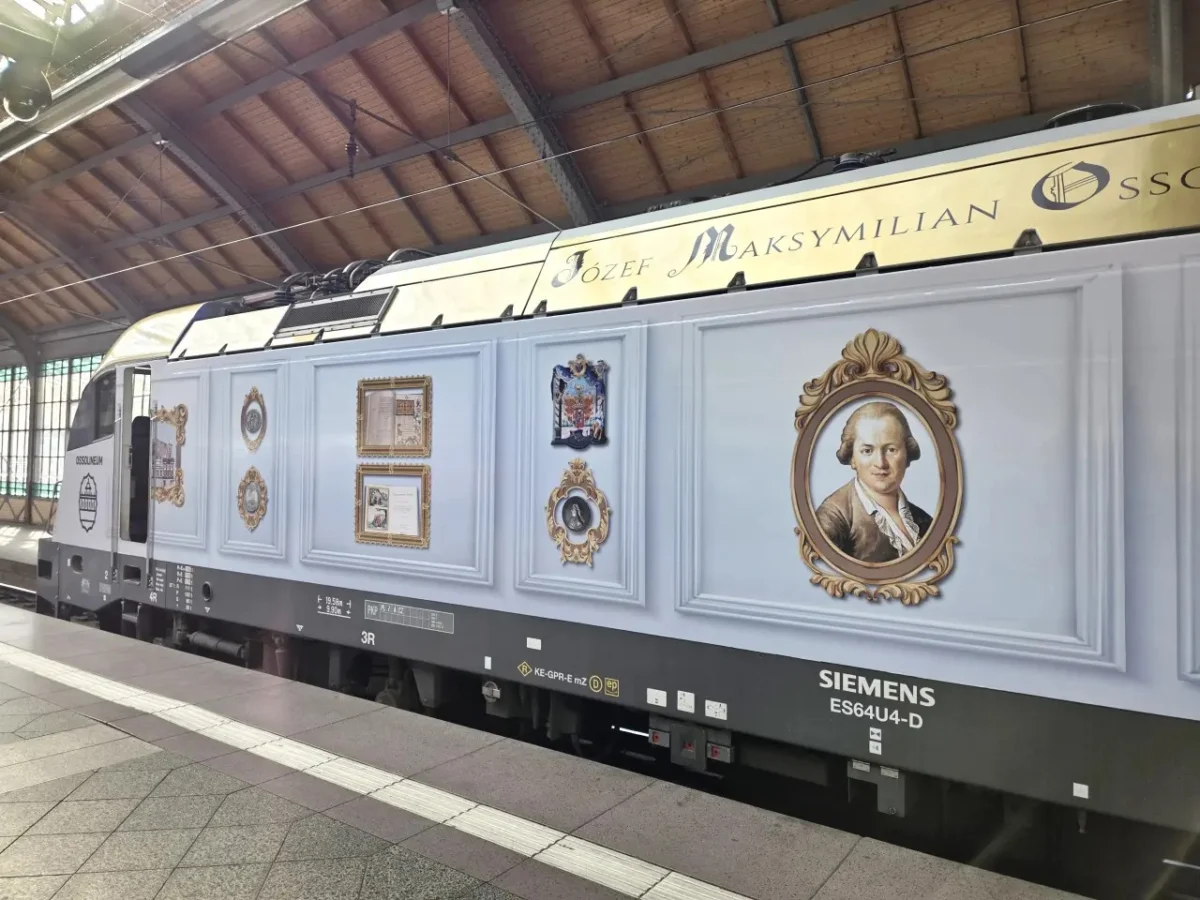
In a move that seamlessly blends modern European rail connectivity with the rich tapestry of Polish intellectual heritage, national rail operator PKP Intercity has officially rebranded its premier international service. Effective September 4, 2026, the train formerly known as the "Danubius"—which connects the Austrian capital of Vienna with the Polish hubs of Wrocław and Poznań—has been rechristened the "Ossoliński."
The renaming is far more than a mere marketing adjustment; it serves as a deliberate cultural homage to Józef Maksymilian Ossoliński, a monumental figure in European humanism and the founder of the Ossolineum, one of Poland’s most significant cultural institutions. As 2026 marks the bicentenary of Ossoliński’s death, the Polish Parliament has designated the year in his honor, making the train’s new moniker a rolling tribute to a man whose life was defined by the very route the train now traverses.
Main Facts: The Evolution of a Strategic Connection
The "Ossoliński" service operates daily, providing a vital artery between Central Europe’s historic imperial capital and two of Poland’s most dynamic economic and cultural centers. The route, which utilizes the train identifiers 47000 (302) for the southbound journey from Poznań to Vienna and 74000 (303) for the northbound return, serves a critical function in the integrated European transport network.
The rebranding effort reflects a broader strategy by PKP Intercity to infuse its international rail corridors with historical significance. By replacing the generic "Danubius" title—a reference to the Latin name for the Danube River—with "Ossoliński," the operator is anchoring the passenger experience in the shared history of Poland and Austria.
This service is part of an expansive portfolio of cross-border connections managed by PKP Intercity. Beyond the new Ossoliński route, the operator maintains a dense web of connections between major Polish cities—including Warsaw, Kraków, and Katowice—and the Austrian capital. The current route of the Ossoliński also provides essential connectivity to regional centers such as Opole, Racibórz, Kędzierzyn-Koźle, Leszno, and Oświęcim, ensuring that the legacy of Ossoliński reaches beyond major metropolises to the heart of the Silesian and Greater Poland regions.
Chronology: A Life Spent Bridging Cultures
To understand the weight of this tribute, one must look to the biography of Józef Maksymilian Ossoliński (1748–1826). His life was a testament to the synthesis of Enlightenment ideals and Polish patriotism.
- 1790: Ossoliński settles in Vienna, beginning a transformative period in his life where he would become a central figure in the Austrian capital’s academic and social life.
- 1808–1826: He serves as the Prefect of the Imperial Court Library in Vienna. During these 25 years, he manages one of the most important book collections in the world, while simultaneously curating his own massive private collection of Polish manuscripts and historical documents.
- 1817: Ossoliński achieves his life’s work by securing the approval of Emperor Francis I for the establishment of the Ossoliński National Institute (the Ossolineum). Originally based in Lviv, the institute was designed to preserve the Polish cultural heritage in the face of political fragmentation.
- 1826: Józef Maksymilian Ossoliński passes away in Vienna. His death marks the end of a pivotal era for Polish intellectuals in the Austrian Empire.
- 1945–1947: Following the geopolitical shifts after World War II, the vast collections of the Ossolineum are relocated from Lviv to Wrocław, where they find a permanent home in the former monastery of the Knights of the Cross with the Red Star.
- 2026: The Polish Parliament declares 2026 the "Year of Józef Maksymilian Ossoliński." In alignment with this national commemoration, PKP Intercity renames the Danubius train to the "Ossoliński."
Supporting Data: The Ossolineum’s Enduring Legacy
The decision to name a train after Ossoliński is rooted in the physical and intellectual migration of his life’s work. The Ossolineum, now located in Wrocław, is not merely a library; it is a repository of national memory. Following its post-war relocation, the institution became the bedrock of Wrocław’s identity as a city of culture and education.
Today, the Ossolineum houses hundreds of thousands of items, including priceless medieval manuscripts, maps, engravings, and photographs that document the history of the Polish Commonwealth and its neighbors. The "Ossoliński" train route, by linking Vienna—where the founder lived—with Wrocław—where his legacy is now curated—creates a symbolic "rail corridor of history."

The operational data for the route highlights its importance. Thousands of passengers utilize the Vienna–Wrocław–Poznań line annually, ranging from business travelers commuting between European hubs to tourists exploring the shared architectural and social heritage of the former Austro-Hungarian influence in Poland. By branding this route, PKP Intercity ensures that international travelers are reminded of the intellectual ties that have bound these regions together for centuries.
Official Responses: Commemoration and Modernity
Janusz Malinowski, Chairman of PKP Intercity, emphasized the dual mission of the national carrier during the official announcement of the name change. "Our goal is not just to provide the most comfortable and efficient connections between European cities," Malinowski stated. "We have a responsibility to act as ambassadors of our culture. By naming this train the ‘Ossoliński,’ we are combining the necessity of international transit with a tribute to a man who, through his tireless work in the Imperial Court Library, forged an inseparable link between the Polish intelligentsia and the vibrant academic atmosphere of Vienna."
The move has been met with praise from historians and cultural institutions, including the current management of the Ossolineum. Experts note that for many Poles living in the 19th century, Vienna was a sanctuary for intellectual discourse, and Ossoliński’s residence was effectively a "Polish consulate of culture." The train now honors that history, transforming a transit time of several hours into a contemplative journey through the biography of one of the 19th century’s most dedicated preservationists.
Implications: The Role of Rail in National Identity
The rebranding of the "Ossoliński" raises broader questions about how modern corporations, especially state-owned transport operators, utilize public space to curate national identity. In an era of high-speed digital travel, the "slow" experience of train transit allows for a unique intersection of travel and education.
Economic and Cultural Synergies
The renaming is expected to have a subtle but positive impact on the promotion of regional tourism. By highlighting the name "Ossoliński," the rail operator encourages passengers to learn more about the destination cities. Passengers traveling from Vienna to Wrocław may be prompted to visit the Ossolineum, thereby increasing the cultural footfall in the city’s historic center.
Regional Integration
The route’s inclusion of towns like Oświęcim and Kędzierzyn-Koźle serves to remind travelers of the industrial and social development of the Silesian region, a territory that was historically tied to the Austrian and Prussian spheres. By anchoring the route in the legacy of an Enlightenment-era intellectual, PKP Intercity is effectively "softening" the perception of the industrial route, overlaying it with the prestige of a scholarly figure.
Sustainability and Heritage
Finally, the "Ossoliński" serves as a reminder that the rail network is a sustainable, long-term infrastructure project. Just as Ossoliński’s library has endured for over two centuries, the rail link aims to provide a permanent, consistent connection across borders. It sends a message of stability and historical continuity in a continent currently undergoing rapid geopolitical and environmental shifts.
Conclusion: A Journey Through Time
As the "Ossoliński" glides out of the station in Vienna and heads north toward the borders of Poland, it carries with it more than just passengers. It carries the weight of 200 years of intellectual exchange. The decision by PKP Intercity to honor Józef Maksymilian Ossoliński is a masterstroke of cultural diplomacy, proving that the infrastructure of the future can, and perhaps should, be grounded in the wisdom of the past.
For the modern traveler, the journey from Vienna to Poznań is no longer just a transit between two coordinates; it is a movement through a landscape shaped by the Enlightenment, the Napoleonic era, the industrial revolution, and the modern European Union. Whether a passenger is a history enthusiast or a business commuter, the "Ossoliński" offers a moment to reflect on the bridges built by those who came before us—bridges that, like the train itself, continue to connect Poland to the heart of Europe.

