

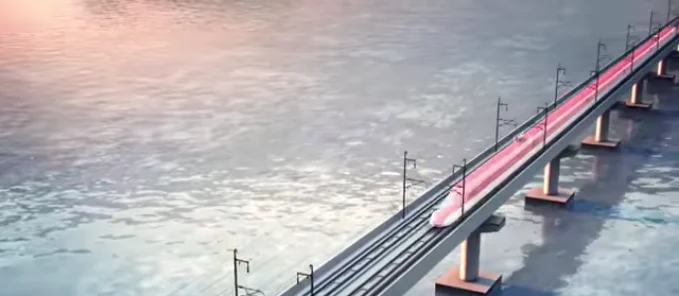
NEW DELHI, INDIA — Demonstrating remarkable resilience and a commitment to maintaining project momentum despite unprecedented global disruptions, the National High Speed Rail Corporation Limited (NHSRCL) recently hosted a series of comprehensive online pre-bid meetings. These vital consultations focused on the construction of 14 major bridges spanning the states of Gujarat and the Union Territory of Dadra and Nagar Haveli, forming a crucial component of the ambitious Mumbai–Ahmedabad High-Speed Rail (MAHSR) project.
As India’s premier infrastructure initiative designed to usher in the era of bullet train technology, the Mumbai–Ahmedabad corridor represents a massive leap forward for the nation’s transportation network. By leveraging digital platforms to engage with prospective domestic and international contractors, NHSRCL has signaled that the realization of India’s first high-speed rail corridor remains a top national priority, pushing forward unhindered by logistical hurdles.
Main Facts
The core objective of the recently concluded online pre-bid conferences was to address technical, financial, and logistical queries raised by potential bidders. By resolving these issues transparently before the final submission of bidding documents, NHSRCL aims to ensure competitive, high-quality, and seamless execution for three major infrastructure tenders tied to the MAHSR project.
The scope of these three critical tenders encompasses a massive engineering undertaking across western India:
- Tender Package 1: Involves the construction of bridges and associated civil works for the section spanning from Zaroli Village (located at the Maharashtra-Gujarat border) to Vadodara in the state of Gujarat, as well as portions within the Union Territory of Dadra and Nagar Haveli.
- Tender Package 2: Focuses on the construction of a new series of bridges and infrastructure along the alignment connecting Vadodara to Ahmedabad.
- Tender Package 3: Specifically targets the procurement, fabrication, rigorous check-assembly, protective painting at designated workshops, and safe transportation of steel truss superstructures to various bridge sites along the route.
When fully operational, the 508-kilometer high-speed rail corridor will bridge India’s financial capital, Mumbai, with Ahmedabad, the commercial hub of Gujarat. The journey will be served by 12 strategically positioned stations, linking the Bandra Kurla Complex (BKC) in Mumbai with the sprawling Sabarmati transport hub in Gujarat. Utilizing state-of-the-art Shinkansen-derived technology operating at speeds up to 320 km/h, the entire distance between the two metropolises will be traversed in a mere two hours.
Despite the operational challenges posed by nationwide lockdowns and health protocols, NHSRCL transitioned its administrative and technical workflows entirely online. From processing complex tenders to real-time progress monitoring, the corporation has ensured that project timelines are managed efficiently, safeguarding the integrity of India’s transport modernization agenda.
Chronology of the Mumbai–Ahmedabad High-Speed Rail Project
The journey toward India’s inaugural high-speed rail corridor has been systematically planned and executed over several years, marked by key milestones in land acquisition, design finalization, and major contract awards.
2017–2018: Foundation and Institutional Setup
- September 2017: The formal foundation stone for the Mumbai–Ahmedabad High-Speed Rail project was laid jointly by Indian Prime Minister Narendra Modi and Japanese Prime Minister Shinzo Abe in Ahmedabad, formally kickstarting the initiative.
- December 2017: The National High Speed Rail Corporation Limited (NHSRCL) accelerated field surveys, geotechnical investigations, and LiDAR aerial mapping of the 508-km alignment.
2019: Major Civil Engineering Tenders Emerge
- September 2019: NHSRCL launched a massive tender for the design and construction of civil and building works for a sprawling 237-kilometer section of the high-speed railway line. This comprehensive package included not only viaducts and bridges but also testing and commissioning protocols, maintenance depots, and multiple stations along the route.
- Throughout 2019: Environmental clearances, statutory approvals, and structural design finalizations progressed concurrently across Maharashtra and Gujarat.
Late 2020: Digital Adaptation and Terminal Developments
- November 2020: NHSRCL officially awarded the contract for the design and construction of the iconic Sabarmati HSR terminal in Ahmedabad. This multi-modal hub was planned to seamlessly integrate high-speed rail operations with the Ahmedabad Metro, the Bus Rapid Transit System (BRTS), and Indian Railways.
- Mid-to-Late 2020: Amidst global pandemic restrictions, NHSRCL successfully pivoted to virtual operations, hosting online pre-bid meetings—such as the recent sessions for the 14 bridges in Gujarat and Dadra and Nagar Haveli—to maintain contractor engagement and keep bidding timelines on track.
2021 and Beyond: Accelerated Construction Phase
- Ongoing Phase: Pier construction, casting yard development, and river-crossing bridge works have accelerated across Gujarat, with civil works making visible headway, laying the groundwork for track-laying and electrical system installations.
Supporting Data and Technical Specifications
The sheer scale of the Mumbai–Ahmedabad High-Speed Rail project is unprecedented in India’s railway history. Backed by extensive feasibility studies and passenger demand forecasting, the corridor is engineered to meet the highest global standards of safety, speed, and passenger comfort.
Route and Infrastructure Statistics
- Total Project Length: 508 kilometers.
- State-wise Distribution: Approximately 156 km in the State of Maharashtra, 4 km in the Union Territory of Dadra and Nagar Haveli, and 348 km in the State of Gujarat.
- Number of Stations: 12 stations, namely: Mumbai (Bandra Kurla Complex), Thane, Virar, Boisar, Vapi, Bilimora, Surat, Bharuch, Vadodara, Anand, Nadiad, and Ahmedabad (Sabarmati).
- Operational Speed: Design speed of 350 km/h, with a maximum operating speed of 320 km/h.
- Travel Times:
- Fast Train Service: Stops only at major hubs (Surat and Vadodara), completing the journey between Mumbai and Ahmedabad in just 1 hour and 58 minutes.
- Stopping Service: Stops at all 12 stations along the route, completing the journey in 2 hours and 57 minutes.
Engineering Marvels: Bridges and Tunnels
The corridor requires complex civil engineering interventions to traverse rivers, national highways, and urban landscapes:
- River Crossings: The high-speed rail line will cross 24 major rivers, including the Narmada, Tapi, Mahi, and Sabarmati.
- Mountainous and Urban Tunnels: A 21-kilometer-long tunnel will be constructed between Mumbai (BKC) and Shilphata. Notably, 7 kilometers of this tunnel will run as an undersea tunnel beneath the Thane Creek, a first for India.
- Viaducts: More than 92% of the total alignment (approx. 468 km) will be constructed on elevated viaducts to minimize land acquisition footprints and prevent trespassing hazards.
Ridership Projections and Economic Impact
According to comprehensive demand-forecast analyses conducted by NHSRCL, the MAHSR project will fundamentally transform regional mobility and commute patterns:
- Initial Ridership (Opening Year): Estimated at 17,900 passengers per day, per direction.
- Long-Term Projections (By 2053): Daily ridership is projected to surge exponentially to nearly 93,000 passengers per day, per direction, driven by regional economic integration, urbanization, and population growth.
- Fare Structure: Designed to be competitive with current domestic airfares and upper-class AC railway travel, ensuring accessibility for business travelers, tourists, and daily commuters alike.
Official Responses and Stakeholder Perspectives
The execution of a mega-infrastructure project of this magnitude requires seamless coordination between central government bodies, state administrations, international financial partners, and corporate contractors.

NHSRCL Leadership on Digital Resilience
Senior officials at NHSRCL emphasized that the successful transition to virtual pre-bid conferences highlights the organization’s adaptability. In official statements released during the bidding process, NHSRCL management noted:
"The continuity of infrastructure development is paramount. By conducting pre-bid meetings through secure digital platforms, we have ensured that prospective bidders face no informational bottlenecks. Our commitment to transparency, clarity, and timely execution remains uncompromised, even in challenging external environments."
International Collaboration: The Japan-India Partnership
The MAHSR project is heavily supported by the Government of Japan, both through financial assistance via soft loans from the Japan International Cooperation Agency (JICA) and through the transfer of advanced Shinkansen bullet train technology. Japanese engineering consultants and contractors have worked closely with Indian counterparts to ensure that safety standards, seismic retrofitting, and environmental management protocols meet world-class benchmarks.
Representatives from JICA have consistently praised the project’s steady progress, highlighting that the incorporation of Japanese technological expertise will not only revolutionize Indian rail transit but also foster deeper bilateral economic ties.
Contractor and Industry Reactions
Major construction conglomerates in India and abroad have responded positively to NHSRCL’s proactive digital outreach. Representatives from participating bidding firms noted that the online pre-bid sessions allowed technical teams to resolve intricate queries regarding steel truss fabrication tolerances, site access points, and monsoon-season construction protocols without needing physical travel. This efficiency has reduced administrative friction and instilled greater confidence among private-sector stakeholders.
Implications of the Mumbai–Ahmedabad High-Speed Rail Project
The completion and operationalization of the Mumbai–Ahmedabad High-Speed Rail corridor extend far beyond faster commute times; it represents a paradigm shift in India’s socio-economic, technological, and urban landscape.
1. Catalyst for Economic Growth and Regional Integration
By connecting India’s financial epicenter (Mumbai) with its burgeoning industrial and manufacturing heartland (Gujarat), the bullet train corridor will act as an economic multiplier. Business travelers will be able to complete round-trip meetings between Mumbai and Ahmedabad within a single working day, significantly boosting productivity, trade, and corporate investment. Furthermore, the intermediate cities—such as Surat, Vadodara, and Vapi—will experience accelerated real estate, commercial, and tourism development.
2. Technological Leap and Skill Development
The infusion of Shinkansen technology serves as a massive catalyst for indigenous capacity building. Indian engineers, technicians, and construction workers are receiving specialized training in high-precision surveying, precast concrete viaduct construction, advanced track-laying, and high-speed signaling systems (such as the Train Control System based on Digital Radio). This knowledge transfer will empower Indian industry to independently execute future high-speed rail corridors across the country.
3. Environmental Sustainability
Transport sector emissions are a major contributor to India’s carbon footprint. By shifting intercity travelers from carbon-intensive road transport and domestic aviation to an electric-powered high-speed railway, the MAHSR project will play a vital role in reducing greenhouse gas emissions. Rail transport is inherently more energy-efficient per passenger-kilometer, aligning with India’s international climate commitments and net-zero aspirations.
4. Urban Regeneration and Multi-Modal Integration
Projects like the Sabarmati HSR hub demonstrate a modern approach to urban planning in India. By integrating high-speed rail terminals with metro systems, bus rapid transit networks, and conventional railways, NHSRCL is pioneering seamless multi-modal transportation hubs. These developments reduce urban congestion, streamline pedestrian flows, and transform station precincts into vibrant commercial and cultural centers.
Conclusion
The successful holding of online pre-bid meetings for the 14 bridges in Gujarat and Dadra and Nagar Haveli underscores NHSRCL’s unwavering resolve to deliver the Mumbai–Ahmedabad High-Speed Rail project on schedule. As civil works gather momentum, viaducts rise across the western landscape, and technical milestones are steadily unlocked, India stands on the threshold of a transformative era in modern mass transit—one that promises unmatched speed, safety, economic vitality, and technological self-reliance.

