

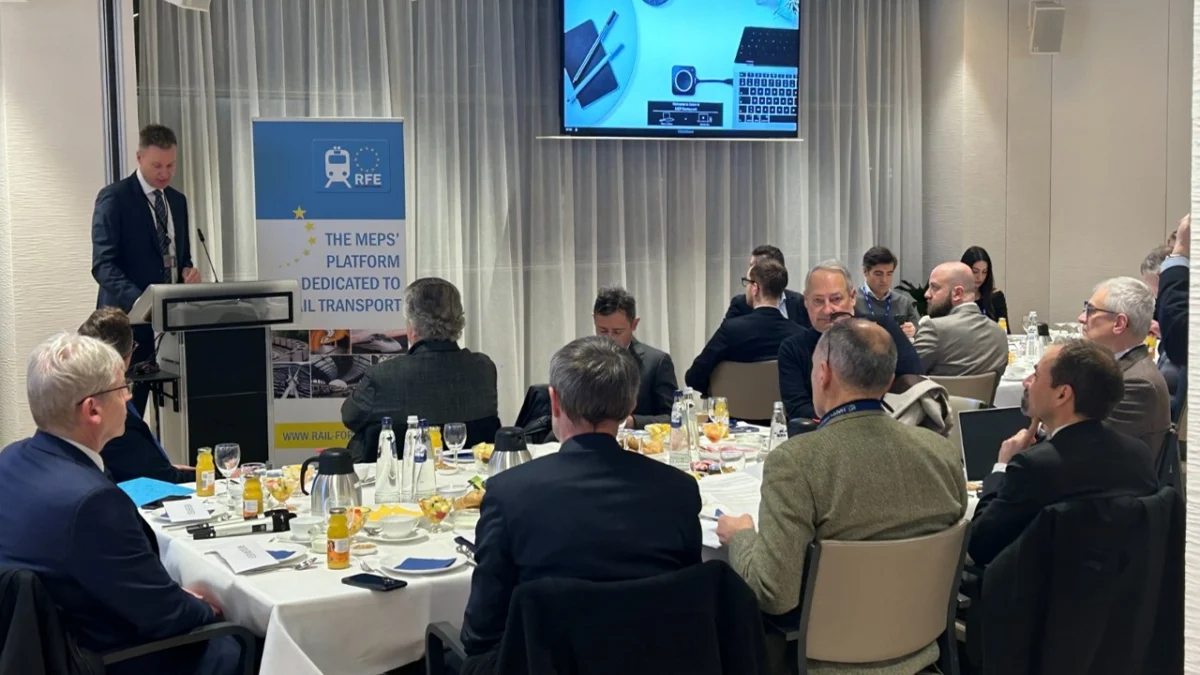
BRUSSELS — Europe stands at a critical juncture in the evolution of its transportation infrastructure. As global powers accelerate technological investments to capture market dominance, the European rail supply industry faces a decisive test of its generational advantage.
Speaking at a pivotal Rail Forum Europe event hosted at the European Parliament on January 27, UNIFE Director General Enno Wiebe issued a stark warning to EU policymakers. Without continued, robust public-private investment in a dedicated successor to the current "Europe’s Rail" Joint Undertaking, the bloc risks losing its world-leading status to heavily subsidized non-EU competitors.
The message from Brussels is clear: maintaining Europe’s technological edge, meeting ambitious climate mandates, and securing strategic autonomy cannot happen through market forces alone. It requires a synchronized, long-term commitment from both European institutions and private industry leaders.
1. Main Facts: The Stakes for Europe’s Rail Manufacturing Sector
At the core of the debate is the future of European competitiveness in high-tech manufacturing and sustainable mobility. For decades, European rail suppliers have set the global standard for safety, efficiency, and engineering excellence. However, this hard-fought leadership is increasingly vulnerable.
The Global Competition Challenge
Major global rivals—most notably China—are pouring vast state resources into domestic rail technologies. These non-EU competitors are rapidly closing the technological gap, leveraging aggressive state support to secure international contracts and achieve global market supremacy.
If EU policymakers fail to establish a robust research and innovation successor to the current Europe’s Rail program, the consequences for the European manufacturing base could be severe. A lack of targeted funding would not only cede technological leadership to foreign competitors but also threaten thousands of high-skilled jobs tied to the European rail supply chain.
The Proposed Financial Blueprint
To counter these threats and ensure Europe remains at the cutting edge, UNIFE has outlined a concrete, two-pronged financial framework for the upcoming EU budgetary cycles:
- €3 Billion from Horizon Europe / FP10: Dedicated funding channeled through the upcoming Framework Programme for Research & Innovation (covering the 2028–2034 period) to drive fundamental research and development.
- €15 Billion from the European Competitiveness Fund: Targeted investment dedicated to the pre-deployment and industrial scaling of key technologies developed under previous research initiatives.
According to industry leaders, this combined financial injection is the minimum requirement to bridge the "valley of death"—the treacherous gap between laboratory innovation and large-scale commercial deployment.
2. Chronology: The Evolution of EU Rail Research
European collaborative rail research has evolved significantly over the past two decades, transitioning from fragmented national projects to highly integrated, EU-wide public-private partnerships (PPPs). Understanding this trajectory illustrates why a successor program is the natural next step.
The Shift Toward Joint Undertakings
- Early Framework Programmes (2000s): Initial EU research efforts focused on interoperability and basic safety standards, laying the groundwork for a unified European Railway Area. However, projects remained largely fragmented across national boundaries.
- Shift2Rail (2014–2020): Marking a massive leap forward, Shift2Rail was the first European joint undertaking dedicated exclusively to rail research. It brought together infrastructure managers, operators, and suppliers to accelerate the integration of new technologies into the railway system, focusing on capacity, reliability, and cost reduction.
- Europe’s Rail Joint Undertaking (2021–Present): Building on the successes of Shift2Rail, the current program expanded its scope toward a systemic transformation of the rail network, embedding digitalization and automation deeply into its core objectives.
- The 2026 Threshold: With the current programming cycle maturing, industry associations and stakeholders are now lobbying intensively for the institutional framework that will succeed Europe’s Rail post-2027, ensuring uninterrupted momentum for ongoing research streams.
3. Supporting Data: Transformative Technologies Awaiting Deployment
The urgency behind UNIFE’s call for a successor program is not based on abstract theory, but on tangible technological breakthroughs achieved over the past decade. Two flagship innovations—developed through previous EU research frameworks—stand ready to revolutionize the European transport network, provided deployment funding is secured.
FRMCS: The Digital Backbone of Signaling
The Future Railway Mobile Communication System (FRMCS) is the indispensable centerpiece of Europe’s upcoming, continent-wide migration from legacy 2G (GSM-R) analog technology to advanced, radio-based digital communication.
- Interoperability: FRMCS will enable seamless cross-border train operations, eliminating the friction points that currently plague international rail travel.
- Capacity and Safety: By facilitating real-time, high-capacity data transmission between trains and control centers, FRMCS allows for closer train spacing (dynamic headways), significantly increasing network capacity without the need to lay new physical tracks.
DAC: Revolutionizing Rail Freight
While passenger rail often captures public imagination, the Digital Automatic Coupling (DAC) system represents a monumental leap forward for the European freight sector.
- Efficiency Gains: Traditional freight coupling relies on manual, labor-intensive, and time-consuming mechanical processes dating back over a century. DAC automates the physical and digital connection of freight cars instantly.
- Modal Shift: By drastically reducing terminal turnaround times and increasing operational efficiency, DAC empowers rail freight to effectively compete against emissions-heavy road transport (trucks) and aviation. This directly supports the European Green Deal’s goal of shifting a substantial portion of freight traffic onto sustainable rail corridors.
4. Official Responses and Industry Perspectives
The campaign for a dedicated successor to Europe’s Rail has galvanized a broad coalition of European railway associations, manufacturers, and institutional stakeholders.
UNIFE and Industry Leadership
During his address at the European Parliament, UNIFE Director General Enno Wiebe emphasized that public-private partnerships represent the absolute pinnacle of European policymaking efficacy.
"Investing in Europe’s Rail successor means the European rail supply industry can compete with the EU’s global rivals, who are focusing and investing in tech to pull ahead and achieve market supremacy," Enno Wiebe stated.
"This is what Europe does best – policymakers working with private industry to ensure tech development that achieves strategic EU goals like growth, decarbonisation, and strategic autonomy."
Industry stakeholders echo this sentiment, pointing out that rail manufacturing is a high-value, capital-intensive sector where individual companies cannot shoulder the entire burden of long-term R&D without institutional backing, especially when competing against foreign entities fueled by state treasuries.
Parliamentary Reception
Members of the European Parliament from across political groups have increasingly recognized that transportation policy is inextricably linked to geopolitical security. Discussions at Rail Forum Europe highlighted growing consensus that technological dependency on non-EU suppliers in critical infrastructure sectors—such as telecommunications, energy, and transport—poses an unacceptable long-term vulnerability.
5. Implications: Strategic Autonomy, Decarbonization, and Economic Growth
The decisions made by EU budget negotiators and the European Commission over the coming months will reverberate across the continent for decades. The stakes can be categorized into three strategic pillars:
1. Achieving Strategic Autonomy
In an era marked by shifting geopolitical alliances and supply chain vulnerabilities, Europe must secure its industrial independence. Relying on foreign technology for critical transport infrastructure compromises the bloc’s sovereignty. By fostering a thriving domestic rail supply industry through targeted innovation programs, Europe ensures it controls the intellectual property, manufacturing capabilities, and maintenance networks that keep its society moving.
2. Accelerating Decarbonization
Rail is inherently the most sustainable mode of mass mechanized transport. However, to absorb the massive influx of passengers and freight required to meet the European Union’s binding climate neutrality targets by 2050, the existing rail network must become dramatically more efficient. Deploying innovations like FRMCS and DAC is not optional—it is a mathematical necessity if rail is to absorb the capacity previously carried by high-emission transport modes.
3. Economic Growth and High-Value Employment
The European rail supply chain supports hundreds of thousands of direct and indirect jobs, spanning advanced engineering, software development, metallurgy, and heavy manufacturing. Maintaining a generation-ahead advantage ensures that these high-value, well-remunerated jobs remain anchored within the European Union, driving regional economic resilience and fostering local innovation ecosystems.
Conclusion
The trajectory of European rail is at a definitive crossroads. The technological foundations laid by programs such as Shift2Rail and Europe’s Rail have proven that European ingenuity, when pooled effectively through public-private cooperation, can deliver world-class solutions.
However, technology does not stand still, and neither do global competitors. As Enno Wiebe and UNIFE have forcefully reminded policymakers in Brussels, failing to invest in a robust successor program to Europe’s Rail risks squandering a generational advantage. To secure Europe’s economic competitiveness, protect its environment, and safeguard its strategic autonomy, EU policymakers must commit the necessary financial and political capital to keep Europe’s trains—and its manufacturing industry—riding at the front of the global pack.

