


In the high-stakes world of global technology, workforce data serves as the ultimate leading indicator. While financial analysts pore over quarterly earnings reports and balance sheets, seasoned corporate leaders look elsewhere to gauge the true direction of the semiconductor industry: the job boards. Hiring patterns act as a real-time pulse check, revealing where companies are betting their capital long before those investments manifest as market share or revenue growth.
As of April 2026, the global semiconductor sector is undergoing a period of recalibration. Following a robust surge in the first quarter of the year, hiring momentum has cooled, presenting a complex narrative for stakeholders. By analyzing the latest job posting data from GlobalData, we can dissect the shifting priorities in themes, geographies, and skill sets that are currently defining the competitive landscape.
The Cooling Trend: Contextualizing April 2026 Hiring
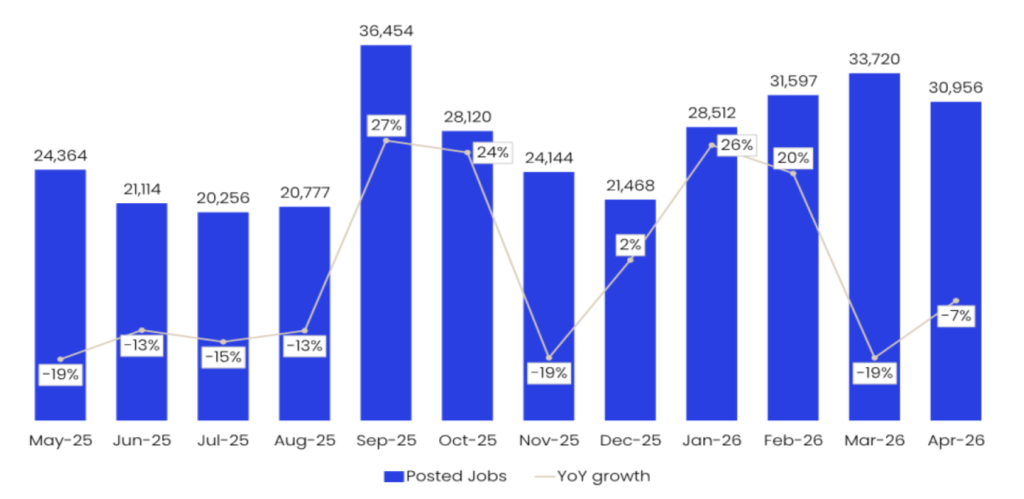
The semiconductor industry is defined by cyclical volatility, and the latest data from April 2026 underscores this reality. Total job postings for the sector fell by 6.58% month-on-month, settling at 30,956. This decline marks the second consecutive monthly contraction following an aggressive acceleration observed between January and February.

A Chronology of Recent Volatility
- Q3 2025 (September): An initial step-up in hiring signals, reflecting the industry’s push to meet demand for next-generation AI hardware.
- Q4 2025 (December): A baseline trough, representing a period of caution and inventory adjustment across the supply chain.
- Q1 2026 (January–February): A sharp, industry-wide hiring surge, driven by optimism regarding the AI-integrated device cycle.
- Q2 2026 (March–April): A period of retrenchment and cooling, as firms reassess their aggressive headcount expansion plans in light of broader macroeconomic pressures.
Despite the recent dip, it is crucial to note that April’s posting levels remain significantly above the lows recorded in late 2025. This suggests that while the sector has moved past the frenetic pace of early 2026, it has not retreated to a state of stagnation. Rather, it represents a "cooling" phase—a strategic pause where companies are likely optimizing their existing teams and refining their talent acquisition focus.
AI and Cloud: The Bedrock of Modern Demand
The thematic distribution of current job postings provides a clear window into the technological priorities of the world’s largest semiconductor manufacturers. The data suggests that hardware is no longer just about silicon; it is about the software-adjacent ecosystem that gives that silicon purpose.
The Dominant Themes
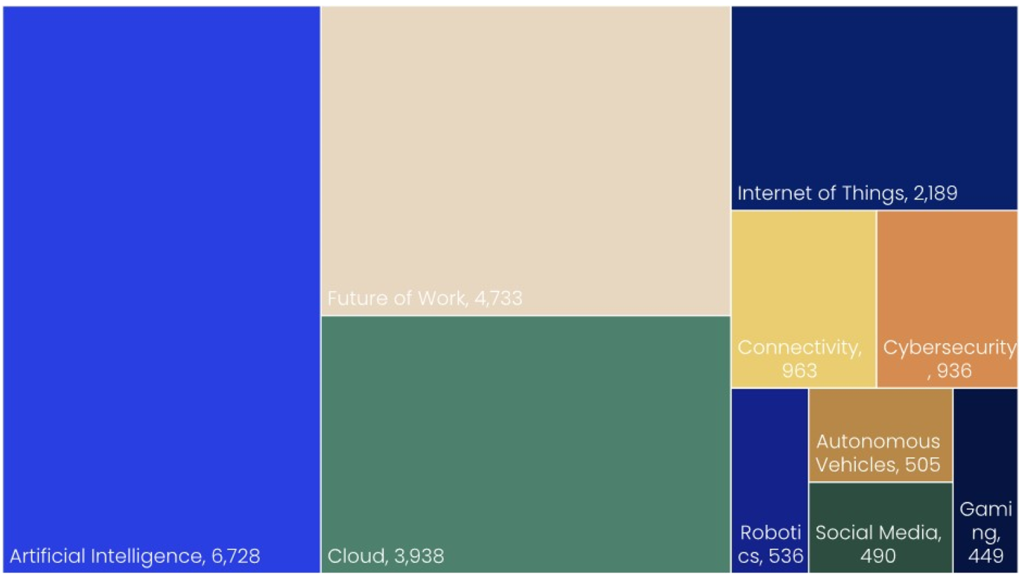
- Artificial Intelligence (6,728 postings): AI remains the undisputed king of industry investment. Companies are aggressively seeking talent to build specialized chips capable of handling massive neural network workloads, moving from general-purpose hardware to application-specific integrated circuits (ASICs).
- Future of Work (4,733 postings): This theme highlights the internal digital transformation occurring within semiconductor firms. As companies transition to more flexible, data-driven manufacturing processes, the need for expertise in digitizing the workplace is paramount.
- Cloud Computing (3,938 postings): The synergy between semiconductor design and cloud infrastructure is tightening. As cloud service providers (CSPs) design their own silicon, the traditional semiconductor firms are responding by hiring engineers who understand cloud-native architectures.
Secondary themes, including the Internet of Things (IoT) and advanced connectivity, occupy a smaller but stable portion of the hiring mix. The "long tail"—comprising sectors like robotics, autonomous vehicles, and gaming—remains limited, suggesting that while these sectors are important, they are not currently the primary drivers of massive-scale hiring.

Geographic Shifts: Stability vs. Emerging Markets
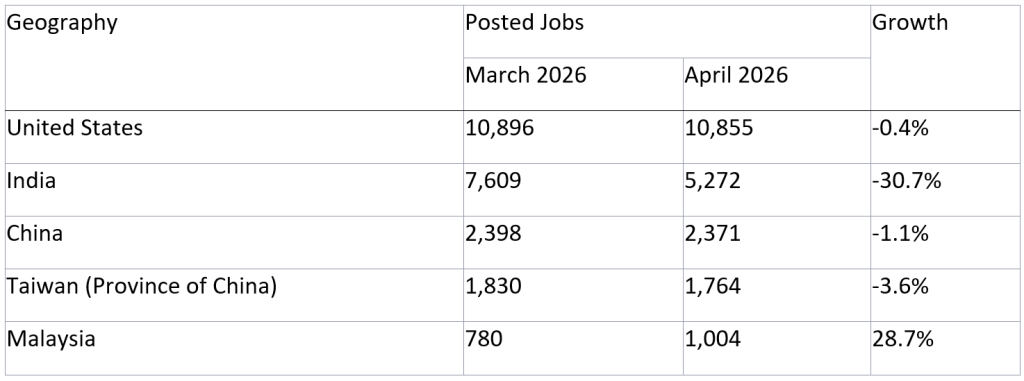
The geographic distribution of semiconductor hiring provides insight into the supply chain’s ongoing diversification. The US remains the dominant global hub for semiconductor employment, maintaining near-total stability in its hiring levels, with a negligible month-on-month change of -0.4%.
However, the international landscape reveals significant shifts:
- India’s Contraction: India recorded the most dramatic decline among major hubs, with a 30.7% drop in postings. This correction may reflect a rationalization of the rapid, possibly unsustainable, expansion seen in previous months.
- The Rise of Malaysia: In a notable departure from the broader trend, Malaysia saw a 28.7% surge in hiring, climbing to 1,004 postings. This highlights Malaysia’s growing importance as a critical link in the back-end assembly, testing, and packaging (ATP) process of the semiconductor supply chain.
- East Asian Hubs: China (-1.1%) and Taiwan (-3.6%) both experienced mild cooling, aligning with the global trend of a managed slowdown rather than a sudden exit.
For leaders, these numbers confirm a trend of "de-risking." While the US maintains its position as the center of innovation and high-level design, countries like Malaysia are increasingly attracting operational and technical investment as firms seek to optimize their global footprints.
Corporate Strategies: The Battle of the Giants
A look at individual employer performance reveals that even the largest industry players are navigating this cooling period differently.
IBM continues to lead the sector in total volume, though its hiring activity has moderated significantly since its peak in February. Meanwhile, companies like Hitachi are exhibiting remarkable stability, maintaining a steady pace of recruitment that suggests a long-term, calculated growth strategy rather than a reactive one.
A particularly interesting development is the emergence of Infineon, which entered the top-tier list in April after recording zero postings in the preceding months. Such sharp, sudden shifts in hiring patterns often indicate a specific, large-scale project win or a strategic pivot that requires a sudden influx of specialized human capital. Conversely, companies like Applied Materials have seen a moderate decline, which may reflect the completion of key hiring cycles for current product development lifecycles.
Technical Skills: What Does the Industry Need?
The "skills-in-demand" metric is perhaps the most granular indicator of where the industry is heading. The current demand is heavily skewed toward platform-level engineering.
- Application Platforms and Containers (4,960 postings): This indicates that semiconductor firms are increasingly prioritizing software-defined silicon. The ability to integrate chips into containerized environments is no longer a "nice-to-have"—it is a core requirement.
- Systems Design and Integration (3,637 postings): As chips become more complex, the skill set required to ensure they function within broader systems (servers, edge devices, and networking equipment) is in high demand.
- Operating Systems (3,408 postings): The focus here remains on the foundational software that bridges the gap between hardware and user applications.
These technical priorities suggest that the semiconductor industry is evolving into a more "software-aware" sector. Engineers who understand how hardware interacts with operating systems and cloud-native platforms are currently the most valuable commodity on the job market.
Strategic Implications: The Leader’s Advantage
For the executive or investor, the lesson from the April 2026 data is clear: hiring data is a forward-looking barometer that operates on a one-to-three-month lead time compared to financial performance.
How to Leverage This Data
- Spotting Competitor Moves: If a competitor suddenly stops hiring in a specific region, they may be planning an exit or a significant restructuring of their manufacturing footprint.
- Identifying Market Gaps: A rise in postings for a specific skill (e.g., containerization) across multiple competitors indicates a shift in the standard tech stack, signaling an opportunity for firms to move early in training or acquiring that talent.
- Managing Risk: High volatility in regional hiring, as seen in the contraction in India, can act as a warning of potential operational disruptions or regulatory hurdles that have yet to hit the front pages.
Conclusion: From Data to Decision
The cooling trend observed in April 2026 is not a cause for alarm, but rather a necessary recalibration. The semiconductor industry remains in a state of high-intensity competition, with resources flowing aggressively toward AI, cloud integration, and systems design.
For leaders tasked with making high-stakes investment decisions, relying on lagging financial indicators is no longer sufficient. By integrating real-time hiring analytics into their strategic planning, firms can move from a reactive posture to a proactive one. In an industry where technological superiority can be gained or lost in a single development cycle, those who can read the signals in the labor market today will be the ones who define the market of tomorrow.
For those looking to gain a deeper, more granular understanding of these trends, GlobalData Jobs Analytics provides point-in-time, actionable intelligence directly from corporate career portals, enabling leaders to turn complex hiring patterns into a sustainable competitive advantage.

