

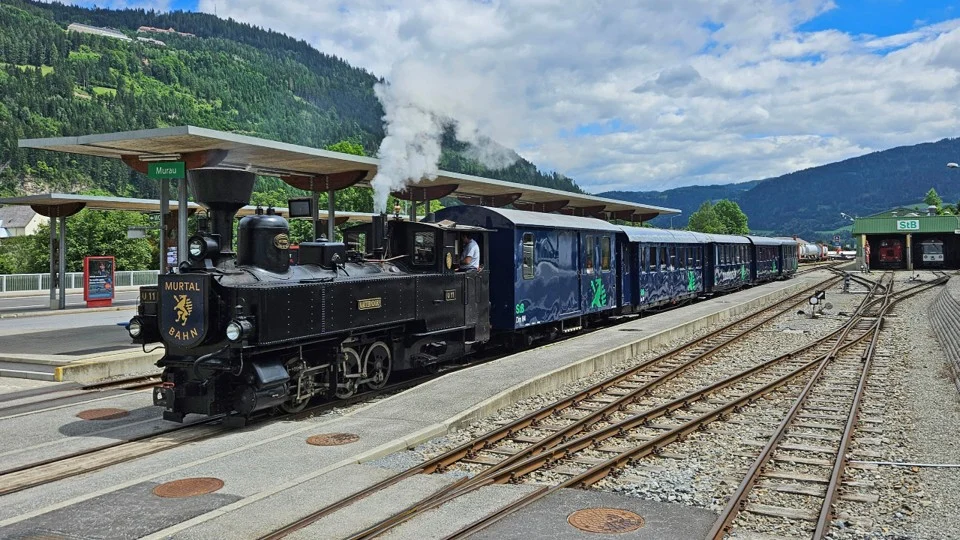
GRAZ, AUSTRIA — In a landmark decision for regional public transportation and sustainable mobility, the government of the Austrian state of Styria has officially resolved to modernize and electrify the Murtalbahn, a picturesque and historically significant narrow-gauge railway. Winding through the scenic valleys of Austria, the route—operating on a unique 760 mm (2 ft 5 15⁄16 in) Bosnian gauge—runs between the towns of Unzmarkt and Tamsweg.
This ambitious multi-million-euro infrastructure and rolling stock overhaul is designed to future-proof the regional rail link, drastically reduce travel times, and align the historic line with modern environmental and climate goals. However, the realization of this grand vision hinges on complex multi-jurisdictional funding negotiations, requiring substantial financial backing from the Austrian federal government and the neighboring state of Salzburg.
Main Facts
The modernization initiative represents a holistic transformation of the Murtalbahn, touching every aspect of its operations from track infrastructure to rolling stock and depot facilities.
At the heart of the project is the complete electrification of the route, which currently relies on diesel-powered operations. Transitioning to electric traction will eliminate direct carbon emissions along the corridor, contributing significantly to Austria’s broader climate targets.
To support the newly electrified line, the state of Styria plans to procure five modern Electric Multiple Units (EMUs). Because the 760 mm track gauge is exceptionally rare in modern European rail transport, acquiring custom rolling stock independently poses a severe financial and logistical challenge. To overcome this market barrier, Styria has joined forces with the operators of two other prominent 760 mm lines in Austria: the Zillertalbahn and the Pinzgauer Lokalbahn. Together, this inter-state working group has orchestrated a joint procurement strategy for a total of 17 EMUs. This collaborative approach creates a viable commercial market, significantly lowers the per-unit manufacturing cost, and lays the groundwork for future cross-network operational synergies.
Beyond rolling stock and overhead line installation, the comprehensive modernization program encompasses:
- Infrastructure Adaptation: Upgrading the railway alignment, safety systems, and signaling to handle modern electric operations safely.
- Depot and Workshop Overhauls: Modernizing maintenance facilities in Murau and other key locations to service and repair the new EMU fleet.
- Travel Time Reductions: Implementing route improvements designed to slash travel times dramatically. Most notably, the journey between Unzmarkt and Murau will be compressed from 36 minutes down to just 24 minutes, offering a highly competitive alternative to private road transport.
The total financial commitment required from the state of Styria alone amounts to EUR 169 million. This figure covers Styria’s share of both the infrastructure adaptations and the rolling stock procurement. However, state approval and the ultimate execution of the project are strictly contingent upon matching co-financing commitments from the Austrian federal government and the state of Salzburg, adhering to established national public transport funding frameworks.
Chronology
The path toward the electrification and modernization of the Murtalbahn is the result of years of strategic planning, technological assessment, and inter-regional coordination.
- Early Operations and Technical Lifespan Planning: For decades, the Murtalbahn—operated by Steiermarkbahn und Bus GmbH (StB)—has served as a vital economic and social lifeline connecting Unzmarkt, Murau, Predlitz, and Tamsweg. Despite comprehensive and ongoing rolling stock renovations by engineers, transport authorities projected that the existing legacy fleet would inevitably reach the absolute limit of its technical service life by the mid-2030s. This sobering timeline forced transport planners to evaluate long-term alternatives well in advance.
- The 760 mm Gauge Crisis: As planning progressed, operators realized that purchasing a small batch of five custom narrow-gauge railcars exclusively for the Murtalbahn was economically unfeasible. The global and European rail manufacturing market does not mass-produce 760 mm electric rolling stock, making bespoke manufacturing prohibitively expensive.
- Formation of the Inter-State Working Group: Recognizing shared vulnerabilities, operators of Austria’s three remaining major 760 mm narrow-gauge systems—the Murtalbahn, the Zillertalbahn, and the Pinzgauer Lokalbahn—formed a strategic alliance. By pooling their requirements, the coalition united to draft a joint procurement initiative for 17 EMUs.
- Current Phase: The working group is currently in the advanced stages of finalizing the comprehensive tender documentation for the 17-unit EMU procurement. Concurrently, regional political bodies have begun formalizing funding proposals.
- The 2030 Horizon: The existing ten-year public transport service contract between the state of Styria and Steiermarkbahn und Bus GmbH remains valid through 2030. Planners intend for the infrastructure upgrades, electrification, and new EMU deployments to align seamlessly with the future generations of this operating contract.
Supporting Data
To fully understand the scope of the Murtalbahn overhaul, it is helpful to examine the technical parameters, operational statistics, and financial architecture underpinning the project:
Geographical and Technical Parameters
- Route Corridors: Unzmarkt to Tamsweg, passing through key regional hubs such as Murau and Predlitz.
- Track Gauge: 760 mm (Bosnian gauge), a historical standard inherited from the Austro-Hungarian Empire’s extensive narrow-gauge military and commercial rail network.
- Surviving 760 mm Networks in Austria: Only three primary networks remain operational on this specialized gauge: the Murtalbahn (Styria), the Zillertalbahn (Tyrol), and the Pinzgauer Lokalbahn (Salzburg).
- Current Fleet Status: Operated by StB, the legacy rolling stock has undergone repeated overhauls but faces structural retirement by the mid-2030s.
Financial and Fleet Metrics
- Total Murtalbahn Investment (Styria’s Share): EUR 169 million.
- Murtalbahn New Vehicle Requirement: 5 Electric Multiple Units (EMUs).
- Joint Procurement Volume: 17 EMUs total across the Styria, Tyrol, and Salzburg working group.
- Operational Performance Boost: Unzmarkt–Murau transit time reduction from 36 minutes to 24 minutes (a 33% improvement in speed).
Official Responses
The decision by the Styrian state government has generated significant commentary from regional leaders, transportation authorities, and public transit advocates, all of whom emphasize the transformative nature of the project.
Claudia Holzer, the Regional Councilor for Transportation and Infrastructure in the State of Styria, underscored the pragmatic necessity of the joint-procurement model during policy announcements.

"Due to the rare 760-mm gauge and the small size of the individual fleets, there is currently no viable market for the separate purchase of new or used vehicles," Holzer explained. By uniting with the operators of the Zillertalbahn and Pinzgauer Lokalbahn, Styria has bypassed this economic hurdle. "This creates a market, reduces the price per unit, and generates future synergies. The working group is currently finalizing the tender documentation."
Holzer was equally clear, however, regarding the conditional nature of the state’s financial commitment. While Styria has earmarked its legislative and budgetary pathways to support the EUR 169 million investment, the project’s execution remains tied to federal participation.
"Styria’s approval of the project’s funding is contingent solely on the federal government and the state of Salzburg providing co-financing in accordance with existing funding rules," Holzer stressed, setting the stage for high-stakes tripartite fiscal negotiations between Graz, Salzburg, and Vienna.
Representatives from Steiermarkbahn und Bus GmbH (StB) have welcomed the clarity provided by the state’s decision. With their long-term operating contract extending toward 2030, the prospect of transitioning from aging diesel units to high-performance, quiet, and eco-friendly electric railcars provides operational stability and ensures that rail remains the premier mobility choice within the Mur Valley.
Implications
The modernization and electrification of the Murtalbahn carry far-reaching implications for regional development, tourism, environmental sustainability, and the broader future of narrow-gauge rail engineering in Central Europe.
1. Environmental Sustainability and Decarbonization
Austria has established itself as a global leader in rail transportation and aggressive decarbonization. By replacing diesel traction with electricity—ideally sourced from regional renewable energy grids such as local hydroelectric installations—the Murtalbahn will effectively eliminate tailpipe emissions along its entire route. This transition directly supports Austria’s overarching goal of achieving climate neutrality by 2040 and reduces the carbon footprint of rural mobility.
2. Economic and Regional Development
Reliable and fast public transportation is vital for combating rural depopulation and supporting regional economies. By slashing the travel time between Unzmarkt and Murau from 36 to 24 minutes, the modernized Murtalbahn will narrow the effective distance between local communities and major national rail corridors (such as the Southern Railway/Südbahn at Unzmarkt). This enhanced speed and frequency will make commuting to work, accessing higher education, and utilizing regional medical services significantly easier for residents.
3. Boosting Tourism
The Murtalbahn is not merely a commuter line; it is a vital tourism asset. Winding through the breathtaking alpine landscapes of Styria and Salzburg, the railway attracts thousands of tourists, hikers, and rail enthusiasts every year. Modern, air-conditioned, panoramic EMUs will dramatically elevate the passenger experience, marrying historical narrow-gauge charm with 21st-century comfort, punctuality, and accessibility.
4. A Blueprint for Austrian Narrow-Gauge Railways
The collaborative procurement model pioneered by Styria, Tyrol, and Salzburg could serve as a vital blueprint for specialty infrastructure projects across Europe. Operating niche rail gauges in an era dominated by standard-gauge mega-projects is notoriously expensive. By pooling their purchasing power, these three Austrian states prove that regional operators can leverage economies of scale to preserve heritage and rural rail lines that might otherwise face closure due to prohibitive manufacturing costs.
5. The Financial Precedent
Ultimately, the success of the Murtalbahn project will test Austria’s collaborative federal funding mechanisms. With Styria committing EUR 169 million, all eyes now turn to Vienna and Salzburg. If federal transport ministries and provincial governments successfully sign off on the funding packages, it will signal a robust, long-term national commitment to maintaining and upgrading decentralized, non-standard rail networks—ensuring that historic lines like the Murtalbahn do not merely survive, but thrive well into the 21st century and beyond.

