


For the modern executive, the traditional financial report is an exercise in history. By the time a company reports its quarterly earnings or profit margins, the strategic decisions that led to those figures were likely made months prior. In the high-stakes world of semiconductor manufacturing—a sector that serves as the bedrock for the global digital economy—hiring data acts as the ultimate "leading indicator." It is the smoke before the fire, revealing where capital is being deployed, which technologies are being prioritized, and where the industry’s center of gravity is shifting.
As of April 2026, the global semiconductor landscape is witnessing a cooling period following a frenetic first quarter. This adjustment, while potentially alarming to casual observers, offers a masterclass in how market leaders recalibrate their human capital investments in response to broader macroeconomic pressures.
The Cooling Trend: Analyzing the April 2026 Contraction
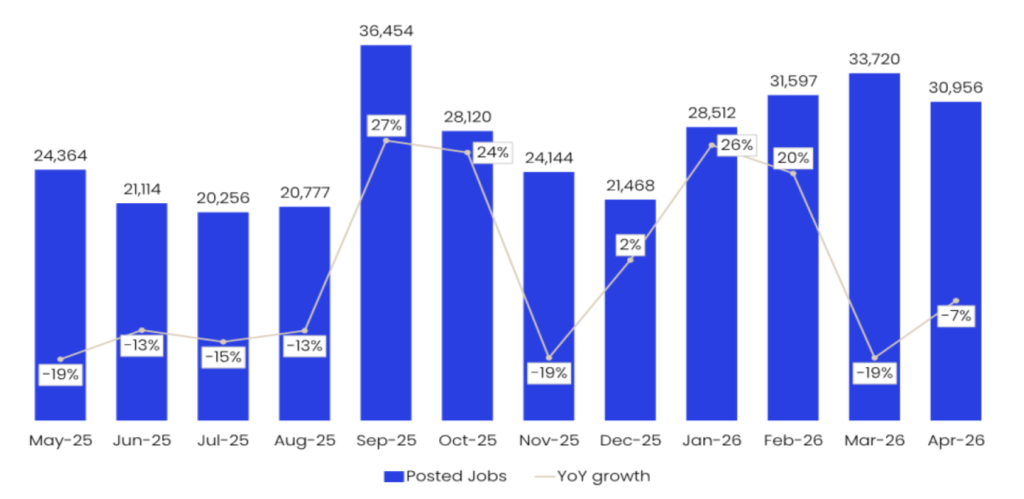
The global semiconductor sector experienced a notable contraction in April 2026, with job postings dipping by 6.58% month-on-month to 30,956. This decline represents the second consecutive monthly pullback, breaking the momentum established during the aggressive hiring surge witnessed in January and February.

A Chronology of Volatility
To understand the current state, one must look at the 12-month trajectory. The industry has been defined by a "stop-start" hiring pattern:
- Late 2025: Hiring reached a localized trough, prompting concerns about mid-year stagnation.
- Q1 2026: A sharp, decisive acceleration in recruitment marked the beginning of the year, driven by optimism regarding AI infrastructure and cloud expansion.
- March–April 2026: A period of retrenchment set in, as firms likely evaluated the sustainability of their Q1 expansion.
Despite the recent dip, it is crucial to note that current posting levels remain significantly higher than the depressed baseline of December 2025. This suggests that while the sector is undergoing a necessary "cooling," it is not sliding back into the recessionary lows of mid-2025. Rather, it reflects a transition toward a more disciplined, strategic approach to talent acquisition.
The Strategic Drivers: Why AI and Cloud Dominate
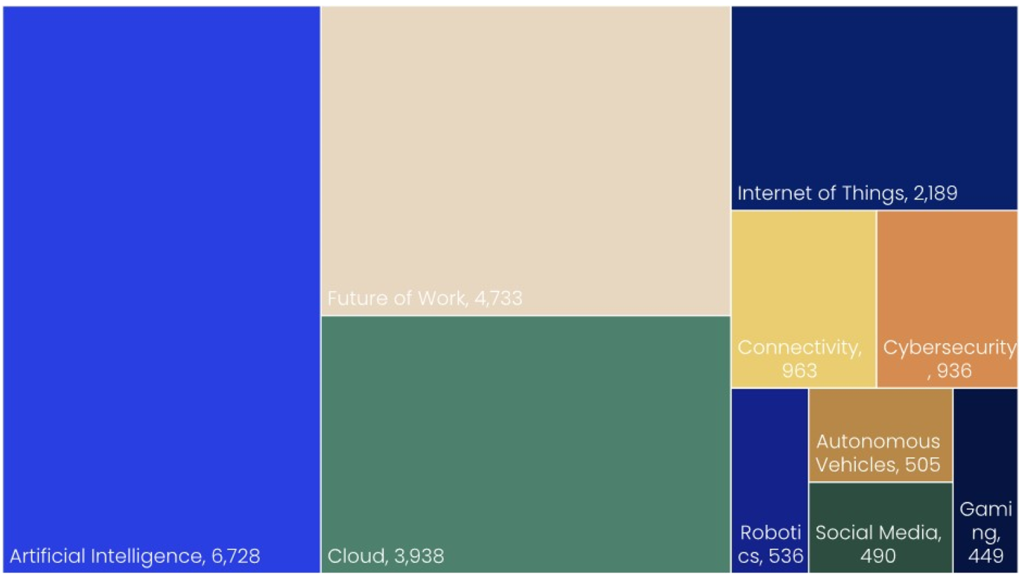
The distribution of job postings by theme provides the clearest window into the R&D priorities of the world’s largest semiconductor firms. The data reveals a industry that is no longer just selling hardware; it is selling the infrastructure for the intelligent, cloud-connected future.

The AI-Cloud Nexus
Artificial Intelligence (AI) continues to lead the pack, accounting for 6,728 postings in April alone. This is followed by "Future of Work" (FOW) initiatives (4,733) and Cloud computing (3,938). This trio dominates the hiring landscape, effectively creating a "software-adjacent" core.
The focus on these areas signals that semiconductor companies are shifting their internal capabilities toward platform engineering. They are building the chips that power massive language models and decentralized data processing, requiring a workforce that understands not just silicon physics, but containerization, virtualization, and large-scale system integration.
Secondary themes, such as the Internet of Things (IoT) and advanced connectivity, continue to attract investment but at a lower volume. This suggests that while the "long tail" of the industry—robotics, autonomous vehicles, and gaming—remains vital, the immediate, high-volume capital is currently being funneled into the foundational layers of the AI and Cloud revolution.
Global Footprints: Shifting Geographic Priorities
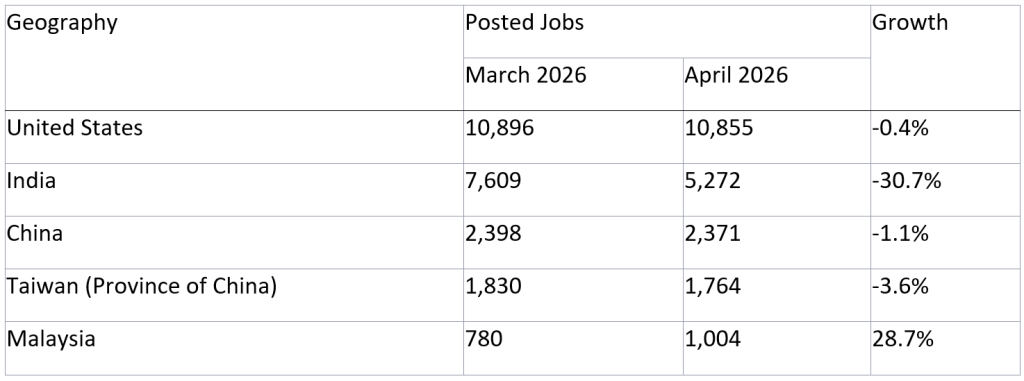
The geographic distribution of semiconductor hiring is undergoing a significant transformation. While the United States maintains its position as the undisputed hub of the industry—holding steady with a marginal 0.4% decline—the rest of the world is seeing a redistribution of growth.
The "India Contraction" and the "Malaysia Rise"
April 2026 brought a significant 30.7% month-on-month decline in job postings in India, which represents the most significant negative swing among major markets. Simultaneously, China and Taiwan saw minor, single-digit contractions.
Conversely, Malaysia emerged as a standout performer, recording a 28.7% growth in postings. This suggests a strategic diversification of the supply chain and R&D operations. As firms look to hedge against geopolitical risk and rising operational costs in traditional hubs, Malaysia is increasingly being positioned as a critical node in the semiconductor value chain. For corporate strategists, this is a clear signal that the "de-risking" of semiconductor supply chains is moving from a theoretical goal to an active hiring reality.
Employer Dynamics: Who is Leading the Charge?
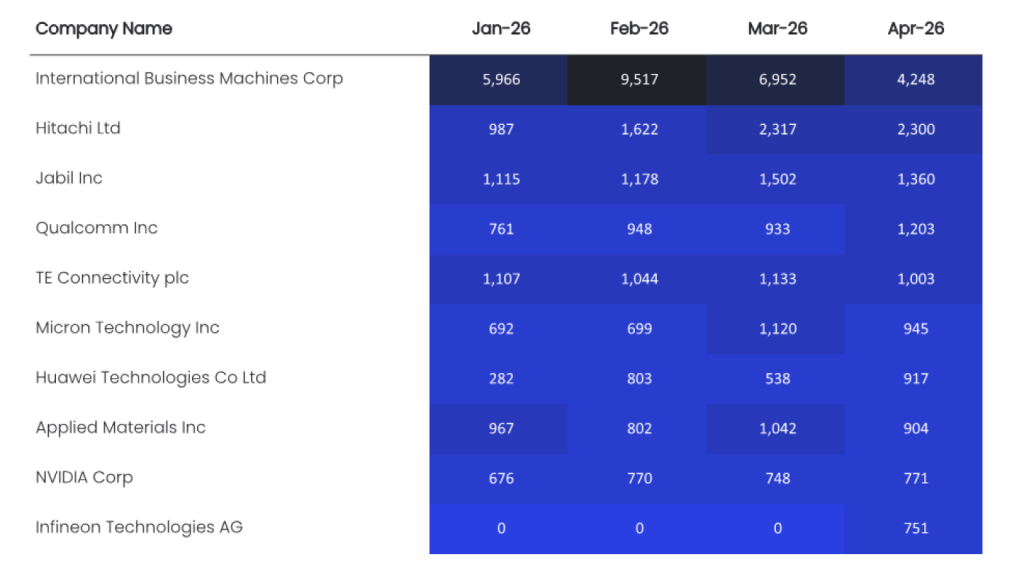
The list of top employers in April 2026 paints a picture of a sector in flux. IBM remains the dominant force in total volume (4,248 postings), yet even this titan has seen a significant cooling from its February peak of 9,517. This volatility in top-tier hiring is a hallmark of an industry currently optimizing its headcount to match shifting project timelines.
Other notable movements include:
- Stability: Hitachi has maintained a steady presence with roughly 2,300 postings, proving that large, diversified conglomerates are taking a more measured, long-term approach compared to the pure-play firms.
- Strategic Upswings: Qualcomm and Huawei showed moderate growth, suggesting specific product-cycle pushes.
- New Entrants: The sudden emergence of Infineon, which posted 751 jobs after a period of near-zero activity, highlights how quickly firms can shift their strategic priorities to meet new demand for power semiconductors and automotive-grade chips.
The Skillset Gap: What Companies Are Actually Looking For
If the themes represent the "where," the technical skill requirements represent the "how." The demand for specific skills in April 2026 confirms that the industry is pivoting toward platform-centric engineering.
The Top 3 Technical Pillars
- Application Platforms and Containers (4,960): This underscores the transition toward modular, software-defined hardware systems.
- Systems Design and Integration (3,637): This indicates that the industry is desperate for talent capable of bridging the gap between hardware design and enterprise-level application.
- Operating Systems (3,408): As chips become increasingly specialized, the need for low-level OS optimization is higher than ever.
The emphasis on these skills demonstrates that the "semiconductor engineer" of 2026 is expected to be a hybrid, capable of navigating both the physical constraints of silicon and the architectural requirements of modern cloud environments.
Implications for Corporate Strategy
For leaders, the data presented in these trends offers more than just market sentiment; it offers a competitive roadmap.
The Three-Month Advantage
The most critical takeaway is the "positioning window." Hiring data typically leads earnings revisions by one to three months. By the time the broader market acknowledges a trend through quarterly reports, the leaders who tracked these hiring patterns will have already adjusted their supply chains, secured their talent, and reallocated their R&D budgets.
Strategic Recommendations
- Monitor the "Hiring Pulse": Do not rely on historical financial data to predict future performance. Integrate real-time labor market analytics into your strategic planning.
- Watch the Geography of Talent: The rise of Malaysia and the cooling of the Indian market are early indicators of where the next generation of infrastructure will be built. Following this talent migration allows firms to predict where costs will rise and where regional opportunities will emerge.
- Prioritize Software-Hardware Integration: The dominance of "Application Platforms" and "Containers" in the hiring mix suggests that any semiconductor firm lacking a robust software strategy will soon be left behind. Talent acquisition should be heavily weighted toward these hybrid skill sets.
Conclusion: Turning Data into Decisions
The semiconductor sector is currently in a state of recalibration. While the headline figure of a 6.58% decline in hiring might seem like a cooling of ambitions, the underlying data tells a more nuanced story of strategic consolidation. Firms are shifting their resources away from generic expansion and toward the high-growth, high-complexity domains of AI and cloud infrastructure.
For those who know where to look, the job boards of today are the balance sheets of tomorrow. By translating these complex hiring patterns into clear, actionable signals, leaders can move from reacting to the market to proactively shaping their organization’s role within it. The window of opportunity is narrow—often no more than 90 days—but for those who utilize these insights effectively, it is the difference between leading the market and being disrupted by it.

