


For corporate strategists and institutional investors, the "black box" of competitor intent is often illuminated long before the quarterly earnings call. In the modern industrial era, hiring data serves as the ultimate leading indicator—a real-time heartbeat of corporate ambition. By examining where companies are pouring capital into human talent, leaders can decipher the trajectory of new product development, market expansion, and technological pivots months before these shifts manifest in financial statements.
Recent data from April 2026 indicates that the global semiconductor industry, a bellwether for the broader technology sector, is undergoing a period of recalibration. While the frantic hiring pace of early 2026 has moderated, the underlying focus on artificial intelligence, cloud infrastructure, and platform engineering remains the dominant narrative.
The Chronology of Cooling: A Sector in Transition
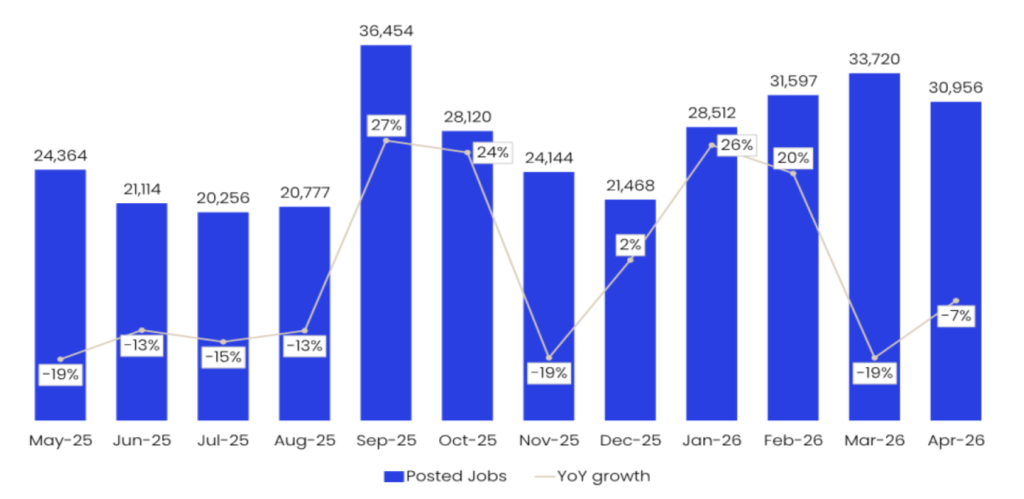
The semiconductor industry, which experienced a robust surge in recruitment activity throughout the first quarter of 2026, hit a speed bump in the second quarter. April 2026 saw global job postings contract by 6.58% month-on-month, bringing the total to 30,956.

To understand this cooling, one must look at the preceding months. January and February were characterized by aggressive expansionary hiring. This was a response to the massive global demand for high-performance computing power required to fuel the AI gold rush. However, the subsequent retrenchment observed in March and April suggests a strategic "wait-and-see" approach.
A Timeline of Recent Volatility
- September 2025: A notable step-up in hiring, signaling the start of a year-end push.
- December 2025: A seasonal and cyclical trough, providing the baseline for the current year.
- January–February 2026: A period of rapid acceleration, as companies sought to secure top-tier talent for the AI-integrated product cycles.
- March–April 2026: A phase of stabilization and contraction. While the April decline is statistically significant, it is critical to note that current posting levels remain well above the late-2025 lows, suggesting that while momentum has slowed, the underlying commitment to long-term capacity building remains intact.
Strategic Themes: The AI and Cloud Dominance
The internal logic of current semiconductor hiring is heavily weighted toward software-adjacent disciplines. The industry is no longer just about manufacturing chips; it is increasingly about creating the foundational ecosystem that allows artificial intelligence to function at scale.
The Top Three Drivers
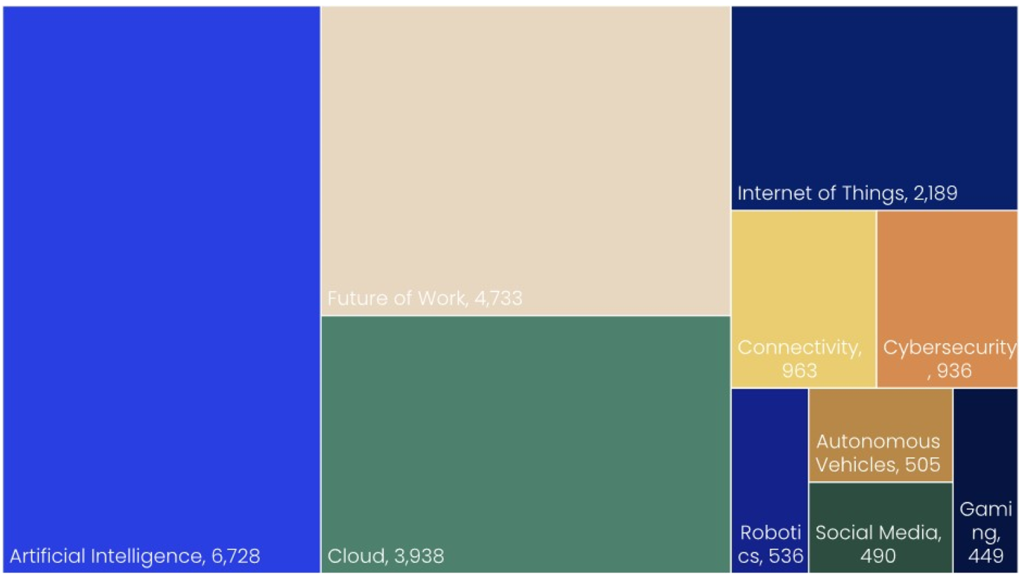
- Artificial Intelligence (AI): With 6,728 postings, AI remains the undisputed king of recruitment themes. Companies are prioritizing talent that can bridge the gap between hardware architecture and machine learning application.
- Future of Work (FOW): As semiconductor firms modernize their own internal operations to manage supply chain complexity, the "Future of Work" theme accounted for 4,733 postings. This reflects a shift toward agile, decentralized, and digital-first management structures.
- Cloud Computing: Representing 3,938 postings, cloud infrastructure continues to be a massive draw. The symbiotic relationship between chip design and cloud-native applications has made this a non-negotiable area for investment.
While secondary themes such as the Internet of Things (IoT) and connectivity occupy space in the hiring mix, they are increasingly dwarfed by the massive resource allocation directed at AI and Cloud. This suggests a consolidation of resources: the industry is betting that the most significant growth will occur in high-end data center and AI acceleration rather than commodity IoT hardware.

Geographic Dispersion: Shifting Hubs of Activity
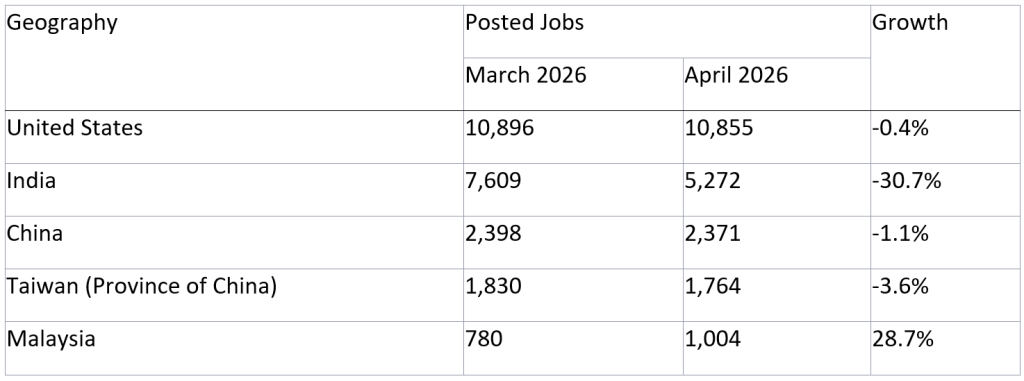
The map of global semiconductor talent is shifting. While the United States remains the undisputed center of gravity, accounting for the largest share of global postings, the growth rates in secondary markets tell a more nuanced story.
The US market held essentially flat in April, recording a marginal -0.4% change. This stability is indicative of a mature market that is maintaining its footprint despite broader global economic headwinds. Conversely, India experienced a significant contraction of 30.7%, reflecting a sharp correction after a period of rapid, perhaps unsustainable, growth.
The Rise of Malaysia
Perhaps the most intriguing development in the April data is the surge in Malaysia. Recording a 28.7% increase in job postings (1,004 total), Malaysia is emerging as a critical "swing" geography. As companies look to diversify their supply chains and de-risk their reliance on traditional manufacturing hubs, Malaysia’s ability to attract technical talent marks it as a key beneficiary of the "China Plus One" strategy currently being adopted by major semiconductor OEMs.
Employer Sentiment: A Mixed Bag of Momentum
The hiring behavior of industry giants provides a window into individual corporate health and strategic priorities. IBM continues to dominate the landscape, with 4,248 postings in April, though this is a significant drop from its February peak of 9,517. This volatility in IBM’s hiring is a strong signal of a company that front-loaded its recruitment and is now shifting into an execution phase.
Conversely, companies like Infineon have re-emerged on the scene. After a dormant Q1, their sudden influx of 751 postings in April suggests an unexpected shift in product roadmaps or a new, urgent project commencement that was not signaled at the beginning of the year. Hitachi continues to show enviable stability, maintaining a steady recruitment pace that suggests a disciplined, long-term capital allocation strategy.
The Technical Skills Gap: What are They Actually Hiring For?
If we look at the specific skills demanded in these job postings, we find that the "hardware-plus" model is in full effect. The top three technical requirements are:
- Application Platforms and Containers (4,960): This emphasizes the move toward containerized, scalable software environments. Semiconductor companies are effectively becoming software-platform companies.
- Systems Design and Integration (3,637): This reflects the increasing complexity of modern chips, which are now rarely standalone components but rather parts of massive, interconnected systems.
- Operating Systems (3,408): As the line between hardware and OS continues to blur, the demand for kernel-level and systems-level expertise remains robust.
Implications for Leaders and Investors
The core takeaway for any leader monitoring this sector is that hiring data is an early warning system. By the time the impact of these hiring shifts is reflected in an earnings report, the window of opportunity for a strategic response has long since closed.
How to Utilize This Data:
- Monitor the "Hiring Lag": Since job postings lead earnings by one to three months, any sharp decline in a competitor’s hiring—especially in AI-linked roles—may suggest that they are hitting capacity or, conversely, that they are bracing for a downturn.
- Spot Geographic Arbitrage: The movement into markets like Malaysia indicates that the next phase of supply chain efficiency will be driven by geography. Leaders should assess whether their own footprint is overly exposed to volatile labor markets like India or whether they should emulate the diversification seen in the industry’s current leaders.
- Evaluate Internal Skill Sets: The prevalence of platform engineering and containerization skills in job descriptions should serve as a benchmark. If your organization is not prioritizing these competencies, you are likely falling behind in the race to build the next generation of scalable hardware solutions.
Conclusion: The Strategic Imperative
The cooling of the semiconductor hiring market in April 2026 is not a sign of industry failure, but rather a sign of industrial maturation. The "frenzy" of early-year expansion has given way to a more clinical, targeted approach.
For the executive, the challenge is to avoid being misled by the "cooling" headline. By looking beneath the surface—at the specific roles, the specific regions, and the specific technological themes—one can see that the semiconductor industry is not slowing down; it is sharpening its focus. Those who can translate these subtle, real-time hiring signals into actionable intelligence will be the ones best positioned to capture the next wave of growth in the digital economy.
For those interested in deep-diving into these trends, GlobalData Jobs Analytics provides point-in-time, granular data direct from company career pages. In an environment where the data moves faster than the market, having the right information is not just an advantage—it is a necessity.

