

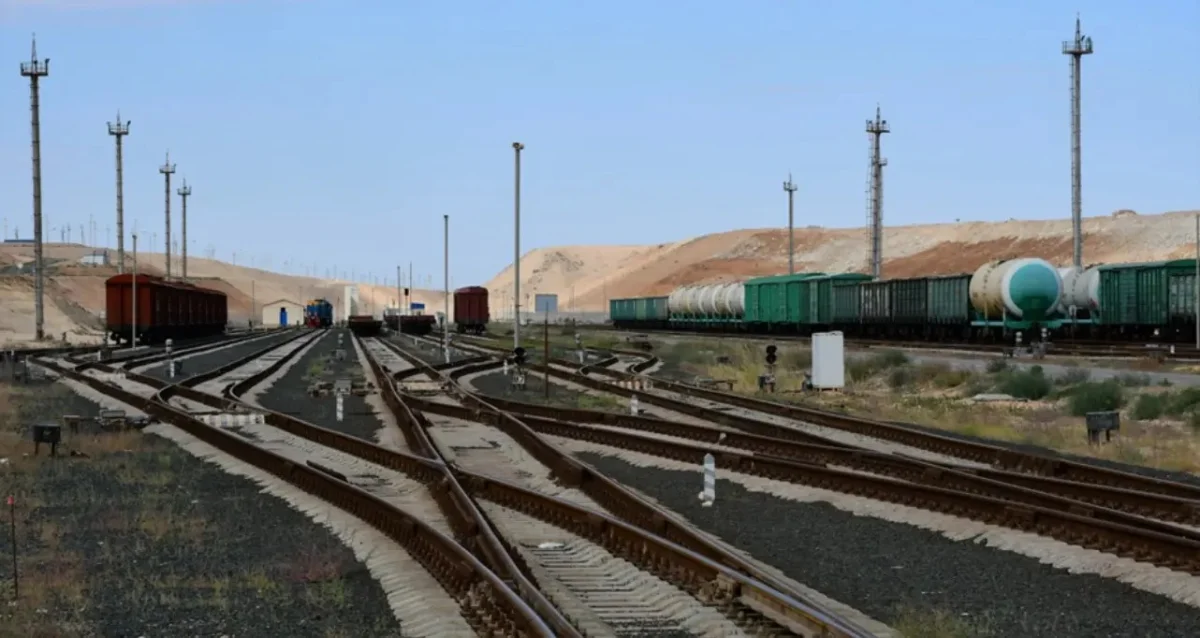
The European Bank for Reconstruction and Development (EBRD) has announced a significant financial commitment to the modernization of Kazakhstan’s rail sector, pledging up to USD 125 million toward a landmark Eurobond issue launched by Kazakhstan Temir Zholy (KTZ), the nation’s state-owned railway operator. This investment represents a critical step in the ongoing effort to upgrade the logistics backbone of Central Asia, specifically targeting the infrastructure of the Trans-Caspian International Transport Route (TITR)—frequently referred to as the "Middle Corridor."
The KTZ Eurobond issue, which has reached an aggregate value of USD 1 billion and is currently listed on both the London Stock Exchange (LSE) and the Kazakhstan Stock Exchange (KASE), serves as a cornerstone for KTZ’s long-term capital expenditure strategy. By participating in this issuance, the EBRD is not merely providing capital; it is signaling a robust vote of confidence in Kazakhstan’s role as a pivotal transit hub connecting the burgeoning economies of Asia with the European market.
Main Facts: The Scope of the Investment
The capital injection is designed to achieve three primary objectives: the modernization of aging passenger terminal infrastructure, the enhancement of operational capacity along the Trans-Caspian Corridor, and the digital transformation of KTZ’s internal security protocols.
Under the terms of the investment, the modernization of passenger stations will prioritize safety, throughput capacity, and energy efficiency. Specifically, KTZ plans to implement advanced lighting systems and, crucially, significant accessibility improvements for passengers with disabilities. This social dimension is a requirement of the EBRD’s engagement, ensuring that infrastructure development aligns with international standards for universal design.
Beyond the terminals, the funds are earmarked for critical maintenance and capacity expansion along the 16,400-kilometer rail network. As one of the region’s largest employers and logistics operators, KTZ manages a fleet of over 1,700 locomotives and nearly 50,000 freight and passenger cars. The infusion of liquidity via the Eurobond market allows the company to undertake these capital-intensive projects without solely relying on domestic state budget allocations.
A Chronology of Engagement: EBRD and Kazakhstan
The relationship between the EBRD and Kazakhstan is one of the most mature in the bank’s portfolio. Since its inception, the EBRD has invested approximately EUR 11 billion across 352 individual projects in the country. This latest transaction is the culmination of years of collaborative dialogue regarding the necessity of modernizing the post-Soviet rail infrastructure.
- Early 2000s: Initial cooperation focused on restructuring KTZ and integrating it into the global market.
- 2015-2020: Shift in focus toward regional connectivity and the formalization of the "Middle Corridor" as a viable alternative to northern land routes.
- 2023: KTZ achieves significant financial milestones, including increased transit volumes, paving the way for international bond market access.
- May 2026: The official issuance of the USD 1 billion Eurobond, with the EBRD securing its position as a anchor investor with a USD 125 million commitment.
This timeline reflects a strategic progression from basic institutional reform to high-level infrastructure investment, underscoring the evolution of Kazakhstan’s rail sector from a regional utility to a global trade facilitator.
Supporting Data: The Logistics Powerhouse
To understand the scale of the operation, one must look at the sheer operational footprint of KTZ. The railway remains the circulatory system of Kazakhstan’s economy. With a network spanning 16,400 kilometers, it handles the vast majority of the country’s bulk commodity exports, including grain, oil, and mineral resources.
- Network Length: 16,400 km of operational track.
- Rolling Stock: 1,700 locomotives, 46,800 freight cars, and 2,300 passenger cars.
- Investment History: 352 projects funded by the EBRD in Kazakhstan over the last three decades.
- Bond Valuation: USD 1 billion total Eurobond issuance, with the EBRD contributing 12.5% of the total target.
These figures illustrate a company undergoing a massive logistical transition. The integration of digital ticketing and monitoring systems—necessitated by the modernization project—will likely yield significant data-driven efficiencies, reducing transit times and lowering the carbon footprint of freight transport across the Eurasian landmass.
Official Perspectives: Aligning Standards and Security
The EBRD’s involvement goes beyond the balance sheet. A key component of the agreement involves technical cooperation funds designed to assist KTZ in adopting international rail standards.

Perhaps most timely is the inclusion of a cybersecurity mandate. As rail operators transition toward digitized signaling, automated dispatching, and digital ticketing, they become increasingly vulnerable to cyber threats. The EBRD’s support ensures that KTZ is not only building "hard" infrastructure (track and stations) but also "soft" infrastructure (data protection and digital governance).
"Modernizing rail networks in Central Asia is not just about moving cargo faster; it is about building a secure, inclusive, and sustainable transport ecosystem that links Europe and Asia," an EBRD spokesperson noted. By enforcing international standards, the bank is helping KTZ mitigate the risks associated with the rapid digitization of state-run logistics.
Implications: The Middle Corridor and Global Trade
The most significant implication of this investment is the strengthening of the Trans-Caspian International Transport Route (TITR). As geopolitical tensions and security concerns have disrupted traditional Eurasian trade routes, the Middle Corridor has emerged as an essential alternative for global supply chains.
1. Geopolitical Significance
The route, which traverses the Caspian Sea, the Caucasus, and Turkey, acts as a crucial bridge. For Kazakhstan, the corridor is an economic lifeline that reduces dependency on singular export paths. The EBRD’s financial backing serves as a "seal of approval," potentially encouraging other institutional investors and private banks to participate in the corridor’s development.
2. Social Impact and Accessibility
By mandating improvements for passengers with disabilities, the EBRD is pushing KTZ to modernize its social contract alongside its rails. The transition to modern stations, equipped with better safety features and universal access, signals a shift toward a customer-centric model of rail service, rather than one strictly focused on industrial freight.
3. Economic Resilience
The USD 1 billion Eurobond provides KTZ with the long-term, stable capital necessary to navigate the volatility of international commodity prices. By diversifying its funding sources, the company protects its essential infrastructure projects from domestic budgetary shocks.
4. Sustainability Goals
Rail is the most environmentally friendly mode of land transport. By increasing the efficiency of the KTZ network, the EBRD is indirectly contributing to the decarbonization of international trade. Modernized locomotives and improved track alignment will naturally lead to lower fuel consumption and reduced emissions, supporting Kazakhstan’s commitments to sustainable development.
Conclusion: A New Chapter for KTZ
The EBRD’s USD 125 million investment into KTZ’s Eurobond issue is more than a financial transaction; it is a strategic alignment of interests between a regional logistics giant and a major international financial institution. As Kazakhstan continues to leverage its geographic position as the "buckle" of the Silk Road, the modernization of its rail infrastructure will remain the single most important factor in its long-term economic prosperity.
With the backing of international investors and a clear roadmap for digital and physical upgrades, KTZ is well-positioned to evolve into a modern, resilient, and globally integrated transport operator. The success of this Eurobond issuance will likely set the stage for further international investments in Central Asia, proving that with the right governance and technical support, the region can become a cornerstone of the future global supply chain.

