


In the high-stakes world of global technology, hiring data acts as a sophisticated, real-time barometer for corporate health. Long before shifts in sentiment appear in quarterly earnings calls or stock market volatility, they are etched into the career portals of the world’s leading firms. For the semiconductor industry—the bedrock of the modern digital economy—April 2026 has provided a definitive signal: a cooling of momentum following a frenetic first quarter.
As organizations grapple with economic uncertainty and the rapid evolution of artificial intelligence, understanding these hiring patterns is no longer just an HR concern; it is a fundamental pillar of strategic decision-making.
The Core Data: A Sector in Transition
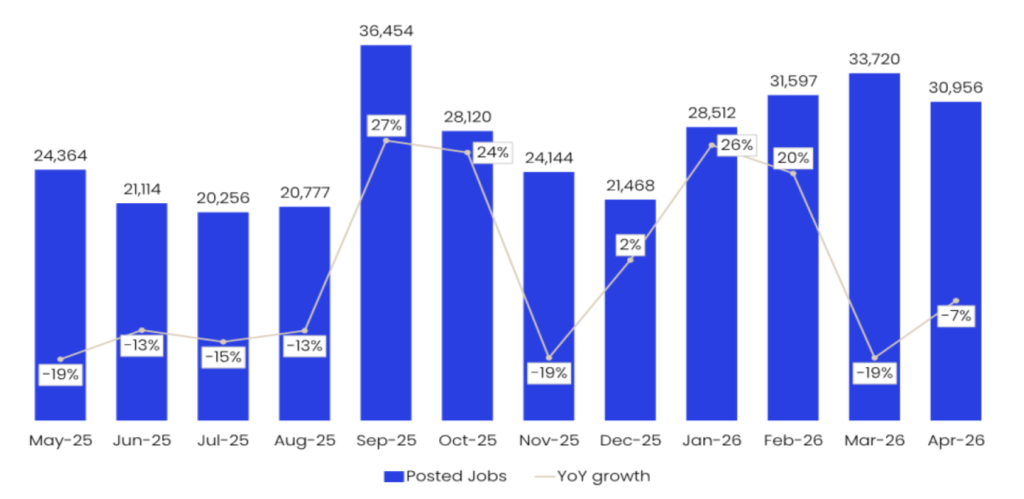
The latest analysis from GlobalData Jobs Analytics reveals that global semiconductor job postings declined by 6.58% in April 2026, totaling 30,956 vacancies. This marks the second consecutive month of contraction, following a robust, high-energy surge during the January–February window.
While a decline of this magnitude might trigger alarms for the casual observer, a deeper look at the 12-month trajectory provides context. The sector remains in a state of "volatile stabilization." Despite the April pullback, current posting levels remain comfortably above the December 2025 baseline. This suggests that the industry is not collapsing into the deep troughs observed in mid-2025, but rather experiencing a necessary, measured cooling phase as companies recalibrate their aggressive Q1 expansion plans.

Chronology of a Shift: From Surge to Calibration
To understand the current state of the semiconductor labor market, one must view the past year as a series of distinct strategic phases:
- Mid-2025 (The Trough): The industry faced a period of consolidation, with hiring activity hitting lows as supply chain inventories normalized and demand for consumer electronics plateaued.
- September 2025 (The First Step-up): As AI-focused infrastructure projects began to scale, firms signaled a renewed appetite for talent, marking the beginning of a growth cycle.
- January–February 2026 (The Acceleration): A period of intense hiring activity, characterized by a race to secure specialized talent for generative AI and cloud-integrated hardware developments.
- March–April 2026 (The Retrenchment): The current phase, defined by a cooling of sentiment as firms assess the ROI of their Q1 hiring spree and align their headcount with tempered macroeconomic growth expectations.
Thematic Drivers: The AI-Centric Hiring Mix
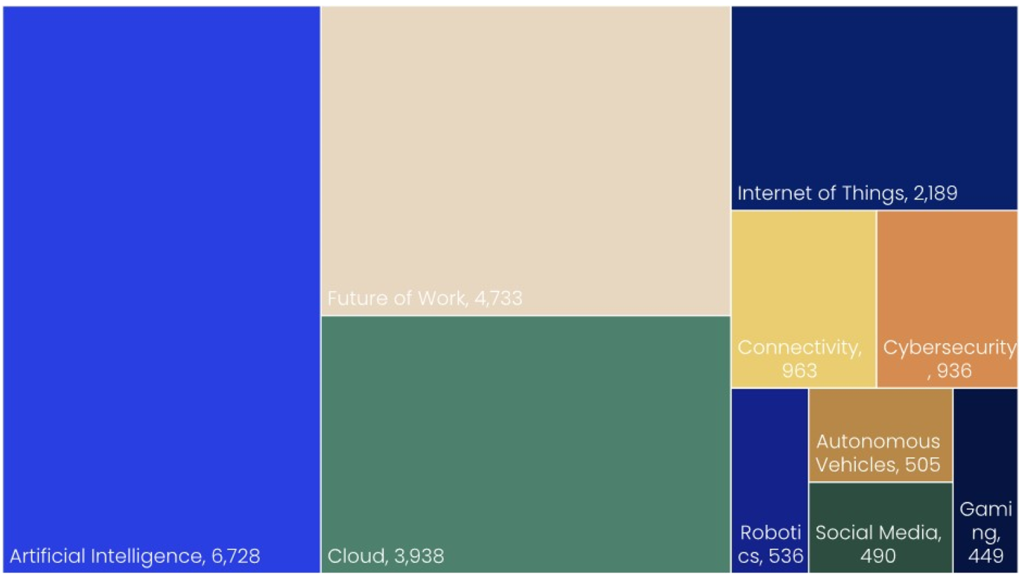
The thematic distribution of current job postings offers a window into where the industry’s "real bets" are being placed. The data indicates a clear, undeniable prioritization of software-adjacent capabilities.
Artificial Intelligence remains the undisputed king of hiring themes, accounting for 6,728 job postings. This is closely followed by the "Future of Work" (4,733) and Cloud infrastructure (3,938). This hierarchy reveals that the semiconductor industry is no longer merely manufacturing chips; it is increasingly integrating itself into the software and platform delivery ecosystem.
Secondary themes, while critical, command a smaller share of the current hiring volume. The Internet of Things (IoT) at 2,189 and connectivity at 963 highlight a steep drop-off, suggesting that while these technologies are vital, they are currently receiving less capital-intensive investment in terms of human capital compared to the "Big Three" of AI, Cloud, and Future of Work. Robotics and autonomous vehicles currently reside in the "long tail" of hiring, serving as niche markets rather than primary drivers of current expansion.

Geographic Dispersion and Market Stability
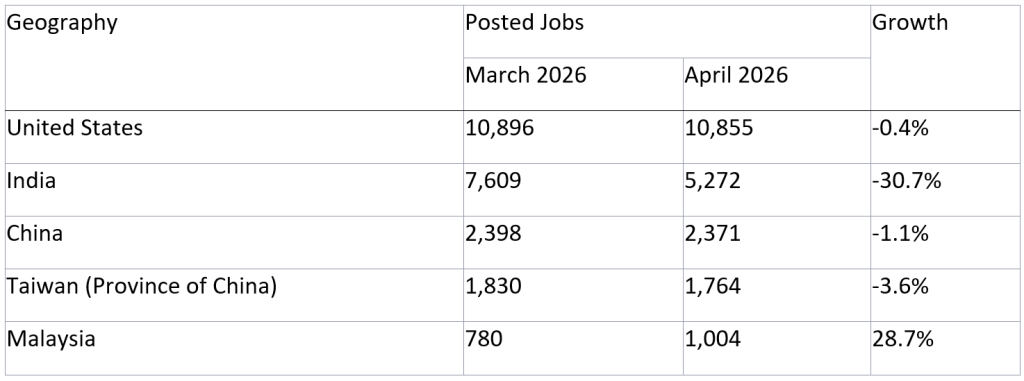
The global geography of semiconductor hiring is undergoing a notable reconfiguration. The United States remains the undisputed global hub for semiconductor innovation, with hiring levels holding essentially flat (-0.4%) in April. This stability signals that the US market remains the anchor for the industry’s long-term R&D and strategic operations.
However, the picture is more fragmented elsewhere. India recorded a sharp contraction of 30.7% in April, representing the most significant negative swing in the dataset. This volatility may reflect a shift in local operational strategies or a realignment of back-office and support functions. Similarly, China and Taiwan (Province of China) saw minor declines of 1.1% and 3.6%, respectively.
The standout performer, however, was Malaysia, which recorded a 28.7% increase in postings, bringing its total to 1,004. This growth trajectory highlights Malaysia’s rising importance in the global semiconductor value chain, particularly in assembly, testing, and packaging (ATP) operations, as companies seek to diversify their geographic footprint away from traditional hubs.
Corporate Momentum: The Major Players
The hiring behavior of industry giants serves as a leading indicator of broader market health. IBM maintains its position as the largest job poster in the sector (4,248 vacancies), yet this figure represents a significant retreat from its February peak of 9,517. This sharp reduction suggests that IBM is moving past its peak expansion phase and into an operational efficiency mode.
In contrast, companies like Hitachi are maintaining relative stability, with 2,300 postings in April compared to 2,317 in March. Meanwhile, the entry of Infineon into the top-employer list—rising from zero postings in Q1 to 751 in April—highlights the "month-specific" nature of hiring cycles, where individual corporate strategy shifts can cause sudden, localized surges in demand for talent.
Technical Skills: What Are Firms Actually Looking For?
The technical profile of the modern semiconductor employee has shifted dramatically. The demand for "Application Platforms and Containers" (4,960) underscores the industry’s pivot toward cloud-native architectures. Following closely are "Systems Design and Integration" (3,637) and "Operating Systems" (3,408), indicating that companies are desperate for talent capable of bridging the gap between raw hardware performance and the software environments where that hardware is deployed.
These findings suggest that the semiconductor engineer of 2026 is as much a software architect as they are a hardware expert. The inclusion of enterprise application domains, such as HR and payroll systems in the top-tier of demand, also suggests that semiconductor firms are investing heavily in their internal digital infrastructure to support a larger, more distributed workforce.
Strategic Implications: Why Leaders Must Listen to the Signals
For the C-suite, the takeaway is clear: hiring data is an early warning system. The "positioning window" for such intelligence is notoriously short—roughly one to three months. By the time a hiring trend is reflected in consensus analyst reports or public financial filings, the opportunity to act has often already passed.
1. Competitive Intelligence
By monitoring competitor hiring patterns, leaders can identify which markets are being prioritized and which technologies are being abandoned. If a competitor shifts focus from IoT to AI, that is a precursor to a new product cycle that will hit the market in the coming quarters.
2. Operational Efficiency
Hiring data allows leaders to spot "overexposure." If a firm is hiring aggressively in a region that is seeing a sector-wide contraction, they may be overestimating market growth or failing to align with regional economic realities.
3. Talent Strategy
The transition toward cloud and platform-heavy roles suggests that the industry is facing a massive skills gap. Leaders who can anticipate these technical requirements ahead of their peers will be the first to secure the talent necessary to win in the AI era.
Conclusion: Turning Data into Decisions
The April 2026 semiconductor hiring data is not a sign of retreat, but of maturation. The industry is moving from a phase of "growth at any cost" to a more refined, platform-focused era of innovation. For leaders, the challenge lies in translating these complex signals into actionable strategy.
GlobalData Jobs Analytics provides the point-in-time clarity needed to navigate this environment. Whether it is identifying emerging hubs like Malaysia or understanding the shift toward containerization and platform engineering, the data is the key to remaining ahead of the curve. In an age where digital agility is the ultimate competitive advantage, those who ignore the hiring trends of today will inevitably be left behind by the market movements of tomorrow.
To gain a competitive edge, request a data sample today by contacting [email protected] or download the latest white paper on workforce analytics to begin mapping your strategic path forward.

