


In the high-stakes world of semiconductor manufacturing, the most reliable harbinger of future market dominance is not found in quarterly earnings reports, but in the quiet, real-time pulse of recruitment activity. As global supply chains recalibrate and the race for artificial intelligence (AI) supremacy intensifies, workforce data serves as a sophisticated early-warning system. It reveals where capital is being deployed, which technologies are reaching maturity, and where the next major competitive battlegrounds are forming.
As of April 2026, the semiconductor industry is experiencing a notable cooling in recruitment activity, providing a critical window for leaders to assess their own competitive positioning. By analyzing the latest hiring data, we can move beyond mere headcount numbers to understand the strategic pivots occurring within the sector.
The State of Play: A Snapshot of April 2026
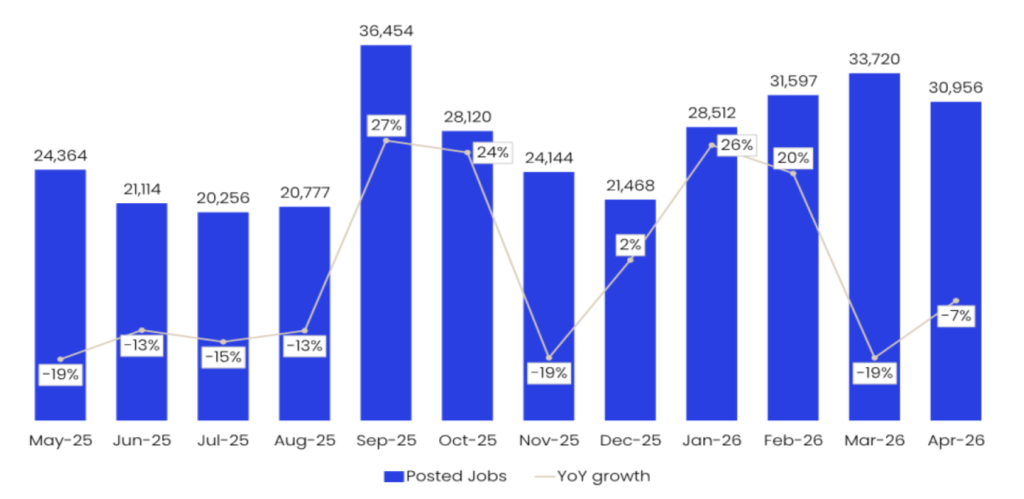
The global semiconductor landscape saw a contraction in hiring in April 2026, with job postings falling by 6.58% month-on-month to a total of 30,956. This decline marks the second consecutive month of cooling, following an aggressive surge in activity during the January–February window.

To understand this movement, one must look at the broader timeline. Throughout the last 12 months, hiring patterns have been characterized by extreme volatility. After a significant uptick in September 2025, the industry saw a secondary sprint in early 2026. The current pullback in March and April represents a necessary period of stabilization rather than a collapse. Crucially, even with this recent softening, total job postings remain comfortably above the levels observed in late 2025. This suggests that while the "fever" of Q1 expansion has subsided, the underlying run-rate of the industry remains robust, reflecting a sector that is still investing heavily in capacity, albeit with more precision and caution.
Thematic Dominance: Where the Capital is Flowing
The shift in hiring is not uniform across all departments. Instead, it is heavily concentrated in themes that define the future of digital infrastructure.
AI and Cloud: The Twin Engines of Growth
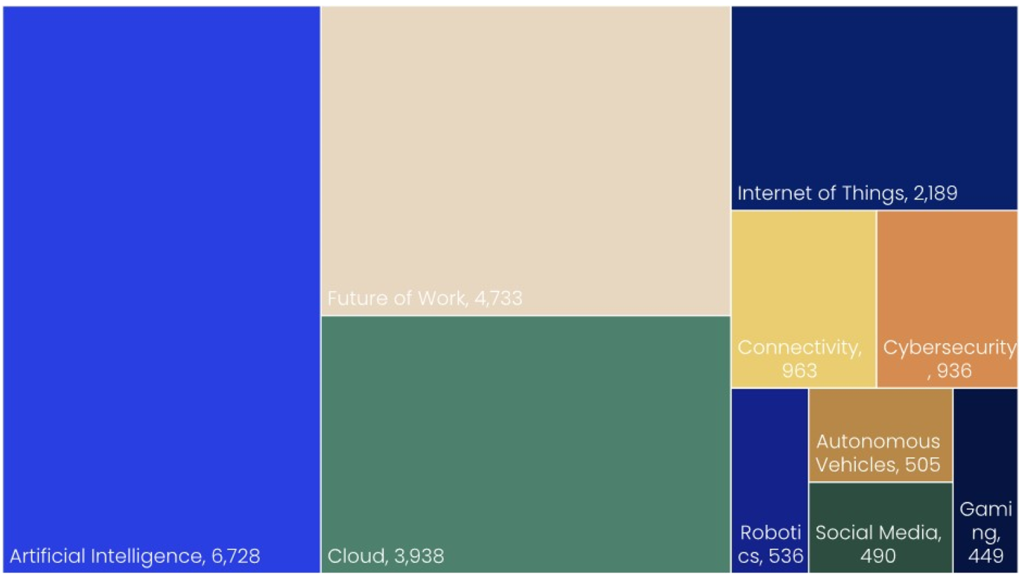
Artificial Intelligence remains the undisputed king of semiconductor recruitment, accounting for 6,728 job postings. This is followed closely by "Future of Work" (FOW) initiatives (4,733 postings) and Cloud-related infrastructure (3,938 postings).

This concentration of talent acquisition signals that semiconductor firms are no longer just "chip makers"; they are increasingly functioning as critical pillars of software-adjacent digital modernization. The demand for engineers who understand the intersection of hardware architecture and AI model training is unprecedented. Secondary themes, such as the Internet of Things (IoT) at 2,189 postings and connectivity at 963, show a marked drop-off, indicating that while these sectors remain vital, the current "gold rush" is centered squarely on high-compute, cloud-native hardware.
Geographic Dispersion: Shifting Hubs of Innovation
The geographic profile of semiconductor hiring in April 2026 reveals a story of stability in established markets and sudden, significant movement in emerging ones.
The US Fortress
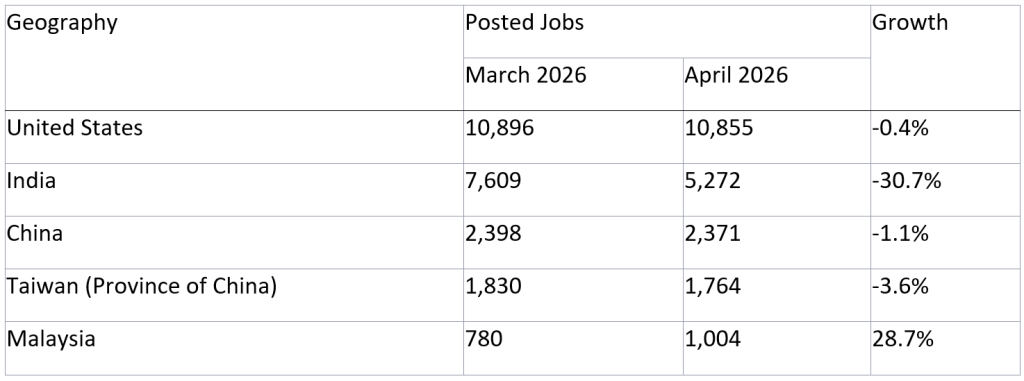
The United States remains the undisputed heavyweight of the semiconductor hiring landscape. Despite the broader cooling, US-based postings remained virtually flat, showing only a 0.4% decline. This indicates that the core of the industry remains committed to maintaining its domestic footprint, likely buoyed by government incentives and a focus on domestic supply chain security.
India’s Correction and Malaysia’s Rise
In contrast, India recorded a sharp contraction of 30.7% in April, marking the most significant negative swing among the major hubs. This decline likely represents a rebalancing after a period of intense, perhaps overheated, expansion in the region.
Meanwhile, Malaysia emerged as the primary "positive mover," with a staggering 28.7% growth in postings, reaching 1,004. This shift suggests that multinational semiconductor firms are actively diversifying their operational footprints to mitigate geopolitical risk, with Malaysia positioning itself as a high-value alternative for specialized manufacturing and design support. China and Taiwan, two other critical hubs, saw minor declines of 1.1% and 3.6%, respectively, reflecting a general global trend of consolidating talent rather than aggressive expansion.
Corporate Strategy: The Major Players
The hiring behavior of industry giants provides a roadmap for the rest of the market. IBM continues to dominate as the largest job poster, with 4,248 postings in April. However, this is a significant drop from its February peak of 9,517. This decline is not necessarily a sign of weakness, but perhaps a signal that the initial "hiring sprint" required to staff new AI-focused initiatives has been completed.
Other players show more varied results:
- Hitachi: Maintained remarkable stability, keeping its postings at 2,300, nearly level with its March performance. This suggests a long-term, steady-state investment strategy.
- Qualcomm and Huawei: Both reported moderate increases in hiring, suggesting a focus on specific product cycle growth.
- Infineon: A notable outlier, the company re-entered the top-employer list with 751 postings after a three-month hiatus, indicating a sudden, strategic push into new market segments.
The Skills Gap: What Employers Are Actually Buying
When we examine the technical skills demanded in these postings, a clear picture of the modern semiconductor workforce emerges. The focus is overwhelmingly on platform engineering and infrastructure.
- Application Platforms and Containers (4,960): The highest demand, proving that semiconductor firms are increasingly adopting cloud-native development practices to support their hardware workflows.
- Systems Design and Integration (3,637): This confirms that the complexity of modern chips requires an "integration-first" mindset, where hardware is designed specifically to interface with complex software ecosystems.
- Operating Systems (3,408): This reinforces the need for deep-level capability in kernel and system-level software, essential for high-performance computing.
The remainder of the top skill sets includes enterprise application management and HR/payroll infrastructure, suggesting that as these firms grow in size and complexity, they are also investing heavily in the "corporate backbone" required to sustain a large, globalized workforce.
Strategic Implications: Translating Data into Decisions
For executive leaders, the lesson is clear: hiring data is an early-warning system that consistently leads financial earnings revisions by one to three months. By the time the market "consensus" catches up to a shift in demand, the most strategic window of opportunity has already closed.
How Leaders Should Respond
- Monitor the "Hiring Lag": If your competitors are suddenly surging in a specific region (like Malaysia) or a specific theme (like AI-native hardware), it is a precursor to a shift in their product roadmap. Adjust your own R&D focus accordingly.
- Identify Overexposure: A sudden contraction in a specific geography—such as the one seen in India—might signal a regional slowdown or a strategic withdrawal. If your supply chain is overly reliant on these regions, now is the time to stress-test your dependencies.
- Prioritize Skill Acquisition: The current demand for platform and container engineering is not a fad; it is a fundamental shift in how hardware companies operate. Ensure your internal training programs are aligned with these high-growth areas to prevent talent erosion.
The volatility observed in the April 2026 data is not a sign of industry decline. Rather, it is a sign of a sector maturing through a period of rapid, AI-driven transformation. Companies that view this hiring data as a "map" rather than just a "metric" will be the ones that navigate the coming quarters with greater agility and insight.
GlobalData Jobs Analytics provides the point-in-time, granular intelligence required to make these decisions. By tracking job postings directly from company career pages, leaders can transform complex, noisy hiring data into the clear, actionable signals necessary to maintain a competitive edge in an increasingly volatile global economy.

