

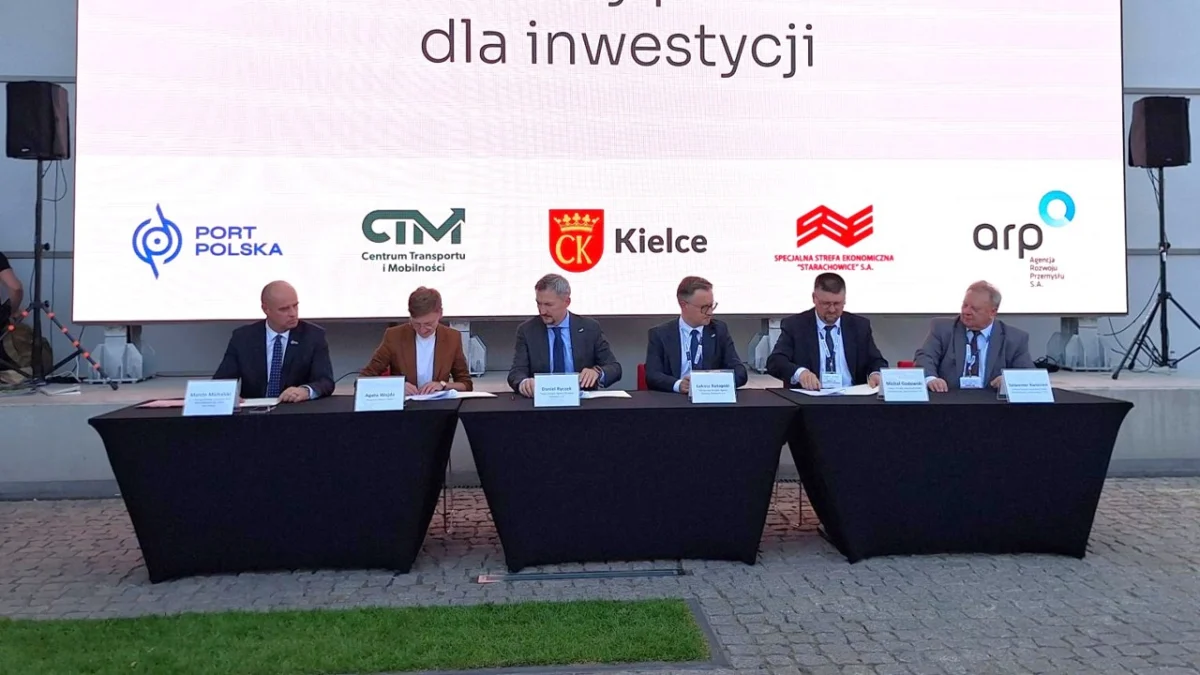
KIELCE, POLAND — In a landmark move designed to reshape the logistics and transportation landscape of central Europe, Port Polska and the municipal authorities of Kielce have officially signed a letter of intent to develop a state-of-the-art intermodal rail terminal. Situated in Obice, approximately 20 kilometers north of Kielce, the ambitious project is poised to serve as a vital economic engine for the Świętokrzyskie region—historically known as the Holy Cross Voivodeship—while significantly bolstering Poland’s national freight and transit capacities.
Covering an expansive area of roughly 25 hectares, the proposed terminal is engineered to bridge regional industrial demands with major international transport corridors. By seamlessly integrating rail and road networks, the facility aims to unlock new economic horizons for local businesses, attract foreign investment, and establish central Poland as an indispensable node in European supply chains. Furthermore, planners are evaluating the dual-use potential of the infrastructure, examining how the facility can simultaneously serve high-volume commercial freight operations and critical military logistics.
Main Facts
The Obice intermodal rail terminal project is a multifaceted infrastructure initiative rooted in strategic regional planning and comprehensive logistical forecasting. Below are the core pillars of the development:
- Location and Footprint: The terminal will occupy an estimated 25 hectares of land in Obice, situated 20 kilometers north of Kielce in the Świętokrzyskie region of central Poland.
- Rail Connectivity: The facility is set to be directly connected to railway line No. 73, a crucial regional route servicing the Kielce urban area and surrounding municipalities, while interfacing with the broader national rail grid.
- Core Objectives: The primary goals are to expand regional freight transport capacity, enhance local corporate access to intermodal logistics, stimulate economic growth in Kielce and the Holy Cross Voivodeship, and facilitate efficient multimodal cargo transfers.
- Dual-Use Capabilities: Planners are actively analyzing the feasibility of designing the infrastructure for dual-use purposes, allowing it to accommodate both commercial freight activities and national/allied military logistics.
- International Scope: Capitalizing on its strategic geographic positioning, the terminal is projected to serve international markets, including the Benelux countries and the Baltic states, while acting as a gateway for eastbound trade routes connecting Europe to Asia and supporting commerce with Ukraine.
- Collaborative Framework: Port Polska will provide foundational technical expertise, know-how, and analytical support to the municipality of Kielce across all developmental phases, including spatial planning, legal structuring, and financial modeling.
Chronology
The genesis of the Obice intermodal terminal is the result of years of systematic transport analysis, infrastructure strategizing, and institutional cooperation. The chronological evolution of the project underscores a deliberate, methodical approach to regional development:
Phase 1: Strategic Vision and Network Conceptualization (2022–2024)
The foundation for the Obice terminal was laid during macro-level transport studies conducted under the Integrated Rail Network (ZSK) project. Spearheaded by the Port Polska Centre for Transport and Mobility, the ZSK initiative sought to identify systemic bottlenecks and growth opportunities within Poland’s rail infrastructure. During this period, transport experts evaluated various regions across the country to determine optimal locations for decentralized intermodal nodes that could alleviate pressure on primary metropolitan hubs.
Phase 2: Identification and Municipal Alignment (2024–2025)
As analytical models refined by Port Polska pinpointed the Kielce district as a high-potential zone for intermodal growth, local municipal authorities in Kielce independently recognized Obice as an ideal site. The location offered a rare combination of available land reserves, favorable topography, and pre-existing industrial zoning potential. Local stakeholders began laying the groundwork for municipal integration, aligning local spatial development plans with broader national transport corridors.
Phase 3: Feasibility Analysis and Preliminary Layouts (2025–Early 2026)
With spatial parameters identified, experts from Port Polska began formulating preliminary design concepts. These included drafting initial track layouts for connecting the terminal to railway line No. 73, assessing highway and secondary road access, and outlining preliminary technical specifications for cargo handling yards, container storage zones, and intermodal transfer equipment.
Phase 4: Formal Agreement and Letter of Intent (September 2026)
The project achieved a formal milestone with the official signing of the letter of intent between Port Polska and the Kielce city authorities. This agreement established a binding framework for cooperation, tasking both entities with joint feasibility studies, legal evaluations, and environmental impact assessments.
Phase 5: Future Implementation and Engineering Studies (2027 and Beyond)
Moving forward, the partnership will transition into detailed technical and financial evaluations. This phase will dictate the ultimate implementation model—exploring public-private partnerships (PPPs), EU structural funding, and national transport grants—with the ultimate objective of breaking ground on the 25-hectare site.
Supporting Data
To understand the economic and logistical weight of the Obice terminal, it is essential to examine the data driving Poland’s broader transportation strategy and the specific attributes of the Świętokrzyskie region:
- 25 Hectares: The total land allocation designated for the Obice terminal, providing ample space for container storage, gantry crane operations, customs facilities, and multi-track rail sidings.
- 20 Kilometers: The precise distance separating the terminal site in Obice from the urban center of Kielce, ensuring proximity to local industrial zones while maintaining sufficient space for large-scale logistical operations without causing urban congestion.
- Railway Line No. 73: The operational artery designated to connect the terminal to the regional network, linking central Polish manufacturing hubs with major north-south and east-west transit corridors.
- National Frameworks: The project directly aligns with Poland’s wider national infrastructure initiatives, notably the pursuit of expanding the country’s rail network capabilities (such as broader plans proposing thousands of kilometers of new and modernized rail lines nationwide).
- Cross-Border Corridors: The terminal’s target markets—ranging from the Benelux economic zone to the Baltic states and Ukraine—represent regions experiencing high demand for resilient, high-capacity intermodal logistics capable of handling shifting geopolitical trade routes.
Official Responses
The announcement of the letter of intent has drawn widespread praise from regional leaders, national transport experts, and municipal officials, all of whom emphasize the transformative potential of the Obice project.

Representatives from Port Polska highlighted the synergy between national transport policy and local municipal initiative. In statements accompanying the release of the project details, the Centre for Transport and Mobility emphasized that modern logistics requires decentralized, highly efficient intermodal nodes. “The analytical work conducted by our experts clearly demonstrated that the Kielce district possesses untapped potential for freight consolidation and transfer,” a Port Polska spokesperson noted. “By pairing our technical expertise with the proactive vision of the Kielce municipality, we are creating a framework that transforms Obice from a local land asset into an international logistics hub.”
Municipal leaders in Kielce echoed these sentiments, pointing out the long-term socioeconomic benefits for local residents and businesses. City authorities stressed that the availability of well-connected land in Obice represents a generational opportunity to attract capital-intensive industries, manufacturing plants, and distribution centers to the region.
“For years, the Świętokrzyskie region has possessed immense industrial capabilities, yet its full economic integration has occasionally been bottlenecked by regional transport limitations,” a Kielce municipal representative stated. “The Obice intermodal terminal changes the equation. It grants our local enterprises direct, frictionless access to European and global supply chains, positioning Kielce as a central logistics capital in Poland.”
Implications
The development of the Obice intermodal rail terminal carries profound implications across economic, strategic, geopolitical, and environmental dimensions:
Economic Transformation of the Świętokrzyskie Region
Historically, the Holy Cross Voivodeship has balanced strong manufacturing, construction materials, and traditional industrial sectors with agricultural roots. However, modern economic competitiveness relies heavily on multimodal supply chain efficiency—the ability to move goods swiftly between trucks and trains with minimal delay. The Obice terminal will directly reduce logistics costs for regional businesses, enabling local producers to scale their operations and reach export markets in Western Europe and the Baltic states with unprecedented ease. Furthermore, the presence of a major logistics hub is expected to attract ancillary service providers, including warehousing firms, freight forwarders, fleet maintenance companies, and technological service centers, creating thousands of high-skilled jobs in the region.
Integration with National and European Freight Networks
From a macro-logistical perspective, Obice addresses a critical geographic gap in central Poland’s transport grid. By tying into railway line No. 73 and integrating with the broader network mapped out by Port Polska’s Integrated Rail Network (ZSK) initiative, the terminal will absorb excess freight traffic from congested primary nodes like Warsaw and Łódź. This decentralization of freight handling enhances the resilience of Poland’s entire rail transport architecture, ensuring that supply chains remain fluid even during periods of high demand or infrastructure maintenance elsewhere in the country.
Dual-Use Infrastructure for National Security and Logistics
One of the most forward-thinking aspects of the Obice project is the evaluation of its dual-use capabilities. In an evolving geopolitical climate characterized by heightened security demands along NATO’s eastern flank, robust military mobility infrastructure is paramount. A 25-hectare intermodal terminal equipped with heavy-duty rail sidings and expansive transfer yards provides the ideal environment for the rapid, secure transit of heavy equipment, supplies, and allied logistical assets. By factoring military logistics into the preliminary design phase, Poland is reinforcing its national defense posture while simultaneously expanding its commercial capacity—a model of dual-use resilience that is increasingly prioritized across the European Union.
International Trade: From the Baltic to the Black Sea and Asia
The strategic location of Obice grants it a truly international dimension. As European trade routes adapt to shifting geopolitical realities, the demand for robust corridors linking the Baltic states in the north with southern European markets—as well as vital trade pathways extending toward Ukraine and the broader Eurasian land bridge—has never been higher. The Obice terminal is ideally situated to function as a transit and consolidation point for goods moving between Western Europe (including the highly industrialized Benelux region) and eastern markets. This positions Kielce not merely as a regional economic center, but as a recognized waypoint on the map of international commerce.
Environmental Sustainability and Modal Shift
Aligning with European Union climate goals, the expansion of intermodal rail terminals represents a decisive step toward decarbonizing the transport sector. Road freight remains a significant contributor to carbon emissions across the continent. By establishing a high-capacity rail terminal in Obice, regional planners are creating a viable infrastructure that encourages companies to shift long-distance cargo transport from highways to railways. This modal shift will reduce highway congestion, lower municipal road maintenance costs, decrease greenhouse gas emissions, and contribute directly to Poland’s sustainable development targets.
Conclusion
The partnership between Port Polska and the Kielce city authorities to develop the Obice intermodal rail terminal marks the beginning of a new chapter for central Poland’s infrastructure. Moving beyond a simple construction project, the 25-hectare facility represents a comprehensive investment in economic competitiveness, national security, and sustainable transport.
As the project transitions from initial analytical studies and spatial planning into detailed engineering and financial structuring, all stakeholders remain focused on delivering a world-class logistics hub. When operational, the Obice terminal will not only elevate the economic standing of Kielce and the Świętokrzyskie region, but will also stand as a testament to Poland’s strategic commitment to modern, resilient, and internationally integrated transport networks.

