

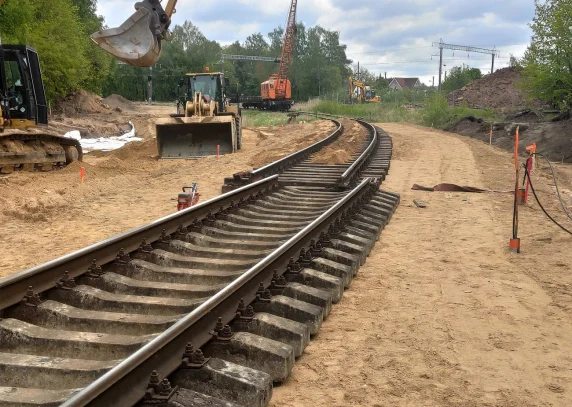
VILNIUS — In a major leap forward for one of Europe’s most ambitious trans-boundary infrastructure initiatives, Lithuania’s railway infrastructure manager has officially launched a sweeping series of procurement tenders valued at an estimated €475 million. The move marks a critical operational milestone for the Rail Baltica mega-project, a high-speed rail corridor designed to seamlessly connect the Baltic States to the broader European rail network.
The newly announced tenders encompass the construction of the vital rail link connecting Kaunas to Panevėžys, an array of complex engineering structures along the route, and the centerpiece of the regional buildout: the longest railway bridge in the entire Baltic region, which will span the Neris River near Jonava.
With strict financial timelines dictated by European Union funding frameworks and an urgent need to modernize regional mobility, Lithuanian authorities are moving swiftly to onboard premier international and domestic construction partners. This expansion represents not only a monumental engineering challenge but also a profound geopolitical and economic realignment for the Baltic region, integrating it firmly into the Trans-European Transport Network (TEN-T).
Main Facts: Scope, Scale, and Financial Architecture
The procurement drive initiated by AB Lietuvos Geležinkelių Infrastruktūra (Lithuanian Railways Infrastructure) focuses heavily on the northern stretch of the Rail Baltica corridor within Lithuanian territory, specifically the segment linking Kaunas to the Lithuanian-Latvian state border.
Core Construction Components
The €475 million investment package is divided into distinct, highly specialized engineering tasks designed to tackle the demanding terrain and technical specifications of a modern European-standard (1,435 mm gauge) railway. The primary components include:
- The Kaunas–Panevėžys Rail Link: The development of the railway embankment, sub-ballast layers, and associated infrastructure across a significant stretch of Lithuanian landscape.
- Complex Engineering Structures: The construction of overpasses, animal crossings, eco-ducts, and localized road networks to ensure the railway does not fragment local communities or ecosystems.
- The Neris River Bridge: Spanning the Neris River near Jonava, this structure will be the longest railway bridge in the Baltic states. Accounting for approximately €67 million of the total tender value, this architectural and engineering feat requires advanced construction methodologies to span the wide river valley safely and sustainably.
- Upper Railway Structure Installation: The subsequent laying of tracks, sleepers, electrification masts, and signaling systems.
Funding and Financial Breakdown
The realization of the Rail Baltica corridor relies heavily on robust international cooperation and centralized European Union funding. Of the €475 million allocated for these specific works, 85% will be directly financed by the European Union through the Connecting Europe Facility (CEF). The remaining 15% will be covered by the national budget of the Republic of Lithuania.
According to comprehensive cost-benefit analyses and expert evaluations conducted initially in 2017, the combined required financing for the entire construction of the railway line from Kaunas to the Lithuanian-Latvian state border is estimated at €977 million. This entire northern section maintains the same favorable 85% EU co-financing ceiling.
Lithuania has already laid the groundwork for rapid capital absorption. The country has submitted formal applications for EU funding, with €201 million specifically earmarked to support the newly launched contracting tenders. This is bolstered by an additional €202 million in EU funding previously secured under the Multiannual Financial Framework (MFF).
Chronology of the Procurement and Execution Strategy
Executing a project of this magnitude requires a highly structured, phased procurement process designed to mitigate risk, attract top-tier global engineering firms, and maintain momentum.
The Two-Stage Procurement Model
To ensure that only qualified, highly capable contractors participate in the physical construction phases, AB Lietuvos Geležinkelių Infrastruktūra has structured the tenders into a rigorous two-stage process:
- Stage One (Qualification and Selection): Construction companies and international consortia matching stringent financial, technical, and safety qualification requirements are selected. During this initial phase, while the qualification adherence competitions are underway, technical requirements for the second stage are meticulously drafted.
- Stage Two (Specific Proposals): The pre-qualified companies submit detailed, binding proposals for individual construction objects and components.
Division into Purchase Object Groups
Recognizing the vast scope of the EU financing, the complexity of technical projects currently being drafted, and the technological nuances of executing high-speed rail construction, Lithuanian planners have strategically split the construction works along the Kaunas–Latvian border line into four main purchase object groups. Separate contracts will be awarded for each group:
- Group 1: Railway embankment and engineering structures construction.
- Group 2: Connecting road laying and local infrastructure reconfiguration.
- Group 3: The flagship construction of the bridge over the Neris River near Jonava city.
- Group 4: Upper railway structure installation works (track-laying and electrification).
Competitions for groups one, three, and four were prioritized for launch, with the qualification adherence competitions for the connecting road network (Group 2) scheduled to follow immediately after.
Supporting Data and Technical Parameters
The technical parameters of Rail Baltica are designed to meet strict European Union interoperability standards, ensuring that trains can travel smoothly from Warsaw through the Baltic capitals and onward to the Finnish border via Tallinn and a future Gulf of Finland tunnel.

Key Technical and Financial Metrics
- Total Tender Value (Current Phase): €475 million.
- Neris River Bridge Allocation: €67 million.
- Total Estimated Cost (Kaunas to Latvian Border): €977 million (based on updated 2017 cost-benefit evaluations).
- EU Funding Contribution: Up to 85% across eligible project phases.
- Gauge Width: 1,435 mm (Standard European gauge), breaking away from the legacy 1,520 mm Soviet-era gauge dominating the region’s historical networks.
- Target Completion/Utilization Deadline: Under current EU Multiannual Financial Framework (MFF) rules, European allocations must be fully utilized by 2023 for specific early-action thresholds, placing an immense premium on swift execution and zero tolerance for bureaucratic delays.
Official Responses and Strategic Perspectives
The announcement of the €475 million tenders drew significant commentary from transport leadership in Lithuania, emphasizing both the economic opportunity and the tight operational deadlines facing the project stakeholders.
Karolis Sankovski, Director-General of AB Lietuvos Geležinkelių Infrastruktūra, underscored the delicate balance between logistical ambition and regulatory pressure during the tender launch.
"In the first [stage], construction companies matching qualification requirements will be selected, and in the second stage, the selected companies will submit the specific proposals for individual construction objects and components," Sankovski explained, detailing the mechanics of the dual-track procurement approach.
Addressing the critical nature of the timeline, Sankovski pointed directly to the strict deadlines imposed by the European Union’s budgetary mechanisms:
"Additional €202 million EU funding was secured by Lithuania and under the actual MFF, the European financing must be used until 2023. Thus, there can be no delay, and in order to complete the project in time, we must begin executing the work as soon as possible."
Transport analysts and industry stakeholders have echoed these sentiments, noting that while the technical complexities of bridging the Neris River and stabilizing embankments across marshy or uneven terrain are substantial, the institutional willingness to streamline procurement is a positive indicator for the project’s long-term viability.
Implications: Geopolitical, Economic, and Logistical Impact
The issuance of these high-value tenders carries profound implications that stretch far beyond the borders of Lithuania, touching upon European security, economic integration, and environmental sustainability.
1. Breaking the "Rail Insulation" of the Baltics
Historically, the Baltic States—Estonia, Latvia, and Lithuania—have operated on the 1,520 mm Russian rail gauge, a relic of the Tsarist and Soviet eras. This technical barrier physically isolated the region’s rail network from the rest of Central and Western Europe, necessitating costly and time-consuming transshipment of freight and passengers at borders. Rail Baltica replaces this isolation with a high-speed, standard-gauge European corridor. The construction of the Kaunas–Panevėžys link and the Neris River bridge directly bridges this missing link, enabling uninterrupted rail travel from Berlin to Tallinn.
2. Dual-Use Infrastructure and Regional Security
In the wake of shifting geopolitical realities in Eastern Europe, infrastructure projects like Rail Baltica have taken on heightened strategic importance. While primarily designed for high-speed commercial passenger traffic (operating at speeds up to 240 km/h) and heavy-freight cargo logistics (accommodating freight trains up to 740 meters long), the line serves as vital "dual-use" infrastructure. In times of crisis, the standard-gauge corridor drastically enhances NATO’s military mobility, allowing for the rapid, secure deployment of allied troops, heavy armored vehicles, and logistical supplies directly into the Baltic region from Western Europe.
3. Economic Stimulus and Job Creation
Deploying €475 million into the regional construction market serves as a massive economic stimulus, particularly as European economies navigate post-pandemic recovery and inflationary pressures. The massive engineering works required for the Kaunas-Panevėžys section and the Jonava bridge will generate thousands of direct jobs for civil engineers, heavy machinery operators, metallurgists, and construction specialists, while indirectly benefiting regional supply chains, hospitality sectors, and local manufacturing industries in Lithuania.
4. Environmental and Green Transition Benefits
Aligning with the European Green Deal, Rail Baltica is engineered to be a sustainable transport mode that drastically reduces carbon emissions compared to road freight and regional aviation. By shifting significant volumes of freight from Lithuania’s highways onto electric-powered rail, the project will help mitigate air pollution, reduce highway maintenance costs, and lower the carbon footprint of Baltic logistics chains. The inclusion of eco-ducts and wildlife crossings in the engineering specifications ensures that habitat fragmentation is minimized along the new corridor.
Conclusion
Lithuania’s launch of the €475 million Rail Baltica tenders is a watershed moment for European infrastructure integration. By maintaining a relentless focus on execution speed, leveraging substantial EU financial backing, and breaking down the complex route into manageable, highly specialized purchase groups, Lithuanian authorities are systematically turning the vision of a unified European rail space into a physical reality. As contractors prepare their qualification bids, the Baltic States stand on the precipice of a new era in modern, high-speed, and secure connectivity.

