

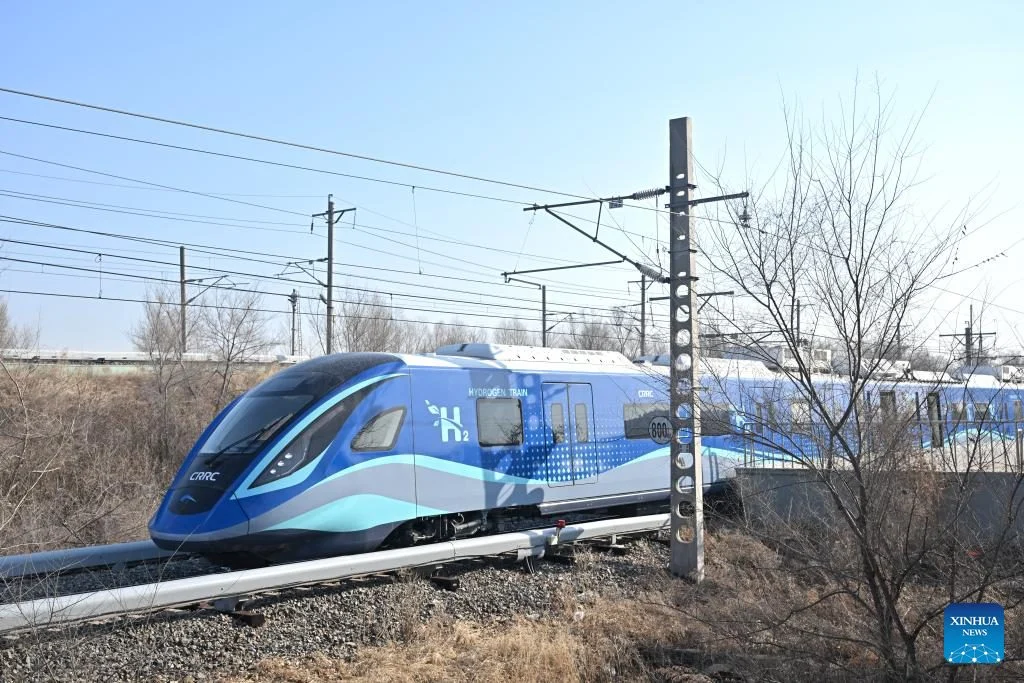
BEIJING — In a landmark achievement that underscores its accelerating transition toward green infrastructure, China has successfully conducted a high-speed operational test of its first domestically developed hydrogen-powered urban train. Reaching a maximum velocity of 160 kilometers per hour, the breakthrough trial not only validates years of intensive research and development in clean transportation but also signals a paradigm shift in how densely populated metropolitan corridors and regional rail networks might be powered in the coming decades.
Developed by CRRC Changchun Railway Vehicles Co., Ltd., a subsidiary of the world’s largest rolling stock manufacturer, China Railway Rolling Stock Corporation (CRRC), the hydrogen-fueled transit unit completed its rigorous evaluation on Thursday. By combining high-speed capability with zero-emission propulsion, the milestone bridges the historically difficult gap between sustainable urban mobility and the performance demands of modern intercity transit.
1. Main Facts
The successful test of China’s pioneering hydrogen city train represents a convergence of advanced rail engineering and cutting-edge alternative energy technology. Unlike conventional internal combustion engine trains or traditional electric multiple units (EMUs) that require costly overhead catenary wire infrastructure, this vehicle operates via an on-board hydrogen fuel cell system.
Key Technical Specifications and Performance Metrics:
- Top Speed: The train successfully achieved its target design speed of 160 km/h (approx. 100 mph) during the recent evaluation phase, placing it among the fastest hydrogen-powered passenger trains in the world.
- Extended Range: Equipped with an advanced hydrogen storage and power system, the train boasts a maximum operational range exceeding 1,000 kilometers (621 miles) on a single fueling cycle, putting its endurance on par with established global benchmarks like Alstom’s Coradia iLint.
- Energy Efficiency: Test telemetry data released following the trial indicates an average energy consumption rate of 5 kilowatt-hours (kWh) per kilometer, positioning the Chinese rolling stock on equal footing with global industry leaders in energy-efficient rail transit.
- Core Innovation: The propulsion architecture integrates high-performance hydrogen fuel cells with supercapacitors, ensuring rapid acceleration, stable power delivery under heavy loads, and efficient regenerative braking recovery.
- Zero Emissions: The sole byproduct of the electrochemical reaction powering the train is pure water, eliminating particulate matter (PM), nitrogen oxides ($NO_x$), and carbon dioxide ($CO_2$) emissions entirely at the point of operation.
2. Chronology: The Journey to 160 km/h
The realization of China’s high-speed hydrogen train was not an overnight success; it is the culmination of a meticulously planned national strategy aimed at decarbonizing transport and establishing industrial dominance in green technologies.
Phase One: Research, Conceptualization, and Design (2019–2021)
As China solidified its "Dual Carbon" goals—peaking carbon dioxide emissions before 2030 and achieving carbon neutrality before 2060—rail transport emerged as a primary target for systemic transformation. CRRC Changchun initiated feasibility studies for a heavy-duty, high-capacity hydrogen propulsion system designed specifically for urban and sub-urban applications. Engineers faced the dual challenge of maximizing fuel cell power output without compromising passenger space or adding prohibitive weight to the trainsets.
Phase Two: Component Integration and Manufacturing (2021–2022)
By late 2022, the first prototype rolled off the production lines in Changchun, the capital of northeast China’s Jilin province. This phase involved rigorous bench testing of the proprietary hydrogen fuel cell modules, cryogenic storage tanks, and intelligent energy management systems. Engineers focused heavily on safety protocols, subjecting hydrogen containment vessels to extreme pressure, impact, and thermal stress simulations to ensure absolute reliability in commercial environments.
Phase Three: Closed-Track Static and Low-Speed Trials (2023–Early 2024)
In early 2023, the train was moved to CRRC Changchun’s dedicated testing facility. Initial trials verified static operations, auxiliary power systems, and low-speed handling. Over subsequent months, engineers progressively expanded the operational envelope, testing the vehicle’s dynamic response under varying simulated weather conditions, passenger loads, and gradient profiles.
Phase Four: The Breakthrough 160 km/h Milestone (March 2024)
The culmination of this exhaustive development cycle occurred on Thursday, when the train underwent a comprehensive system-wide performance evaluation on the company’s test track. Operating at its maximum design speed of 160 km/h, the train successfully validated all safety, control, and powertrain metrics. According to state media reports from Xinhua, the trial marks a definitive turning point in the practical application of hydrogen energy within heavy rail transport.
3. Supporting Data and Comparative Analysis
To contextualize the significance of CRRC’s achievement, industry analysts look at global trends in hydrogen rail technology and the underlying economics of energy consumption.
Comparative Landscape: Hydrogen in Global Rail
While European manufacturers—most notably France’s Alstom with its Coradia iLint—pioneered early commercial deployment of hydrogen trains on regional routes, those legacy models typically operate at lower maximum speeds (generally capped between 140 km/h). Germany and regional European networks have embraced hydrogen to replace diesel units on non-electrified tracks.
However, China’s new train pushes the envelope further by combining a higher operational velocity (160 km/h) with a heavy-duty urban transit capacity. This makes the Chinese model uniquely suited not just for rural or scenic branch lines, but for high-frequency commuter and regional networks connecting sprawling metropolitan clusters.
Energy Consumption Breakdown
Energy efficiency remains the ultimate metric for commercial viability in public transport. The recorded average consumption of 5 kWh per kilometer demonstrates exceptional engineering efficiency for a trainset of this size and speed.

$$textEnergy Efficiency = fractextTotal Energy Expended (kWh)textDistance Traveled (km) = 5 text kWh/km$$
This low energy footprint is achieved through several technological integrations:
- Hybrid Power Architecture: The combination of hydrogen fuel cells and lithium-titanate or supercapacitor energy storage allows the train to capture kinetic energy during braking and redeploy it during acceleration.
- Lightweight Body Construction: Utilizing advanced carbon-fiber composites and lightweight aluminum alloys, engineers reduced the overall tare weight of the trainset, directly lowering the energy required to propel it at high speeds.
- Smart Energy Management System (SEMS): An onboard artificial intelligence algorithm dynamically adjusts power distribution between the fuel cells and storage batteries based on real-time track topography, speed limits, and schedule demands.
4. Official Responses and Industry Stakeholders
The successful test has drawn enthusiastic responses from government officials, corporate leaders, and scientific institutions alike, highlighting the strategic importance of the project.
CRRC Changchun Railway Vehicles
In official statements following the test, project leads at CRRC Changchun emphasized that the validation of the train’s full-scenario performance proves domestic manufacturing is ready to supply global markets with advanced green alternatives.
"This milestone demonstrates that China has mastered the complete technology chain for hydrogen-powered urban and intercity trains," noted a lead engineer involved in the testing program. "We have successfully overcome the technical barriers associated with high-speed hydrogen fuel cell integration, opening the door to widespread commercialization."
Media and Public Reception
Major state outlets, including the Xinhua News Agency, heralded the event as a monumental step forward for China’s green transportation strategy. Analysts pointed out that the trial aligns with China’s broader industrial policies, which prioritize the cultivation of "New Quality Productive Forces"—high-tech, high-efficiency, and environmentally sustainable industries designed to drive future economic growth.
5. Broader Implications for Global Transportation
The successful testing of a 160 km/h hydrogen city train carries profound implications for urban planning, energy markets, and the global race toward net-zero emissions.
1. Decarbonizing Non-Electrified Rail Corridors
While high-speed rail networks globally rely heavily on overhead catenary wires, electrifying low-density regional lines, industrial spurs, or suburban commuter links is often economically prohibitive. Installing electrical infrastructure across thousands of kilometers of track requires billions of dollars in capital expenditure and causes extensive environmental disruption. Hydrogen trains offer a "drop-in" replacement for diesel locomotives, utilizing existing track infrastructure while instantly eliminating carbon emissions.
2. Infrastructure Independence and Energy Security
By diversifying the energy matrix away from imported fossil fuels and reducing reliance on complex electrical grid expansions, hydrogen trains offer regional transport authorities greater operational resilience. Furthermore, as green hydrogen production—derived via water electrolysis powered by wind and solar energy—scales up globally, the entire supply loop from fuel generation to transport operation can achieve absolute carbon neutrality.
3. Setting a New Export Standard
As developing and developed nations alike seek cost-effective ways to green their transit systems, Chinese rolling stock manufacturers are poised to capture significant international market share. Offering a high-speed (160 km/h), long-range (1,000+ km) hydrogen platform at a competitive price point gives CRRC a distinct advantage in global procurement tenders across South America, Southeast Asia, the Middle East, and parts of Europe.
4. Future Outlook: Toward Full Commercial Deployment
Following the successful completion of these rigorous trials, the hydrogen city train is expected to transition into pilot commercial operations. Municipalities across China with ambitious green transit mandates are already eyeing the technology to replace aging diesel fleets. As hydrogen refueling infrastructure continues to expand alongside industrial production hubs, the 160 km/h hydrogen train stands ready to redefine the future of clean, high-speed regional mobility.

