

The global landscape of urban governance is undergoing a seismic shift. For over a decade, cities worldwide have experimented with "smart" technologies—deploying sensors to track traffic, waste, and energy consumption. However, the next frontier is not merely the collection of data, but the intelligent application of it. At the recent Global Government AI CITY Innovation Summit, held during Huawei Connect 2026 in Shanghai, leaders from across the globe converged to discuss the transition from reactive smart cities to proactive, AI-driven urban ecosystems.
The core argument presented at the summit was clear: the future of urban resilience depends on robust digital foundations, open-source collaboration, and a fundamental transition toward AI-native governance.
The Evolution of the Smart City
The trajectory of urban development has evolved through distinct phases. Initially, cities focused on digitizing records and installing basic infrastructure. Now, the emphasis is on the "AI City" model. In this framework, digital foundations are layered with AI agents that function as autonomous operators—detecting anomalies, forecasting shifts in population needs, recommending interventions, and automating routine tasks.
The summit underscored that this is not a technological luxury but a necessity for modern urban planning. As global populations continue to concentrate in metropolitan areas, the complexity of managing resources, public safety, and infrastructure has outpaced the capacity of traditional, human-led management systems.
Chronology of AI-Driven Urban Transformation
The summit showcased a series of real-world implementations that illustrate how AI is currently reshaping urban environments.

- Pre-2025: The Foundation Phase: Many participating cities, such as Guangzhou, spent years building the technical architecture—public clouds and high-performance computing clusters—necessary to support AI applications.
- April 2025: Launch of MESOB in Ethiopia: The Ethiopian government introduced the Modern Ethiopian Service for Organized Benefits (MESOB), a hybrid digital and physical platform designed to decentralize public services and reach remote populations.
- July 2026: Typhoon Noul Response: Shenzhen, China, demonstrated the power of AI in emergency management. The "Long Xiao Er" agent, an urban governance AI, processed data from over 740,000 images to identify potential hazards and coordinate emergency responses before the typhoon made landfall.
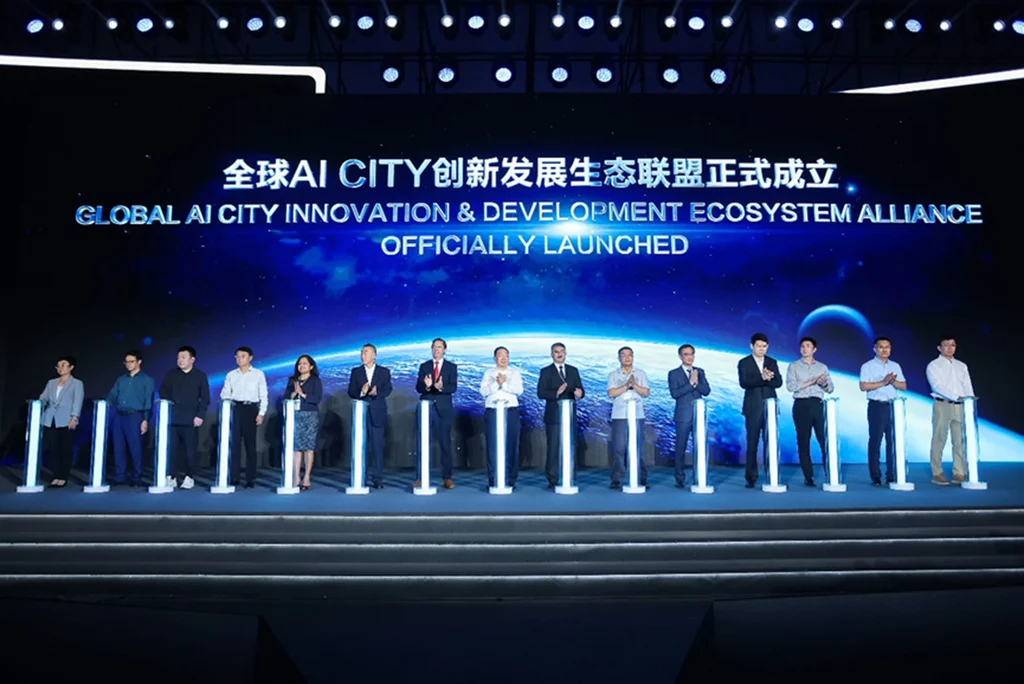
- October 2026: The Global AI City Innovation and Development Ecosystem Alliance: The summit concluded with the formal launch of this alliance, signaling a move toward standardized, collaborative global development.
Supporting Data and Performance Metrics
The shift toward AI is yielding measurable, high-impact results. During the summit, officials from Guangzhou, China, provided a window into the scale of their transformation. Currently, the city has 20 active AI agents, with a goal of reaching 50 by the end of the year.
The efficiency gains are substantial:
- Government Workflow Automation: Guangzhou’s smart office agent now supports 55 agencies and 26,000 public servants, having processed over 5 billion token invocations.
- Emergency Dispatch: The city’s new AI-powered hotline agent has reduced ticket dispatch times from one hour to a matter of seconds.
- Resolution Rates: The automated hotline maintains a first-contact resolution rate exceeding 69%.
- Workload Reduction: Data governance and cataloging agents have successfully offloaded 80% and 90% of manual workloads, respectively, allowing human staff to focus on high-level decision-making.
In Shenzhen, the deployment of AI in typhoon preparedness allowed for the issuance of over 2,800 early warnings to front-line personnel, effectively moving the city’s emergency management from a "reactive rescue" model to a "proactive prediction" model.
Official Responses and Strategic Perspectives
The summit provided a platform for international leaders to share their strategies for navigating the complexities of AI integration.
The Foundation-First Strategy (China)
Cheng Ou, Deputy Director-General of the Guangzhou Municipal Government Services and Data Administration, emphasized that AI success is predicated on "eight unifications." She argued that before deploying sophisticated agents, governments must harmonize their data standards, network architecture, and security protocols. Without a common foundation, AI initiatives risk becoming siloed, inefficient experiments.

Citizen-Centric Innovation (Angola)
Meick Afonso, General Director of Angola’s Administrative Modernization Institute (IMA), offered a sobering reminder of the realities facing developing nations. With a median population age of 17, Angola’s primary challenge is scale. Afonso cautioned against the "AI trap"—the temptation to implement complex automation on top of broken, fragmented manual processes. His advice to peers was to "redesign procedures first, then automate," ensuring that digital tools directly address the immediate needs of a rapidly growing population.
Closing the Feedback Loop (Saudi Arabia)
Mohammed Ashgar, CEO of the Center for Monitoring City Operations in Saudi Arabia, highlighted the importance of accountability. By creating an AI-empowered National Command Control Center, the Kingdom has unified disparate detection sources—such as reports on road defects and hygiene issues—into a single, transparent workflow. Ashgar’s key takeaway was that detection is only half the battle; the "closed-loop" system ensures that the government can verify whether corrective actions were actually taken, preventing the common issue of reported problems falling into a bureaucratic void.
Localizing Digital Models (Ethiopia)
Melaku, Director at MESOB, focused on the inclusivity of digital government. He argued that technology should not be an urban privilege but a tool for accessibility. By using mobile service buses and localized digital interfaces, Ethiopia is proving that AI and digital infrastructure can bridge the gap between urban centers and remote communities, fostering greater trust and transparency in government.
Implications for the Future of Governance
The transition to an "AI City" carries significant implications for both citizens and government officials.
The End of the "Reactive" Era
The most profound implication is the shift from reacting to crises to preventing them. Whether it is predicting flood patterns in Shenzhen or optimizing road repairs in Saudi Arabia, AI allows governments to be "always on." This shift requires a change in culture, moving public servants away from data entry and manual dispatch toward roles that involve supervising AI outputs and managing complex, multi-agency collaborations.
The Necessity of Global Collaboration
Recognizing that no single city or country has all the answers, the summit’s conclusion focused heavily on collective growth. The launch of the Global AI City Innovation and Development Ecosystem Alliance marks a transition from competitive tech development to cooperative innovation. By sharing "AI-ready" data structures and pre-built agents through platforms like the AI Foundry, governments can avoid reinventing the wheel.
Ethical and Technical Considerations
While the gains in efficiency are clear, the summit participants were cognizant of the challenges ahead. Trust remains the cornerstone of digital government. As AI systems become more deeply embedded in the lives of citizens—handling financial services, urban safety, and public utilities—the demand for transparency and security will only grow. The focus on "trusted digital foundations" suggests that the next phase of development will require as much investment in cybersecurity and ethical oversight as it does in processing power.
Conclusion: The Path Ahead
The vision for the AI City is one where technology acts as an invisible, silent partner in the success of a city. It is a future where the friction of daily life—the delay in public services, the ambiguity of government communication, and the lag in disaster response—is minimized by the precision of intelligent systems.
As Simon Zhou of Huawei noted, "Technology keeps breaking city boundaries, bringing inclusive services to everyone." The challenge for the coming decade will be to ensure that these boundaries are broken equitably. For the governments represented in Shanghai, the path is clear: build a unified foundation, focus on the citizen’s journey, and collaborate across borders to turn the promise of artificial intelligence into the reality of a more livable, resilient, and responsive city.

