

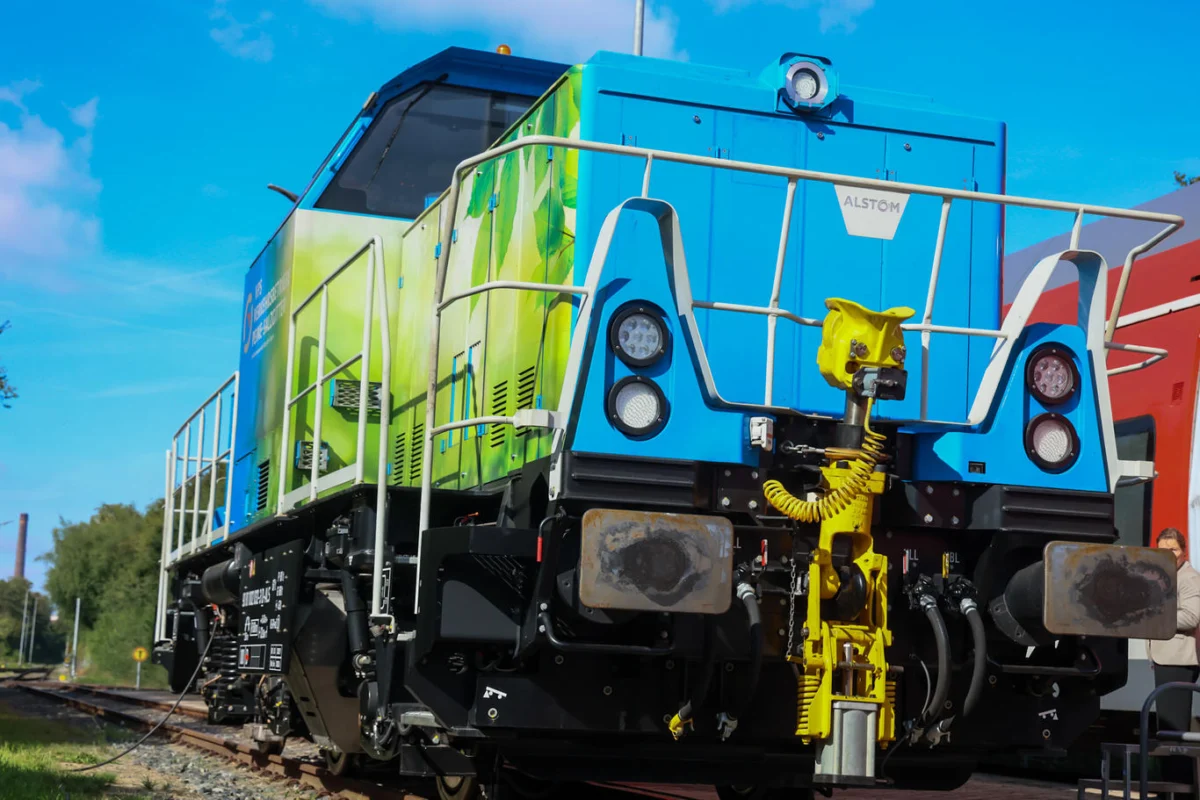
In a landmark achievement for sustainable industrial transport, Alstom has successfully completed the world’s first trial run of a shunting locomotive retrofitted from traditional diesel power to hydrogen combustion. Conducted at the company’s Salzgitter site in Germany, this technological milestone represents a pivotal shift in how the rail industry approaches the decarbonization of short-haul and yard-based logistics. By proving that existing heavy machinery can be modernized rather than scrapped, Alstom is setting a new precedent for circular economy principles within the global rail sector.
Main Facts: A Paradigm Shift in Rail Propulsion
The project centers on the conversion of a legacy diesel shunting locomotive into a hydrogen-powered machine capable of performing the same rigorous tasks without the environmental footprint. Unlike fuel-cell technology, which converts hydrogen into electricity, this specific conversion utilizes direct hydrogen combustion, allowing the engine to run on carbon-free fuel.
This initiative is not merely an engineering experiment; it is a collaborative industrial effort involving heavyweights such as VPS Verkehrsbetriebe Peine-Salzgitter, the research expertise of WTZ Roßlau gGmbH, the academic rigor of TU Braunschweig, and the advanced material science capabilities of the Fraunhofer Institute for Surface Engineering and Thin Films.
The locomotive is currently undergoing intensive industrial testing at the Salzgitter Group’s steel production facilities. This phase is critical, as it subjects the retrofitted engine to the demanding realities of moving massive steel loads within an active industrial site. The trial period is slated to continue through October 2025, after which the locomotive will be returned to its original configuration, providing the data necessary to refine the conversion process for future commercial scaling.
Chronology: From Concept to Carbon-Free Combustion
The journey toward this successful run began with the identification of a massive, untapped market: the thousands of aging diesel shunters currently operating across European rail networks.
- Project Inception: Recognizing the potential to modernize rather than replace, Alstom and its consortium partners identified the shunting locomotive as an ideal candidate for hydrogen integration due to its controlled operational environment.
- Engineering and Research Phase: Working in tandem with TU Braunschweig, the team addressed the technical challenges of hydrogen combustion, particularly the complexities of exhaust gas turbocharging, which requires precise handling of high excess air levels.
- Funding Approval: The project secured a significant financial boost via the city of Salzgitter, which allocated EUR 1.5 million from Lower Saxony’s EUR 50 million structural aid package. This state support underscored the strategic importance of the project to the region’s economic and environmental goals.
- The Pilot Run: Following months of laboratory and bench testing, the locomotive successfully hit the tracks at the Salzgitter facility, marking the first time a hydrogen-converted shunter has operated in a real-world industrial setting.
- Current Testing Phase (Ongoing – October 2025): The engine is currently being stress-tested under daily operating conditions at the steel plant. This period will produce the empirical data required to determine the viability of a standardized, mass-market conversion kit.
- Post-Trial Evaluation: Following the conclusion of the tests in late 2025, the findings will be analyzed to develop a blueprint for potential series production.
Supporting Data: The Scale of the Environmental Opportunity
The environmental impact of this initiative is staggering when extrapolated across the European rail landscape. Currently, there are approximately 1,000 diesel shunting locomotives operating in Germany alone, with roughly 4,000 in service throughout the European Union. These machines are often the most difficult to decarbonize due to their long operational lifespans and the high cost of total replacement.
Alstom’s data indicates that a single converted shunting locomotive can save up to 150 tonnes of CO2 emissions annually. Over a typical remaining service life of 15 to 20 years, a single unit could prevent up to 3,000 tonnes of CO2 from entering the atmosphere. To put this into perspective, the impact of one such locomotive is equivalent to removing the emissions of 650 passenger cars or planting 200,000 trees.
The project is also a key component of the wider decarbonization strategy at Salzgitter AG. VPS, the logistics arm of the steel giant, operates a fleet of 42 shunting locomotives. The successful transition of these units would integrate seamlessly with the SALCOS (Salzgitter Low CO2 Steelmaking) programme, which aims to shift the company’s entire steel production process away from coal-reliant blast furnaces toward hydrogen-based direct reduction.
Official Responses: A Vision for the Future
The project has garnered significant attention from both government officials and industry leaders, all of whom view this trial as a blueprint for the future of green infrastructure.
François Muller, Vice President of Services for Central and Northern Europe at Alstom, framed the development as a breakthrough in sustainability: "With this research project, we are once again pioneering the use of hydrogen in rail transport. We are expanding the spectrum of vehicle modernization with a doubly sustainable approach—thanks to this solution, our customers can switch to emission-free operation without having to replace their existing fleet."
Frank Klingebiel, Mayor of Salzgitter, highlighted the city’s proactive role in the energy transition. "At our Hydrogen Campus, we are developing the technologies of tomorrow in the areas of factory transformation, green hydrogen, and hydrogen storage," Klingebiel stated. "In the joint project to decarbonize shunting traffic, the city is not only on the sidelines but is also an active player with a financial contribution of EUR 1.5 million."
From the technical side, Prof. Dr. Peter Eilts of TU Braunschweig expressed pride in the engineering solutions achieved. "We have worked intensively on the design of the exhaust gas turbocharging, as the high excess air poses a particular challenge here. With success! The project demonstrates how hydrogen’s unique combustion properties can actually lead to improved efficiency while drastically cutting emissions."
Dr. Christian Reiser of WTZ Roßlau emphasized the significance of the achievement for the broader rail sector, noting that the project represents the successful transition of hydrogen technology "from the test bench to the real track."
Implications: The Road to Scalable Green Logistics
The implications of Alstom’s success are far-reaching. By creating a methodology to convert existing diesel engines, Alstom provides rail operators with a cost-effective path to sustainability that avoids the immense capital expenditure and environmental cost of manufacturing thousands of new electric or hydrogen-powered vehicles.
1. Retrofitting as a Sustainable Strategy
The "doubly sustainable" approach mentioned by Alstom is critical. Manufacturing a new locomotive involves significant carbon expenditure in the mining of raw materials and the industrial production of parts. By extending the life of the existing fleet, the industry avoids this "embedded carbon" and keeps older assets useful for decades to come.
2. Standardizing the Technology
The results gathered through October 2025 will dictate the feasibility of a modular conversion kit. If the trial continues to yield positive results, Alstom could potentially offer this as a service to other rail operators, creating a standardized "Hydrogen Conversion Package" that could be applied to various locomotive models across the continent.
3. Synergies with Green Industry
The project proves that rail decarbonization does not happen in a vacuum. It is most effective when integrated into wider industrial ecosystems—like the steel industry—where hydrogen infrastructure (such as supply pipelines and electrolysis plants) is already being built for other manufacturing processes. This creates a "Hydrogen Hub" effect, where the logistics of moving materials become as green as the materials themselves.
4. Policy and Funding
The involvement of the Lower Saxony government highlights the shift in public funding from purely new-build projects to the modernization of legacy infrastructure. As Europe tightens its emissions regulations under the European Green Deal, projects like this will likely become the standard for accessing government grants and subsidies.
Conclusion: A Turning Point for European Rail
As the trial at the Salzgitter steel plant progresses, the eyes of the rail industry remain firmly fixed on the performance metrics of the converted locomotive. If the transition from diesel to direct hydrogen combustion proves durable, efficient, and reliable under the heavy-duty conditions of steel production, it will unlock a massive decarbonization potential for the European rail network.
By proving that the technology is ready for the "real track," Alstom, VPS, and their research partners have provided a tangible solution to one of the most stubborn problems in the transport sector. As the project reaches its conclusion in late 2025, the rail industry may well look back at this initiative as the moment the locomotive—the engine that fueled the industrial revolution—successfully pivoted to fuel the clean energy transition.

