

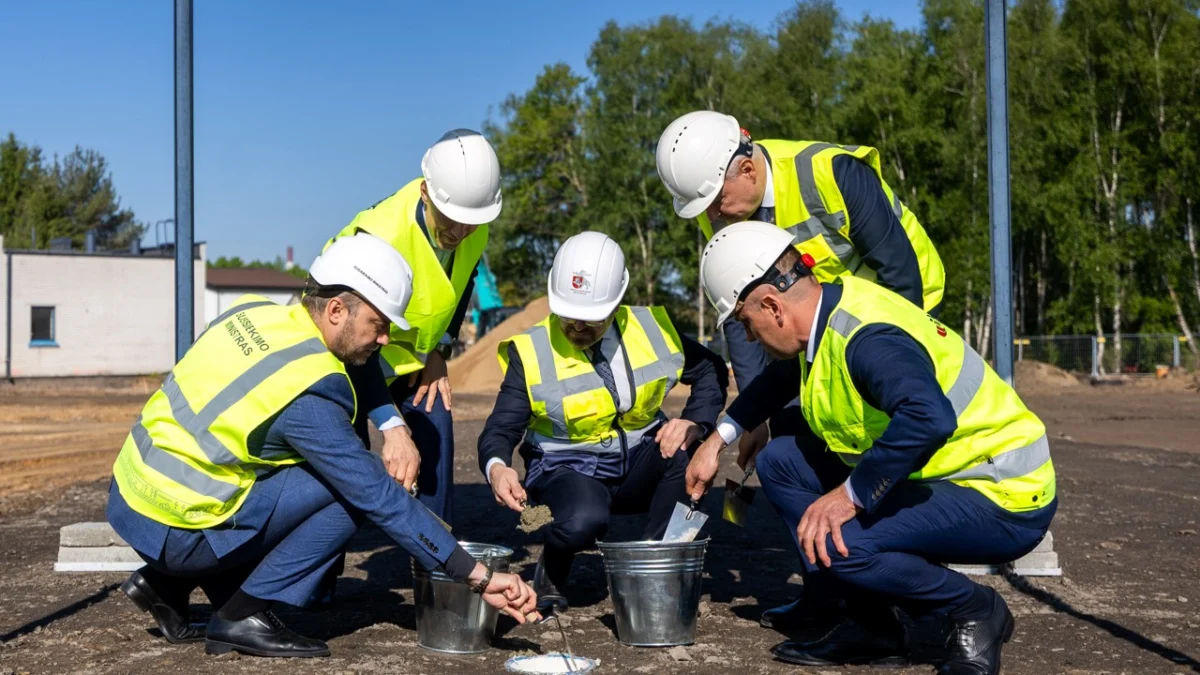
In a significant move to fortify the security architecture of the Baltic region, Lithuania has officially commenced construction on a state-of-the-art intermodal terminal in Palemonas. Managed by the national railway infrastructure operator, LTG Infra, this ambitious project is designed as a dual-use facility, seamlessly integrating civilian commercial logistics with high-capacity military mobility requirements. As geopolitical tensions necessitate a more robust defense posture, the Palemonas terminal stands as a critical investment in the logistical readiness of NATO’s eastern flank.
Main Facts: The Scope and Strategic Intent
The project, which represents a total investment of 37.4 million EUR, is far more than a simple upgrade to existing rail infrastructure. It is a strategic pivot designed to bridge the gap between European standard-gauge (1,435 mm) rail networks and the broader-gauge (1,520 mm) systems that dominate the Baltic region and Eastern Europe.
By creating a facility that can handle the rapid transshipment of heavy military equipment, Lithuania is addressing a historical bottleneck in NATO’s logistics chain. The terminal will feature a reinforced loading platform spanning approximately 36,000 m², engineered to support cargo weights of up to 100 tons and vehicles up to 120 tons—specifications necessary to accommodate heavy armored units, such as Main Battle Tanks (MBTs) and self-propelled artillery.
The scope of the project includes:
- Surface Modernization: A total of 46,000 m² of hard surfaces will be newly built or upgraded.
- Track Expansion: The installation of two 1,435 mm gauge lines and one 1,520 mm gauge line, complete with specialized terminal ramps.
- Infrastructure Connectivity: The construction of three new 1,435 mm lines with a minimum usable length of 750 meters, and the extension of three existing lines to meet these same capacity standards.
- Technical Upgrades: The reconstruction of 5.5 km of tracks and the installation of 12 advanced switches, all managed via Building Information Modeling (BIM) to ensure long-term operational efficiency.
Chronology of the Project
The transition from planning to execution marks the culmination of years of collaborative efforts between the Lithuanian Ministry of Transport, the Ministry of National Defense, and the LTG Group.
- Project Formulation: Following increased NATO emphasis on the "Military Mobility" action plan, the Lithuanian government identified Palemonas as a key hub due to its central location and existing rail connectivity.
- Public Procurement: Competitive tenders were launched to select contractors capable of managing the dual-use requirements. The contracts were awarded to a consortium of companies: Gevalda, Kauno keliai, and Statybų techninė priežiūra.
- Groundbreaking Ceremony: The project was officially inaugurated with a symbolic time capsule burial ceremony. This event served as a formal declaration of intent, attended by high-ranking government officials and defense representatives, signaling the importance of the terminal to the national security agenda.
- Operational Timeline: Construction is currently underway, with the project utilizing advanced digital modeling to synchronize the complex civil engineering required for both the heavy-duty concrete foundations and the precision rail laying.
Supporting Data: Engineering for Resilience
The technical requirements for this project are stringent, reflecting the reality of modern heavy-armor logistics. To facilitate the movement of allied forces, the terminal must be resilient enough to handle constant heavy-load traffic without degradation.
The use of 750-meter-long tracks is particularly significant. Standardizing this length across both gauge types allows for the rapid "unit train" movement of brigades. Instead of breaking down shipments, NATO forces will be able to transport complete logistical packages from Western Europe directly into the Lithuanian rail network.
Furthermore, the integration of noise and vibration reduction measures, along with modern utility networks and security surveillance, ensures that the terminal remains a viable neighbor for the surrounding Palemonas community while adhering to high environmental and security standards. The inclusion of BIM methodology is a hallmark of modern infrastructure development in the EU, allowing LTG Infra to create a "digital twin" of the terminal, which will facilitate predictive maintenance and rapid disaster recovery planning in the future.
Official Responses and Strategic Significance
The commencement of the Palemonas project has been met with strong backing from the highest levels of the Lithuanian government, underscoring the shift in how the nation views its civilian infrastructure.

Minister of Transport Juras Taminskas emphasized the dual utility of the investment: "Railways are particularly important for both civilian evacuation and the rapid movement of military forces in Europe. By investing in the development of military mobility infrastructure in Palemonas, we are strengthening the security of Lithuania and the entire Baltic region. This is about building a logistics backbone that can pivot from commercial trade to national defense in a matter of hours."
Arūnas Rumskas, acting CEO of the LTG Group, highlighted the interoperability aspect: "The expansion of the military mobility infrastructure in Palemonas is a strategic step that strengthens Lithuania’s readiness to receive large volumes of military transport. It ensures that our railway network operates as reliably as the logistics hubs of the most advanced NATO countries. It is an investment that is equally important for both defense and civilian logistics."
Minister of National Defense Robertas Kaunas linked the project to the broader NATO mission: "By investing in military mobility today, we are investing in Lithuania’s security, readiness, and closer cooperation with our allies. The loading area at the Palemonas terminal will ensure that Lithuania is prepared to rapidly receive allied forces, efficiently coordinate logistics, and strengthen the resilience of NATO’s eastern flank."
Implications: A New Era for Baltic Defense
The Palemonas terminal is set to become a linchpin of the Alliance’s logistics chain in Northern and Eastern Europe. Its implications are far-reaching:
1. Facilitating the German Brigade Deployment
Lithuania’s commitment to hosting a permanent German brigade requires a sophisticated logistical support system. The Palemonas terminal provides the exact infrastructure needed to sustain this deployment, ensuring that equipment, ammunition, and personnel can be moved with the speed and volume required for a high-readiness force.
2. Standard-Gauge Integration
The ability to transship cargo from 1,435 mm (standard) to 1,520 mm (broad) gauge is the most critical feature of this project. By streamlining this process, Palemonas allows for seamless transit from the European heartland to the port of Klaipėda—a vital node for maritime reinforcement—or toward the borders of Latvia and Estonia. This eliminates the "gauge gap" that has historically slowed down the deployment of allied heavy armor.
3. Civil-Military Synergy
The project proves that military resilience does not have to come at the expense of civilian economic development. By modernizing the intermodal terminal, the project also enhances Lithuania’s capacity to handle standard containerized cargo, potentially increasing the efficiency of the country’s export and import activities during peacetime.
4. Deterrence and Readiness
In the current security climate, the speed at which an Alliance can mobilize is the primary deterrent against aggression. By investing in permanent, hardened, and high-capacity infrastructure, Lithuania is signaling its readiness to provide a secure staging ground for NATO. The Palemonas terminal serves as a physical manifestation of Article 5 commitment, showing that the logistics of defense are being taken as seriously as the tactical deployment of troops.
Conclusion
As construction crews continue their work in Palemonas, the project stands as a testament to the evolving nature of European security. The terminal is more than just concrete, steel, and tracks; it is a vital organ in the body of the Atlantic Alliance. Through the meticulous planning of LTG Infra and the political commitment of the Lithuanian government, the Palemonas intermodal terminal will ensure that when the need for rapid deployment arises, the infrastructure of the Baltic region will be ready to meet the challenge, ensuring both the sovereignty of Lithuania and the stability of the entire eastern flank.

