

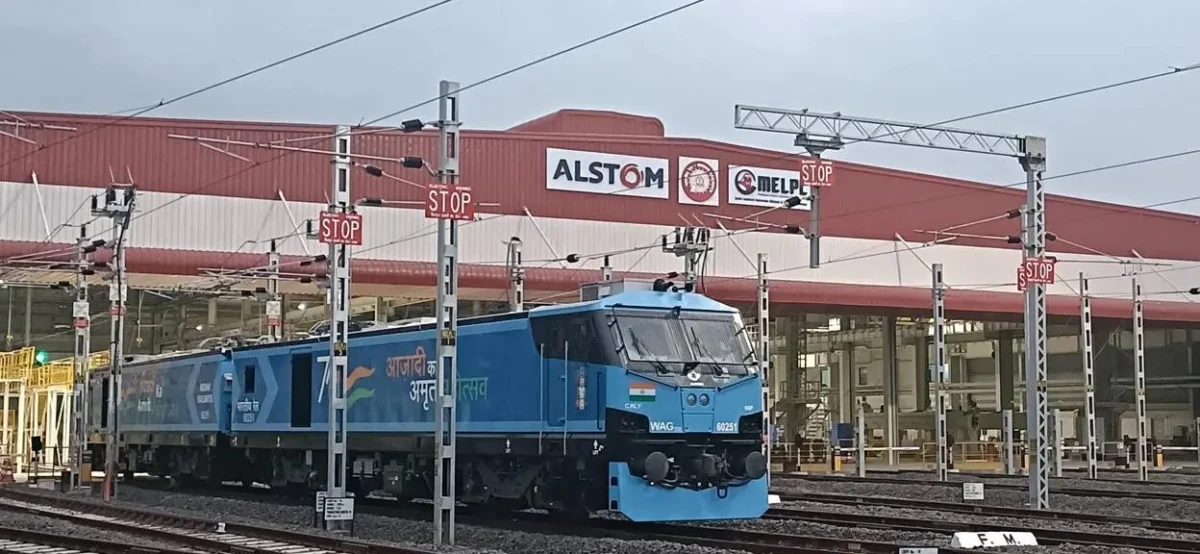
In a significant move that underscores the deepening industrial synergy between French rolling stock giant Alstom and the Indian government, a new maintenance contract worth €107 million has been finalized. This agreement, which centers on the sustained performance of the WAG-12B electric freight locomotive fleet, marks a pivotal moment in the ongoing modernization of India’s railway infrastructure. The contract has been awarded to Madhepura Electric Locomotive Private Limited (MELPL), the joint venture between Alstom and Indian Railways, ensuring that 250 of the most powerful locomotives in the Indian network remain at the cutting edge of operational efficiency.
The Core Agreement: Sustaining a Logistics Powerhouse
The five-year contract is not merely a service agreement; it is a strategic commitment to the reliability of India’s heavy-haul freight sector. Under the terms, MELPL will oversee the comprehensive maintenance of 250 WAG-12B electric locomotives, all of which are serviced out of the state-of-the-art facility in Nagpur.
This contract builds upon the success of a preceding four-year agreement, which served as a proving ground for the partnership. By formalizing this renewal, Alstom and Indian Railways have signaled that the operational benchmarks established during the initial phase have not only been met but have become the new standard for heavy freight locomotive maintenance within the country.
Chronology: From Vision to Industrial Benchmark
The journey of the WAG-12B, known globally as the Prima T8, is a testament to the "Make in India" initiative.
- The Inception (2015): The foundation was laid when Alstom and the Ministry of Railways signed a landmark agreement to manufacture 800 high-power electric locomotives in India. This move was intended to overhaul the country’s aging freight infrastructure.
- Facility Establishment: The Madhepura locomotive facility was commissioned, becoming one of India’s most advanced industrial units. Simultaneously, the Nagpur depot was established as a strategic nerve center for maintenance and rapid response.
- The First Phase (2020–2024): The initial four-year maintenance contract set the operational parameters. During this period, the Nagpur depot transformed into a center of excellence, integrating advanced diagnostics and predictive maintenance technologies.
- The Current Milestone (2024–2025): The awarding of the new €107 million contract confirms the long-term viability of the joint venture and marks the transition from the "deployment phase" to the "optimization phase" of India’s freight corridor operations.
Supporting Data: The Power of the WAG-12B
The WAG-12B is not an ordinary locomotive; it is a heavy-haul machine designed specifically for the rigorous demands of the Indian landscape.
- Technical Might: These locomotives boast a staggering 12,000 horsepower (CP), providing the torque necessary to haul massive freight loads of up to 6,000 metric tons.
- Efficiency: Capable of reaching speeds of up to 120 km/h, the Prima T8 units have drastically reduced transit times for essential goods, including coal, iron ore, and finished industrial products.
- Environmental Impact: By enabling heavier loads to be hauled by a single locomotive, these engines drastically reduce the carbon footprint per ton-kilometer, supporting India’s broader climate goals of transitioning freight from road to rail.
- Operational Availability: The maintenance regime at Nagpur ensures that fleet availability remains consistently high, minimizing downtime and ensuring that the Dedicated Freight Corridors (DFCs) operate at maximum capacity.
Comprehensive Maintenance: The Nagpur Ecosystem
The scope of the contract extends beyond simple mechanical repairs. MELPL is tasked with a holistic approach to fleet health. This includes the maintenance of the depot’s sophisticated infrastructure, which features digital diagnostics and automated test benches.
A cornerstone of this agreement is the deployment of mobile rapid-response teams. These specialized units, stationed at strategic nodes across the Indian rail network, are equipped with proprietary Alstom tools and an inventory of critical spare parts. Their existence minimizes "mean time to repair," ensuring that if a locomotive encounters an issue in the field, it is rectified with minimal disruption to the supply chain.
Furthermore, the contract mandates on-site training programs. By upskilling local technicians and engineers, Alstom is ensuring that the knowledge transfer—a critical component of the "Atmanirbhar Bharat" (Self-Reliant India) vision—is sustainable. This investment in human capital ensures that the expertise to maintain 12,000-horsepower locomotives remains firmly embedded within the Indian workforce.
Official Responses: Strengthening the Partnership
The renewal of the contract has been met with enthusiasm from both the private and public sectors. Olivier Loison, Managing Director of Alstom India, emphasized that this contract is a reflection of the trust established over the last decade.

"The renewal of this contract is a strong confirmation of our commitment to Indian Railways and the success of our partnership," Loison stated. "We are proud that the trust placed in us has translated into the proven performance and reliability of the WAG-12B electric locomotives, which are essential to the freight transport revolution in India."
Industry analysts point out that for a global leader like Alstom to commit such significant resources to a maintenance contract speaks volumes about the maturity of the Indian rail market. The partnership is no longer viewed as a foreign supplier-client relationship but as a deep-rooted industrial integration.
Implications for the Indian Rail Sector
The implications of this €107 million deal are far-reaching:
1. The "Make in India" Catalyst
By operating through six manufacturing facilities and five major engineering centers in India, Alstom has successfully localized its supply chain. This deal reinforces the government’s goal of making India a global manufacturing hub for rolling stock.
2. Dedicated Freight Corridors (DFCs)
The success of India’s DFCs—the backbone of the country’s industrial growth—relies entirely on the uptime of locomotives like the WAG-12B. With this contract, Indian Railways ensures that its most valuable assets are serviced by the original equipment manufacturer (OEM), reducing long-term lifecycle costs and improving overall logistics efficiency.
3. Economic Multiplier Effect
The maintenance ecosystem in Nagpur creates a ripple effect of economic activity. From specialized training and supply chain management to the local sourcing of components, the contract supports thousands of jobs and fosters a culture of high-tech industrial maintenance.
4. Technological Sovereignty
As India continues to push toward a 100% electrified railway network, the ability to maintain the world’s most advanced electric locomotives domestically is a strategic advantage. The knowledge gained at the Nagpur depot is transferable, potentially positioning India as a regional leader in heavy-haul rail maintenance.
Conclusion: A Future-Proof Strategy
As India looks toward a future of high-speed freight and expanded logistics, the partnership between Alstom and Indian Railways remains a defining feature of the sector. The €107 million contract for the WAG-12B fleet is more than just a business transaction; it is a critical piece of the infrastructure puzzle that will enable India to meet its ambitious logistics and climate targets.
Through the meticulous maintenance of these 250 locomotives, Alstom is not only ensuring the reliability of today’s freight but is also building the foundational expertise required for the next generation of rail technology in India. As the Nagpur depot continues to set benchmarks for excellence, the message to the industry is clear: the modernization of Indian rail is no longer a promise—it is a high-speed reality, powered by innovation, collaboration, and a relentless focus on performance.

