

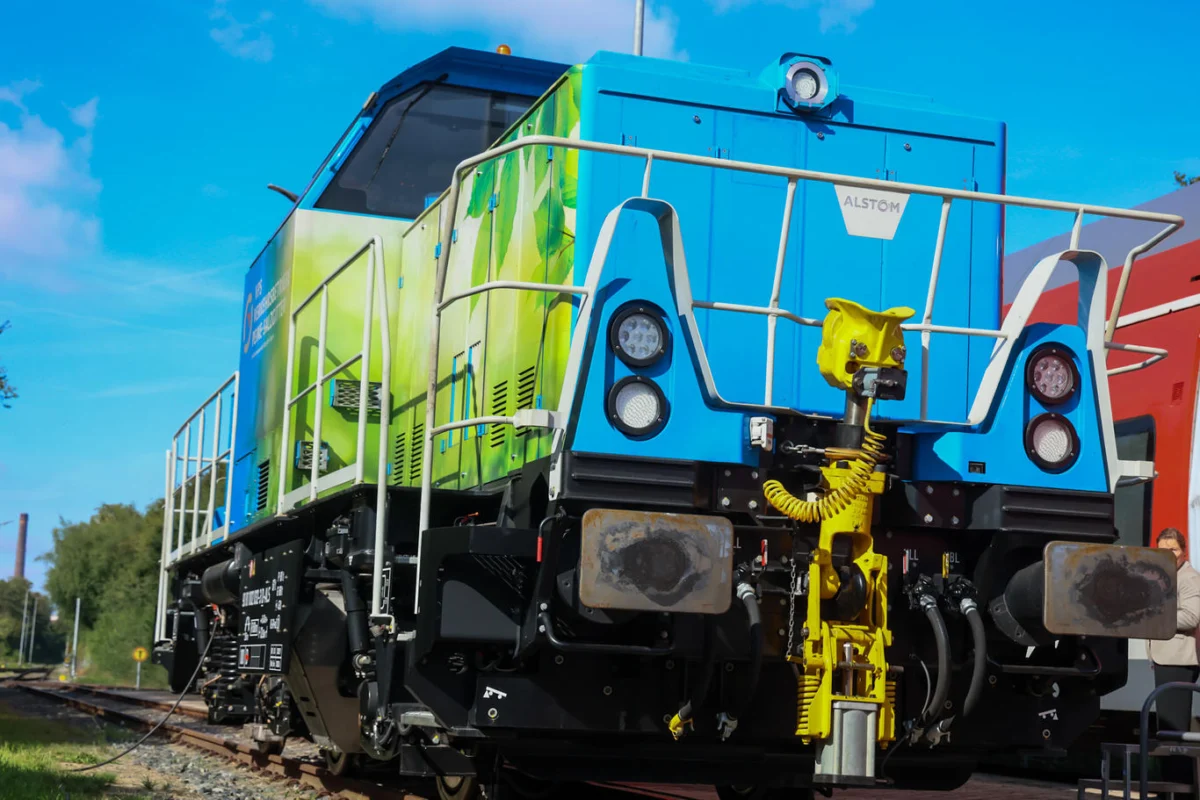
In a landmark achievement for sustainable industrial logistics, Alstom has successfully completed the world’s first trial run of a shunting locomotive retrofitted from diesel to hydrogen power. Conducted at the company’s facility in Salzgitter, Germany, this milestone represents more than just a technical success; it is a fundamental shift in how the rail industry approaches the decarbonization of legacy assets. By proving that existing heavy-duty machinery can be "re-powered" rather than scrapped, Alstom has opened a new, economically viable pathway to a zero-emission future for European rail freight.
Main Facts: A Technical and Strategic Breakthrough
The project, which centers on the conversion of a conventional diesel shunter to direct hydrogen combustion, serves as a proof-of-concept for the circular economy in heavy rail. Unlike battery-electric conversions, which often require significant structural changes or massive battery arrays, this hydrogen-combustion approach utilizes the existing locomotive chassis, allowing for a "doubly sustainable" impact. The vehicle does not merely operate on a cleaner fuel; it avoids the massive carbon footprint associated with manufacturing entirely new locomotives.
The locomotive is currently undergoing rigorous industrial testing within the steel production facilities of the Salzgitter Group. This environment—characterized by heavy loads, continuous duty cycles, and harsh industrial conditions—provides the perfect proving ground for the technology. The testing phase is scheduled to run until October 2025, after which the locomotive will be returned to its original configuration, providing the research team with vital data on performance, durability, and emission profiles.
Chronology: The Road to the First Run
The journey to this first hydrogen-powered shunting run began years ago as part of a collaborative research initiative involving a consortium of academic, industrial, and municipal stakeholders.
- Project Inception: Recognizing the urgent need to address carbon emissions in non-electrified rail segments, Alstom, in partnership with VPS (Verkehrsbetriebe Peine-Salzgitter), WTZ Roßlau gGmbH, TU Braunschweig, and the Fraunhofer Institute, initiated the study.
- Funding Approval: The project secured a major boost when the city of Salzgitter committed EUR 1.5 million in funding, drawn from Lower Saxony’s broader EUR 50 million structural aid package. This financial support underscored the project’s strategic importance to the region’s economic and environmental transformation.
- Development and Engineering: Engineers spent months modifying the engine to handle the combustion properties of hydrogen. A critical challenge—the design of the exhaust gas turbocharging to accommodate high excess air—was addressed through intensive collaboration with TU Braunschweig.
- The Milestone Run: In late 2025, the converted locomotive successfully moved under its own power using hydrogen fuel on the Salzgitter site, marking the first time such a transition has been achieved for a shunting vehicle.
- Current Phase: The locomotive is now in the midst of its year-long industrial field test, with final evaluation and project conclusion slated for autumn 2025.
Supporting Data: The Magnitude of Environmental Impact
The environmental imperative for this project is anchored in hard numbers. Europe’s rail network is still heavily reliant on diesel, particularly in shunting yards where locomotives operate in stop-start patterns that are notoriously inefficient for internal combustion engines.
Current statistics indicate that there are approximately 1,000 diesel shunting locomotives in operation in Germany alone, with the total across Europe reaching nearly 4,000 units. If these were all converted to hydrogen, the collective reduction in greenhouse gas emissions would be monumental.
According to Alstom’s projections, a single converted locomotive can save up to 150 tonnes of CO2 annually. Over a typical remaining service life of 15 to 20 years, this equates to a total reduction of 3,000 tonnes of CO2 per unit. To put this into perspective, the impact of one such locomotive is equivalent to:
- Removing the annual emissions of approximately 650 passenger cars.
- Planting nearly 200,000 trees to offset the carbon footprint.
These figures do not account for the additional benefits of reduced nitrogen oxide (NOx) emissions and particulate matter, which significantly improve air quality in and around industrial zones and urban rail hubs.
Official Responses: A Consensus on Innovation
The project’s success has drawn praise from across the industrial and political spectrum, highlighting the collaborative spirit required to drive the "Green Transition."
François Muller, Vice President Services for Central and Northern Europe at Alstom, noted the strategic elegance of the project: "With this research project, we are once again pioneering the use of hydrogen in rail transport. We are expanding the spectrum of vehicle modernization with a doubly sustainable approach—thanks to this solution, our customers can switch to emission-free operation without having to replace their existing fleet."
Frank Klingebiel, Mayor of Salzgitter, framed the project as a pillar of the city’s identity: "At our Hydrogen Campus, we are developing the technologies of tomorrow. In the joint project to decarbonize shunting traffic, the city is not only on the sidelines but is also an active player with a financial contribution of EUR 1.5 million."
Dr. Johannes Dreier, Managing Director of VPS, confirmed that the project is an essential part of the company’s broader transition, while Dr. Christian Reiser of WTZ Roßlau emphasized the technical triumph of moving hydrogen technology "from the test bench to the real track."
From the academic side, Prof. Dr. Peter Eilts of TU Braunschweig spoke to the technical intricacies: "We have worked intensively on the design of the exhaust gas turbocharging, as the high excess air poses a particular challenge here. With success! The hydrogen combustion properties actually allow for improved efficiency while drastically reducing emissions."
Implications: The Future of Rail Decarbonization
The implications of the Salzgitter trial extend far beyond the borders of Germany. If the October 2025 results prove the viability of the conversion, Alstom will have a scalable, commercialized solution ready for the European market.
1. Scaling the "Circular" Approach
The greatest hurdle to rail decarbonization is the sheer cost and capital expenditure required to replace entire fleets. By proving that a locomotive can be modernized rather than retired, Alstom provides an off-ramp for rail operators who face regulatory pressure to go green but lack the capital for new-build hydrogen or electric fleets.
2. Synergy with Green Steel (SALCOS)
The project is intrinsically linked to the SALCOS (Salzgitter Low CO2 Steelmaking) program. As steelmakers shift to hydrogen-based direct reduction for iron ore, having a hydrogen-powered logistics chain—from the shunting of raw materials to the transport of finished steel—creates a closed-loop, emission-free industrial ecosystem.
3. Regulatory and Market Shifts
As the European Union continues to tighten its "Fit for 55" climate goals, the demand for non-diesel propulsion will only increase. This project serves as a template for other logistics subsidiaries and private rail operators. It signals to the market that hydrogen is no longer just for high-speed passenger trains like the Coradia iLint; it is a viable, workhorse solution for the heavy industrial rail sector.
4. Technical Standardization
The successful integration of hydrogen combustion into an existing platform provides a blueprint for technical standards. Future work will likely focus on the infrastructure required to support hydrogen fueling in shunting yards, which is significantly simpler than the massive investment required for overhead electrification.
Conclusion
The success at the Salzgitter site is a powerful reminder that the energy transition in heavy industry is not always about inventing the "next big thing" from scratch; often, it is about the ingenuity required to modernize the world we already have. By transforming the aging diesel fleet into clean, hydrogen-burning machines, Alstom and its partners are proving that the path to a zero-carbon railway is not just possible—it is already on the tracks. As the final data is collected throughout 2025, the rail industry will be watching closely, ready to embrace a future where the rumble of a locomotive no longer comes at the cost of the environment.

