

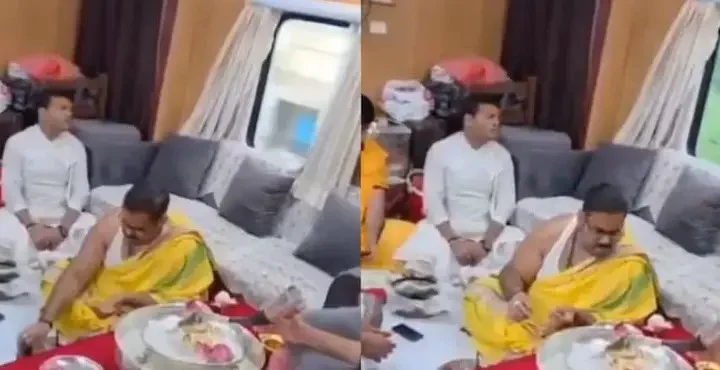
New Delhi, India – A piece of mobile phone footage depicting a traditional Hindu religious ceremony, or puja, being conducted inside an Indian Railways carriage has ignited a fierce debate on social media, prompting questions regarding the secular nature of public transport and the boundaries of private charters. The video, which surfaced on X (formerly Twitter) in mid-July 2026, captured a priest officiating a ritual on the floor of a train carriage, surrounded by a group of devotees dressed in white.
While the imagery initially drew criticism from observers who questioned the appropriateness of religious displays within the confines of public infrastructure, Northern Railway has stepped in to provide crucial context. The incident, according to officials, did not occur in a standard passenger coach, but within a specialized "salon" carriage chartered for private use, shedding light on the often-misunderstood world of luxury rail travel in India.
The Viral Incident: A Snapshot of Controversy
The video clip, which gained significant traction after being shared by the user @vizhpuneet, shows a group of individuals seated on the floor of what appears to be a moving train. A priest is seen performing rituals, with incense and traditional offerings present, creating an atmosphere typically reserved for temples or private residences.
The caption accompanying the viral post was scathing: "After a honeymoon car, now worship rituals in a saloon car of Indian Railways. Indian Railways is turning into a circus." This sentiment resonated with a segment of the public who believe that public transport should maintain a neutral, professional environment. Within hours, the footage had generated thousands of views and ignited a polarized discussion. Critics argued that the space, while chartered, remains part of a state-run service, potentially alienating other passengers or setting a precedent for the conversion of public utility into private event spaces.
Chronology of Events
To understand the scope of the incident, it is essential to trace the timeline of the charter and the subsequent public outcry.
- July 10, 2026: A private group secures a salon railcar attached to the 12926 Paschim Express, traveling from New Delhi Station to the Bandra Terminus in Mumbai. The booking is facilitated through the Indian Railway Catering and Tourism Corporation (IRCTC).
- July 12, 2026: Footage of the ceremony, which took place during the transit, is uploaded to social media platforms. The video goes viral, triggering widespread speculation about the misuse of railway property.
- July 13, 2026: Northern Railway issues an official clarification, confirming that the railcar was indeed a privately chartered unit and that the ceremony took place in a space legally reserved for the group’s exclusive use.
- July 14, 2026 onward: The incident sparks broader discussions in Indian media and legislative circles regarding the commercialization of railway assets and the ethical boundaries of private luxury travel within the public network.
The Anatomy of a Salon Railcar
The confusion surrounding the video stems largely from the public’s unfamiliarity with "salon" carriages. These are not standard sleeper cars; they are specialized, high-end rolling stock designed for VIP travel, corporate outings, and luxury tourism.
Historically, these carriages were reserved exclusively for high-ranking government officials, cabinet ministers, and senior railway executives. They offer a level of privacy and amenity far beyond the reach of the average commuter. A standard salon car typically features:
- Living Quarters: Air-conditioned bedrooms with integrated berths.
- Utility Spaces: A fully equipped kitchen, private bathrooms, and a pantry area.
- Social Spaces: A lounge area and a dining room capable of hosting small gatherings.
By allowing these carriages to be chartered by private groups, the IRCTC has sought to diversify its revenue streams. For a fee, private citizens or organizations can essentially attach a "mobile hotel room" to a scheduled express train, moving between major cities in total privacy. This service, while lucrative for the national carrier, has now become a focal point of intense scrutiny.
Official Response: Northern Railway’s Defense
Following the viral backlash, Northern Railway felt compelled to address the optics of the situation. Their response focused on the contractual legality of the charter.
"The carriage in question was a salon railcar, fully booked by a private group through the established IRCTC commercial channels," a spokesperson stated. "The group paid the required fees to utilize the carriage as a private space during the journey from New Delhi to Mumbai. Within the terms of their charter, the group is entitled to use the space for their requirements, provided they adhere to safety regulations and do not disrupt the operation of the train or the experience of passengers in other coaches."

The railway administration emphasized that there was no violation of passenger conduct rules because the carriage was not accessible to the general public. The passengers inside were not regular commuters but members of the charter group who had exclusive access to the carriage for the duration of the journey.
Economic Implications: The Cost of Exclusivity
One of the most revealing aspects of this controversy is the price tag attached to such luxury. The private group paid a total of 308,580 Indian rupees (approximately 2,800 EUR) for the one-way journey. This figure covers the haulage charges, the rental of the salon car, and the catering services provided by the IRCTC.
This pricing structure underscores a growing trend in Indian infrastructure: the monetization of "experiences." For the Indian Railways, which operates under the dual mandate of providing affordable transport for the masses and generating revenue to sustain its massive network, these charters are a significant source of high-margin income. However, the incident highlights a tension between the railway’s role as a public service and its function as a provider of private commercial luxury.
Implications for Public Policy and Ethics
The controversy surrounding the puja on the Paschim Express raises several pertinent questions for the future of public transportation in India.
1. The Secular/Public Nature of Transit
Can a space be truly "private" if it is physically attached to a public, state-run train? Critics argue that even if a carriage is chartered, it remains part of the Indian Railways brand. When religious rituals are performed in such a public-facing environment, it can lead to perceptions of state endorsement or preferential treatment. While the railway maintains that the car was a private rental, the social media backlash suggests that the public expects a level of uniformity and neutrality from the national rail operator.
2. Commercialization vs. Social Responsibility
Indian Railways has been aggressively pushing for modernization, including the introduction of luxury tourist trains like the Maharajas’ Express. As the organization leans further into the tourism sector, it must navigate the fine line between providing luxury services and maintaining its identity as a social equalizer. The "circus" comment from the viral post reflects a deeper concern: that the railway is prioritizing the wealthy at the expense of its core mission of public transit.
3. Regulation of Private Charters
The incident may lead to stricter guidelines regarding what can be done inside a chartered carriage. While the IRCTC has clear policies regarding prohibited items (such as flammable materials, which are strictly banned due to fire risks), it has historically been less prescriptive about the activities conducted within a private salon car. Moving forward, the railway administration may face pressure to define "appropriate use" of these spaces to avoid future public relations disasters.
Conclusion: A Balancing Act
The puja on the Paschim Express is more than just a viral moment; it is a symptom of a rapidly changing Indian society where the lines between the public and the private are increasingly blurred. As India continues to integrate high-end, individualized experiences into its massive public transport framework, it must grapple with the social implications of these services.
For the Indian Railways, the challenge is to maintain its reputation as a reliable and neutral service provider for over 20 million daily passengers while simultaneously capitalizing on the demand for premium, customizable travel. The backlash to the viral video serves as a reminder that in the age of social media, every corner of a public train—even the most private of salon cars—is under the constant, critical gaze of the public.
As the debate cools, the incident will likely lead to a review of how private charters are marketed and managed. Whether this results in more restrictive policies or a reaffirmation of the "customer is king" philosophy remains to be seen. What is certain, however, is that the image of a priest performing a ceremony in a speeding carriage has left an indelible mark on the public’s perception of what can, and should, happen on board India’s legendary railway network.

