

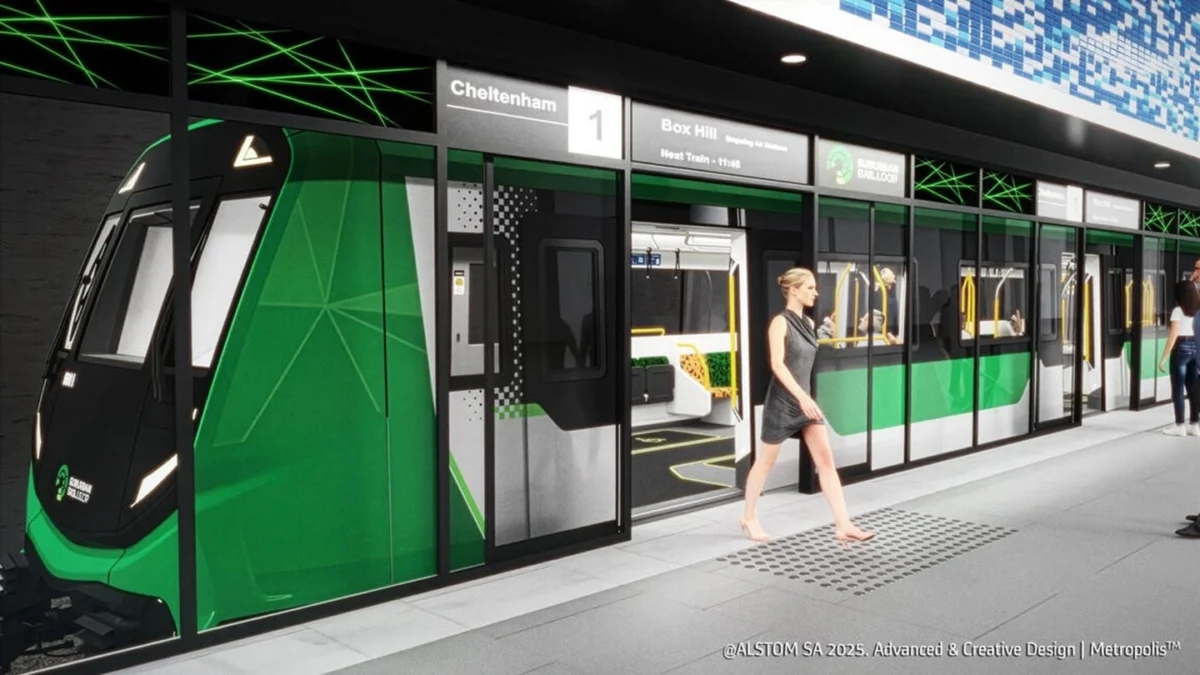
MELBOURNE, AUSTRALIA — In a major milestone for Australia’s largest civil infrastructure project, Alstom has secured a €1 billion ($1.17 billion) contract to deliver the rolling stock, signaling systems, and long-term maintenance for the first phase of Melbourne’s Suburban Rail Loop (SRL).
The contract is part of a larger €4.9 billion package awarded by the Suburban Rail Loop Authority (SRLA) to the TransitLinX Alliance. This world-class consortium comprises Alstom, John Holland, KBR, WSP, and RATP Dev. Together, these companies will deliver the integrated rail systems, automated fleet, and operational infrastructure required to bring Melbourne’s public transport network into the driverless era.
The Suburban Rail Loop East (SRL East) section will introduce Grade of Automation 4 (GoA4) technology—the highest level of rail automation—marking Victoria’s first fully driverless mainline metro system and the second of its kind in Australia.
Main Facts: The TransitLinX Consortium and Alstom’s €1 Billion Mandate
The contract awarded to the TransitLinX Alliance represents one of the most significant public transport procurement packages in Victorian history. While the total value of the package stands at €4.9 billion, Alstom’s individual share of the contract is valued at €1 billion.
Under the terms of the agreement, Alstom will take charge of the technology and equipment core of the project. This includes:
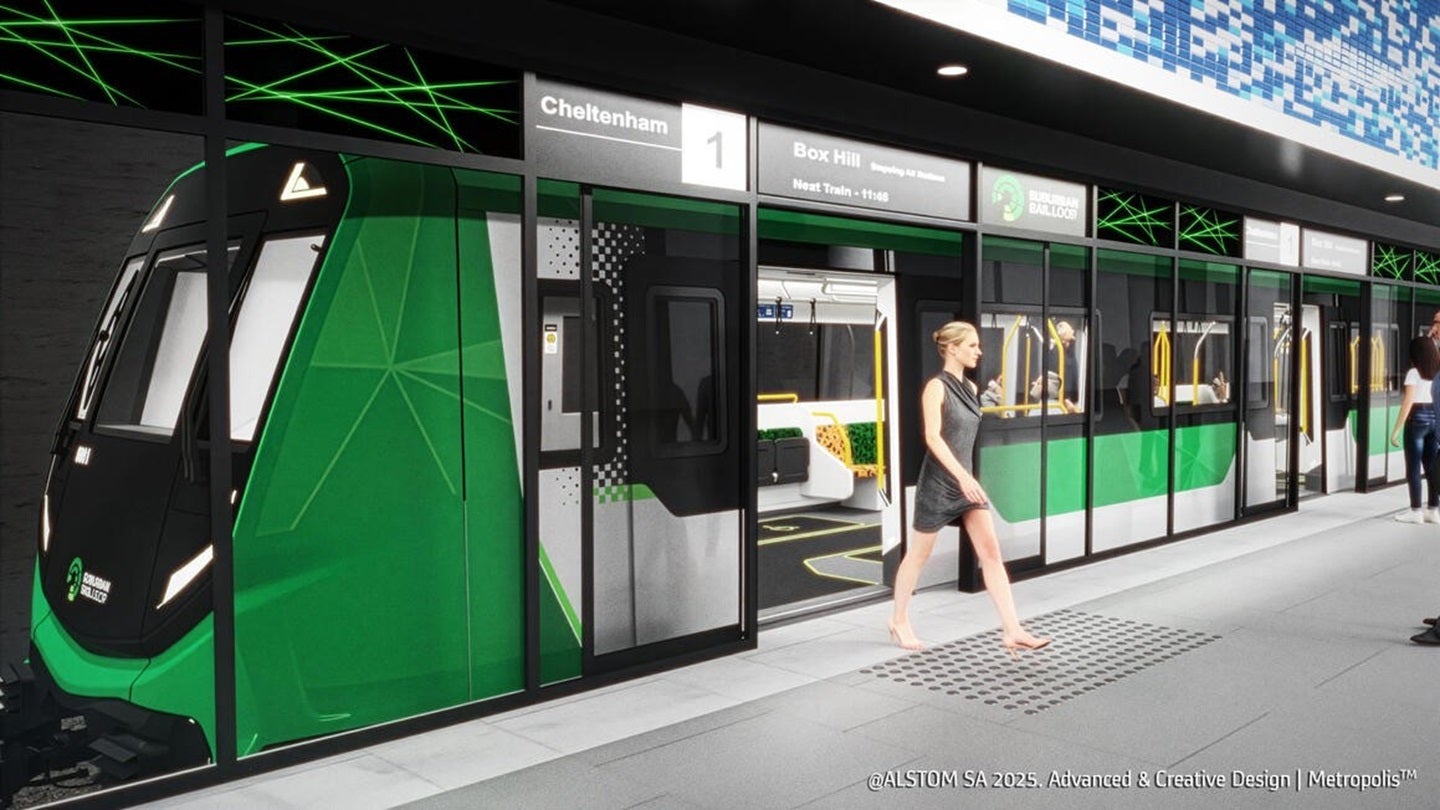
- The design, manufacture, and commissioning of 13 four-car automated Metropolis metro trains.
- The installation of Alstom’s proprietary Urbalis Forward Communications-Based Train Control (CBTC) signaling system.
- The implementation of state-of-the-art digital network infrastructure and comprehensive system integration across the SRL East corridor.
- A 15-year FlexCare Perform maintenance agreement covering the rolling stock, signaling assets, and related infrastructure.
The other members of the TransitLinX Alliance will handle complementary aspects of the project. John Holland will lead the civil construction and structural works; KBR and WSP will provide multidisciplinary engineering, design, and environmental services; and RATP Dev will bring its global expertise in operating driverless metro networks to assist in operations planning and system integration.
Chronology: From Vision to the 2035 Commercial Launch
The Suburban Rail Loop was first announced by the Victorian State Government in 2018 as a multi-decade, transformational project designed to reshape how people move through Melbourne’s middle suburbs.
[2018] Project Announcement & Initial Feasibility Studies
   │
[2022] Early Works Begin & Environmental Effects Statement (EES) Approved
   │
[2024/2025] Main Works Contracts Awarded (TransitLinX Alliance Appointed)
   │
[2026-2030] Construction of Tunneled Corridors & Stations
   │
[2031-2033] Rolling Stock Manufacture (Dandenong) & Track Laying
   │
[2034] Extensive Testing, Commissioning & GoA4 Safety Integration
   │
[2035] SRL East Commercial Operations Commence- 2018–2021 (Planning and Approvals): The project underwent extensive feasibility studies, route alignments, and business case developments. The Environmental Effects Statement (EES) was put on public display, receiving formal planning approval in 2022.
- 2022–2024 (Early Works and Procurement): Early construction works began, focusing on utility relocations and site preparation. Concurrently, the SRLA ran a competitive bidding process for the primary tunneling and systems contracts, culminating in the appointment of the TransitLinX Alliance.
- 2025–2032 (Manufacturing and Construction): Heavy construction, tunneling, and station excavation will continue. Alstom will begin the design and manufacturing phase of the Metropolis fleet at its Victorian manufacturing hub.
- 2032–2034 (Testing and Integration): The newly built Metropolis trains will undergo rigorous safety, signaling, and dynamic testing on the track. This phase is critical to certifying the GoA4 driverless systems under simulated operational conditions.
- 2035 (Targeted Commissioning): The SRL East section is scheduled to open to the public, carrying its first passengers between Cheltenham and Box Hill.
Supporting Data: Technical Specifications and Infrastructure Blueprint
The technical delivery of SRL East relies on a highly sophisticated integration of mechanical engineering, digital communication, and dedicated maintenance facilities.
The Metropolis Fleet and Victorian Manufacturing
Alstom will manufacture the 13 four-car automated Metropolis trains at its Dandenong facility in Victoria. This facility has long been the cornerstone of Victoria’s rail manufacturing industry, and utilizing it ensures the project complies with the Victorian Government’s Local Jobs First Policy.
The Metropolis trains will feature:
- High-capacity walk-through carriages.
- Advanced real-time passenger information systems.
- Optimized accessibility features, including level-boarding and dedicated spaces for passengers with mobility aids.
- Energy-efficient traction systems and lightweight materials to reduce overall energy consumption.
Grade of Automation 4 (GoA4) and Urbalis Forward CBTC
By deploying GoA4 technology, the SRL East fleet will operate entirely without on-board staff. The trains will be managed from a central control room, with automated systems handling starting, stopping, door operations, and emergency contingencies.
This level of automation is enabled by Alstom’s Urbalis Forward CBTC system. CBTC uses high-resolution radio communication to continuously transfer data between trains and wayside equipment. This "moving block" technology allows trains to run closer together safely, maximizing frequency, reducing dwell times at stations, and allowing the network to dynamically scale service frequency during peak commuting hours.
+-----------------------------------------------------------------------+
|                       ALSTOM URBALIS FORWARD CBTC                     |
|                                                                       |
|  [Train 1] <--- (Real-Time Radio Link) ---> [Wayside Controller]      |
|                                                     ^                 |
|                                                     │ (Fiber Network) |
|                                                     v                 |
|  [Train 2] <--- (Real-Time Radio Link) ---> [Control Centre]          |
|                                                                       |
|  * Moving Block Technology: Safely minimizes headway between trains.  |
|  * Bi-directional communication ensures constant location tracking.   |
+-----------------------------------------------------------------------+
The Heatherton Maintenance Depot and FlexCare Perform
To support the fleet over its operational lifecycle, a state-of-the-art train stabling and maintenance facility will be constructed in Heatherton, in Melbourne’s southeast.
Alstom’s 15-year FlexCare Perform contract will operate out of this facility. The maintenance program will utilize predictive maintenance technologies, including acoustic sensors, wheel-profile measuring systems, and digital twins. These tools will analyze real-time data from the trains and track to schedule preventative maintenance, thereby avoiding service disruptions and extending the lifespan of the assets.
SRL East Alignment and Corridor Profile
SRL East will span 26 kilometers of twin-bore underground tunnels, connecting six new underground stations designed to integrate seamlessly with the existing radial rail network:
- Cheltenham (interchange with the Frankston line)
- Clayton (interchange with the Cranbourne/Pakenham lines, forming a major regional transport hub)
- Monash (serving Australia’s largest university campus)
- Glen Waverley (interchange with the Glen Waverley line)
- Burwood (serving Deakin University)
- Box Hill (interchange with the Belgrave/Lilydale lines)
Official Responses: Executive and Government Commentary
The awarding of the systems contract has been met with strong support from both Alstom’s global leadership and local executives, who emphasize the combination of international technology and local expertise.
Pascal Dupond, Managing Director of Alstom Australia and New Zealand, highlighted the deep-rooted relationship between the company and the Victorian State Government:
"This contract award further deepens our partnership with the Victorian Government to deliver the rail transport priorities of the Victorian Government with leading rail industry partners. The Suburban Rail Loop solutions Alstom will provide draw from a range of our leading global technologies across rolling stock, signaling and services complemented by our local knowhow in Victoria, which uniquely we bring to our customers."
Ling Fang, President of Alstom’s Asia-Pacific region, emphasized the global scale of the project and its role in placing Melbourne alongside the world’s leading smart cities:
"As the world’s leading pure rail player, we bring comprehensive turnkey solutions to meet the needs of our customers in Australia and the wider Asia Pacific Region. This project is of global significance in its ambition and scale, and Melbourne joins the ranks of other leading global cities in deploying Alstom solutions to enable advanced rail passenger solutions."
Implications: Reshaping Melbourne’s Urban and Economic Landscape
The Suburban Rail Loop is more than a transit project; it is a structural intervention in the spatial economy of Melbourne. For over a century, Melbourne’s rail network has operated on a radial "hub-and-spoke" model, requiring almost all suburban commuters traveling to adjacent suburbs to journey into the city center (Flinders Street or the City Loop) before transferring back outward.
   Radial Model (Traditional)                  Orbital Model (SRL)

         [Outer Suburb A]                        [Outer Suburb A]
               │                                       │
               │                                       │   (Direct Link)
               ▼                                       ▼   ▼
       [Central Business]                      [Central Business] ── [Outer Suburb B]
               ▲                                       ▲
               │                                       │
               │                                       │
         [Outer Suburb B]                        [Outer Suburb B]
Decentralizing the Radial Network
By establishing a 90-kilometer orbital line, the completed SRL will allow commuters to bypass the central business district (CBD) entirely. SRL East will link high-growth health, education, and employment precincts—such as Monash University, Deakin University, and the Box Hill medical hub—directly to residential areas. This orbital connection is expected to take up to 600,000 daily car trips off Melbourne’s congested arterial roads and freeways once the full loop is operational.
Economic and Manufacturing Stimulus
The mandate to build the Metropolis trains at the Dandenong facility secures the future of Victoria’s rolling stock supply chain. This contract will support hundreds of highly skilled engineering, manufacturing, and technical jobs in Melbourne’s southeast. Additionally, it creates a long-term pipeline of work for local sub-contractors, component suppliers, and service providers.
The 15-year maintenance agreement at Heatherton ensures that the economic benefits of the project will continue long after the construction phase is complete, establishing a generation of technicians trained in advanced driverless rail systems.
Technological Leadership in the Pacific Rim
The deployment of GoA4 driverless technology on SRL East cements Australia’s growing status as a leader in automated rapid transit. Following the successful launch of the Sydney Metropolis metro trains in 2019—which also utilized Alstom’s rolling stock and CBTC technology—Melbourne’s SRL East will build on proven operational frameworks.
By implementing these advanced digital rail solutions, Victoria establishes a highly reliable, safe, and energy-efficient transit baseline. This sets a clear precedent for the subsequent phases of the project, including SRL North (Box Hill to Airport West) and SRL West (Sunshine to Werribee), ultimately forming a unified, world-class orbital transit network.

