

Executive Summary: A Milestone Year for Rail Maintenance
Deutsche Bahn (DB) has marked a significant operational milestone as its state-of-the-art maintenance facility in Cottbus completes its inaugural year of operation. Designed to serve as the backbone for the heavy maintenance of the ICE 4—the most vital series in Germany’s long-distance rail network—the plant has exceeded initial performance targets.
In its first year, the Cottbus facility successfully processed 13 ICE 4 trainsets, comprising over 160 individual carriages. This achievement has been instrumental in stabilizing DB’s long-distance services, most notably during the high-demand 2024 holiday season, where optimized maintenance schedules ensured a higher availability of trains for passengers. As DB looks toward 2025, the facility is scaling its operations, consolidating all ICE 4 variants under one roof, and solidifying its position as a cornerstone of the company’s digital and technological transformation strategy.
Chronology of Progress: From Vision to Industrial Reality
The journey of the Cottbus maintenance plant is one of rapid development and strategic foresight.
- January 2024: Construction officially commenced on Hall 1, a massive 500-meter-long structure designed to handle the most intensive maintenance cycles.
- Early 2024: Operations ramped up in Hall 2, which was specifically engineered for the IS 600 maintenance stage—a critical periodic inspection cycle.
- Late 2024: The facility hit its primary ramp-up targets, completing the final overhaul of the year ahead of schedule, a feat that provided the operational buffer necessary for reliable Christmas travel.
- January 2025: The facility expanded its scope to include the seven-car ICE 4 variants, marking the beginning of a full consolidation of the ICE 4 fleet maintenance in Lusatia.
The decision to accelerate the consolidation of maintenance work in Cottbus reflects the facility’s success. Initially, DB had planned for a protracted transition period involving multiple legacy plants. However, the efficiency of the specialized infrastructure and the dedicated technical teams in Cottbus allowed the operator to bypass these transition phases, centralizing maintenance earlier than anticipated.
Supporting Data: Infrastructure and Operational Capacity
The Cottbus plant is not merely a repair shop; it is a highly specialized industrial ecosystem designed for the specific modular architecture of the ICE 4.
The Mechanics of Efficiency: Hall 2 and the IS 600
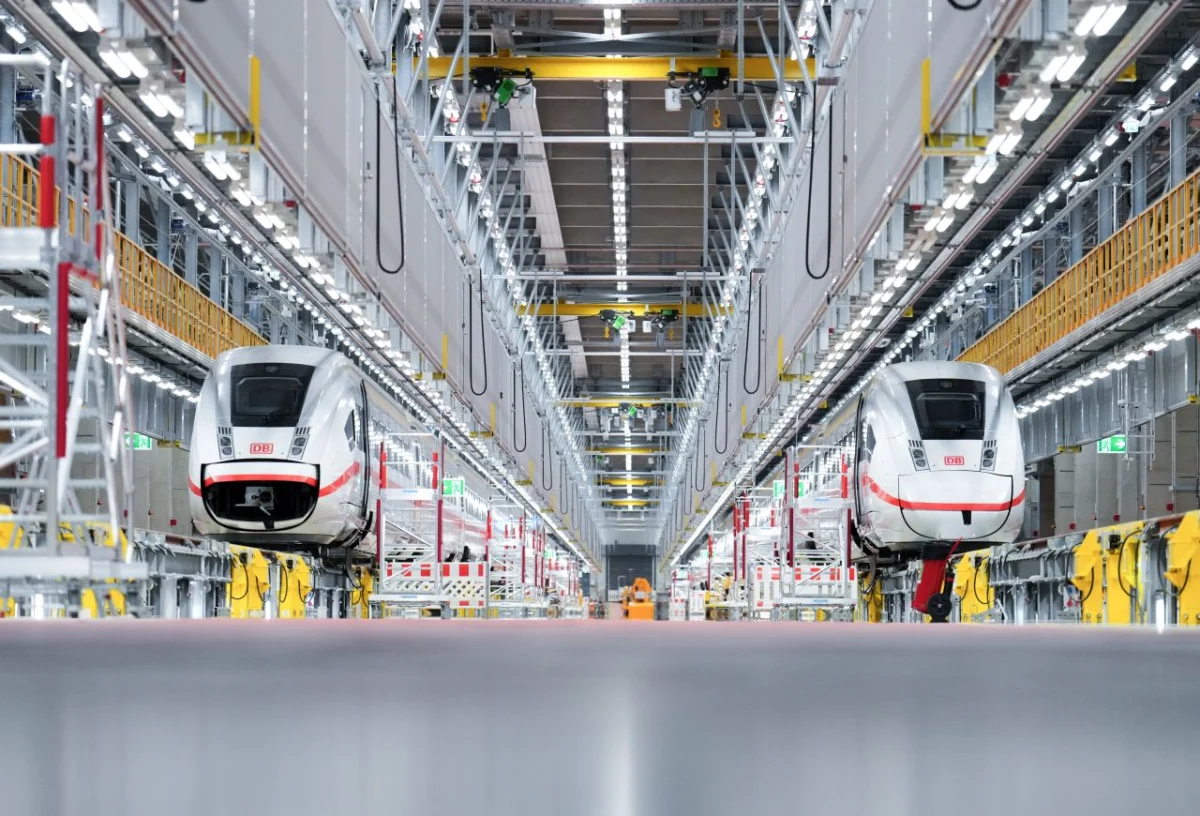
Hall 2 serves as the primary hub for the IS 600 maintenance stage. This facility allows full-length ICE 4 trains to enter under their own power, eliminating the need for shunting locomotives and significantly reducing downtime. The architectural design facilitates a multi-level workflow:
- Roof Level: Specialized platforms allow technicians direct access to air conditioning units and pantographs.
- Side Level: Access flaps along the train body allow for rapid maintenance of onboard technical components.
- Pit Level: A continuous work pit enables comprehensive inspection and maintenance of the undercarriage.
A standout feature of the facility is the integration of foldable rails on elevated tracks. This allows bogies to be replaced with surgical precision, while swing-away overhead power lines ensure that roof inspections are performed with maximum safety and minimal mechanical interference.
Scaling Up: The IS 700 and Hall 1
As the facility matures, the scope of work is expanding to include the IS 700 maintenance cycle. This stage is mandated after 3.3 million kilometers of operational mileage and is significantly more intensive than the IS 600.
While IS 600 tasks are currently optimized in Hall 2, the construction of Hall 1 is nearing completion. Once operational, Hall 1 will feature three maintenance tracks, a dedicated painting track, and a commissioning track. The IS 700 process involves:
- Decoupling: Complete separation of train carriages.
- Component Overhaul: Thorough inspection and potential replacement of couplings, carriage transitions, braking systems, and doors.
- Structural Maintenance: Replacing front noses and deep-level maintenance of running and driving bogies.
Official Perspectives: Transforming DB’s Technological Landscape
The success of the Cottbus plant is a focal point of the current leadership’s strategy to modernize DB. Dr. Daniela Gerd tom Markotten, DB Board Member for Digitalization and Technology, emphasized the dual impact of the facility on the company’s restructuring.
"The ICE maintenance in Lusatia is already a great success," Dr. Gerd tom Markotten stated. "Our experts designed the two-track workshop for rapid and efficient maintenance, especially of the ICE 4. The teams in Cottbus have implemented the optimized processes in practice even faster than expected. This means that the new Cottbus plant is already making an important contribution to high vehicle availability and a stable service from DB in its first year of operation—and is thus supporting the restructuring of the DB Group."
By fostering an environment where digital integration meets heavy industrial engineering, DB is attempting to shift the perception of rail maintenance from a cost center to a competitive advantage.
Implications: The Future of Rail Reliability
The consolidation of ICE 4 maintenance in Cottbus has profound implications for both the rail operator and the German labor market.
Strengthening the Backbone of Long-Distance Travel
The ICE 4 is the workhorse of the German rail network, representing the largest fleet series in the DB portfolio with 137 units. By streamlining the maintenance of the entire range—from the seven-car units to the 13-car "XXL" variants—DB is creating a standardized maintenance environment. This uniformity reduces the learning curve for technicians and accelerates the return of vehicles to the track, directly addressing the passenger demand for more reliable and frequent connections.
Economic and Employment Impact in Lusatia
The project is a significant economic driver for the Lusatia region. With the completion of both Halls 1 and 2, DB is set to create 1,200 high-quality industrial and technical jobs. This is not only a boon for local employment but also a long-term investment in regional technical expertise. The facility is effectively becoming a training ground for the next generation of railway engineers, as the teams currently performing the IS 600 and IS 700 work are actively shaping the standard operating procedures that will govern the facility for decades to come.
Outlook for 2025
For the calendar year 2025, DB has aggressive targets for the Cottbus site. The plan is to overhaul 24 ICE 4 units, evenly split between short seven-car sets and long 12-to-13-car configurations. Of these, 14 will undergo the comprehensive IS 700 overhaul.
As the site continues to evolve, it represents a departure from the traditional, fragmented maintenance model that characterized the early years of the ICE fleet. By centralizing heavy maintenance in a purpose-built, high-tech environment, Deutsche Bahn is demonstrating that it can successfully align its infrastructure with the complex technical requirements of modern, high-speed rail.
The success in Cottbus provides a blueprint for future infrastructure projects within the DB network. By prioritizing "rapid and efficient" maintenance flows, the company is proving that the path to a reliable, customer-centric rail network begins in the workshop. As the 1,200 new roles are filled and the full capacity of Hall 1 is unleashed, Cottbus will remain the heart of the German high-speed rail maintenance machine, ensuring that the ICE 4 continues to connect the nation with the reliability travelers expect.

