

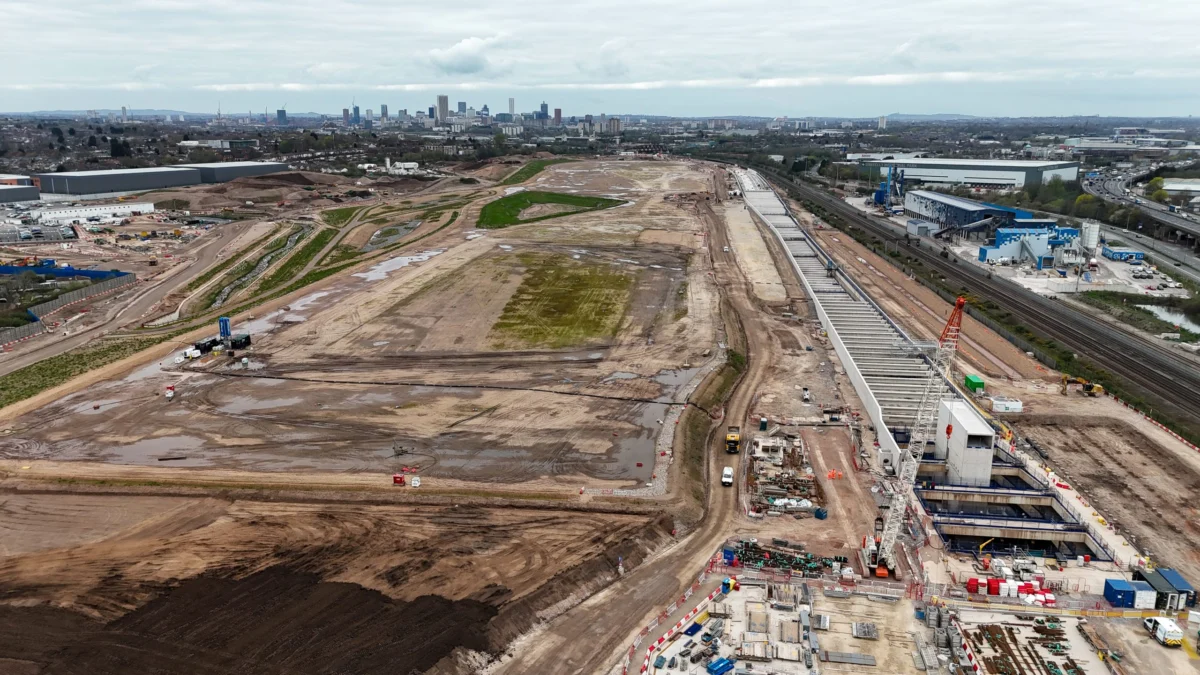
The landscape of British infrastructure is undergoing a seismic shift as High Speed 2 (HS2) Ltd officially moves into its next major phase of delivery. In a landmark announcement for the West Midlands, the TWA joint venture—a powerhouse collaboration between Taylor Woodrow Infrastructure and Aureos Rail—has been awarded the contract to design and construct the HS2 rolling stock maintenance depot and Network Integrated Control Centre (NICC).
Valued at approximately £856 million (EUR 991 million), this contract represents more than just a civil engineering project; it is a catalyst for the socio-economic regeneration of Washwood Heath, a historic industrial heartland of Birmingham. The project aims to transform a 70-hectare brownfield site into a high-tech hub of railway excellence, supporting over a thousand permanent jobs and reinforcing Birmingham’s position at the center of the UK’s future transport network.
1. Main Facts: The Scope of the Washwood Heath Transformation
The Washwood Heath site, once the bustling home of the LDV van factory and the Metro-Cammell railway works, has sat largely dormant since 2005. Under the stewardship of the TWA joint venture, this derelict expanse will be repurposed into the operational "brain and heart" of the HS2 network.
The Rolling Stock Maintenance Depot
Spanning roughly 30 hectares of the total site, the depot will be the primary facility for the maintenance, fleet management, and servicing of the HS2 high-speed train fleet. The technical specifications of the facility are world-class, featuring:
- A State-of-the-Art Maintenance Building: A massive hangar-like structure designed to accommodate the 200-meter-long (and potentially 400-meter-long doubled) high-speed train sets. It will house specialized pits, overhead cranes, and workshops for deep-level maintenance.
- Automatic Vehicle Inspection Building (AVIB): Utilizing cutting-edge laser and camera technology, this facility will scan trains as they enter the depot, identifying wear and tear or technical anomalies in real-time before a technician even touches the vehicle.
- Train Washing Plant: A high-efficiency, environmentally friendly facility designed to keep the fleet in pristine condition while recycling water to minimize the environmental footprint.
- Stabling Sidings: Extensive track layouts where trains will be "stabled" overnight, cleaned, and prepared for the next day’s service.
- Dedicated Test Track: A section of track allowing engineers to test train systems and performance in a controlled environment before they enter the main line.
The Network Integrated Control Centre (NICC)
While the depot maintains the hardware, the NICC will manage the software and operations. As the nerve center of the entire HS2 line between London and the West Midlands, the NICC will be where signallers, controllers, and engineers monitor train movements, manage dispatching, and communicate with drivers. It is designed to ensure the "clockwork" precision required for a high-frequency, high-speed rail service.
2. Chronology: From Industrial Decline to High-Speed Future
The story of Washwood Heath is a microcosm of British industrial history—a journey from Victorian manufacturing dominance to post-industrial decline, and now, to a high-tech renaissance.
The Manufacturing Era (1845–2005)
For over 150 years, Washwood Heath was synonymous with rail manufacturing. The Metro-Cammell works produced rolling stock that was exported globally, including the iconic London Underground trains and the Blue Pullman. Most notably, the site was the birthplace of the Class 390 Pendolinos, which currently serve the West Coast Main Line. The closure of the LDV factory and the railway works in the mid-2000s left a void in the local economy, resulting in the loss of thousands of skilled manufacturing roles.
The Preparation Phase (2021–2024)
Before TWA could be awarded the construction contract, years of preparatory work were required. HS2’s main works contractor for the West Midlands, Balfour Beatty VINCI (BBV), spearheaded the remediation of the site. This involved the demolition of dozens of derelict industrial buildings and the complex cleaning of land contaminated by over a century of heavy industrial use.
Simultaneously, BBV completed the 750-meter-long "retained cutting" on the northern edge of the site. This engineering feat allows the HS2 tracks to descend from the surface into the Bromford Tunnel, which stretches 3.5 miles toward the heart of Birmingham.
The Construction Phase (2025 and Beyond)
With the contract now awarded to TWA, the project enters the final design and delivery stage. The joint venture will collaborate with HS2 Ltd and the eventual train operators to finalize the layout. Construction is expected to ramp up through the mid-2020s, with testing and commissioning of the depot facilities occurring in tandem with the arrival of the first HS2 train prototypes.
3. Supporting Data: Socio-Economic Impact and Deprivation
The decision to locate the depot in Washwood Heath was strategic, aimed at addressing deep-seated economic challenges in the region.
Addressing Deprivation
According to the 2021 Census, Washwood Heath is one of the most socio-economically challenged wards in the United Kingdom. Data indicates that approximately 77% of households in the area experience deprivation in at least one of the four key dimensions: employment, education, health and disability, and housing. By placing a major operational hub in this specific location, HS2 is targeting "levelling up" in its most literal sense.

Employment Figures
The project is a massive job creator:
- Construction Phase: Approximately 500 temporary roles will be created during the building of the depot and NICC, providing opportunities for local apprentices and tradespeople.
- Operational Phase: Once the depot is fully functional, it will provide roughly 1,000 permanent, highly skilled jobs. These range from high-tech engineering and software management to facilities maintenance and logistics.
- Regional Growth: A recent economic study suggests that the presence of HS2—specifically the Curzon Street station, Interchange station, and the Washwood Heath depot—will generate a £10 billion economic uplift for the West Midlands over the next decade.
Environmental and Community Integration
The project does not occupy the entirety of the 70-hectare site. Significant portions have been earmarked for:
- Commercial Development: Creating space for third-party businesses to settle near the hub.
- Green Spaces: The creation of new wildlife habitats and community green zones to offset the industrial nature of the site and improve local air quality and biodiversity.
4. Official Responses: A New Era of Governance
The awarding of this contract comes at a pivotal moment for HS2 Ltd, which has faced scrutiny over costs and timelines. The project is currently undergoing a "major reset" led by Chief Executive Mark Wild, the former CEO of Crossrail.
Government Endorsement
UK Rail Minister Peter Hendy emphasized the long-term vision of the project:
"Washwood Heath and the wider HS2 programme will create thousands of jobs across the West Midlands—from the construction teams transforming this former industrial site to the skilled workforce that will operate this modern facility for decades to come. Together, they will help deliver faster and more reliable rail journeys across the country."
Strategic Oversight
Mark Wild’s leadership has introduced a more rigorous approach to contract management. Prior to the TWA award, the project’s "readiness to proceed" was vetted by an independent review panel. This panel drew on lessons learned from the James Stewart review of HS2 governance and the complexities encountered during the Elizabeth Line (Crossrail) project. The goal is to ensure that the Washwood Heath contract is delivered with maximum efficiency and at the "lowest reasonable cost" to the taxpayer.
The TWA joint venture itself brings a wealth of experience to the table. The partners have previously worked on landmark projects such as the Elizabeth Line’s depots and the Old Oak Common "super-hub" in London. Their combined workforce of over 3,000 people provides a deep well of technical expertise in delivering complex rail infrastructure.
5. Implications: The Future of UK Rail and Regeneration
The construction of the Washwood Heath depot carries implications that extend far beyond the borders of Birmingham.
A Template for Brownfield Regeneration
The project serves as a blueprint for how large-scale infrastructure can be used to remediate "orphaned" industrial land. By taking a site that was a liability—contaminated and derelict—and turning it into a high-value asset, HS2 is demonstrating the potential for infrastructure to drive urban renewal without encroaching on greenbelt land.
Connectivity and Reliability
From a technical standpoint, the depot and NICC are essential for the reliability of the HS2 service. High-speed rail operates on much tighter tolerances than conventional rail. The ability to inspect, wash, and maintain trains daily in a localized, state-of-the-art facility ensures that the 18-trains-per-hour target (at peak) remains achievable. The NICC, meanwhile, will be the proving ground for digital signalling and automated train control in the UK.
The "Railway Town" Identity
Finally, the project restores a sense of identity to Washwood Heath. For over a century, the community was a "railway town" within a city. The closure of the manufacturing works felt like the end of an era. The TWA contract signifies a return to that heritage, albeit with a 21st-century twist. Instead of just building the trains of the past, the area will now be responsible for the operation and maintenance of the most advanced transport system in British history.
As the TWA joint venture begins to mobilize its teams, the focus remains on delivering a facility that balances technical excellence with community benefit. For the people of Washwood Heath, the arrival of HS2 is no longer a distant plan—it is a £856 million reality that promises to reshape their economic future.

