
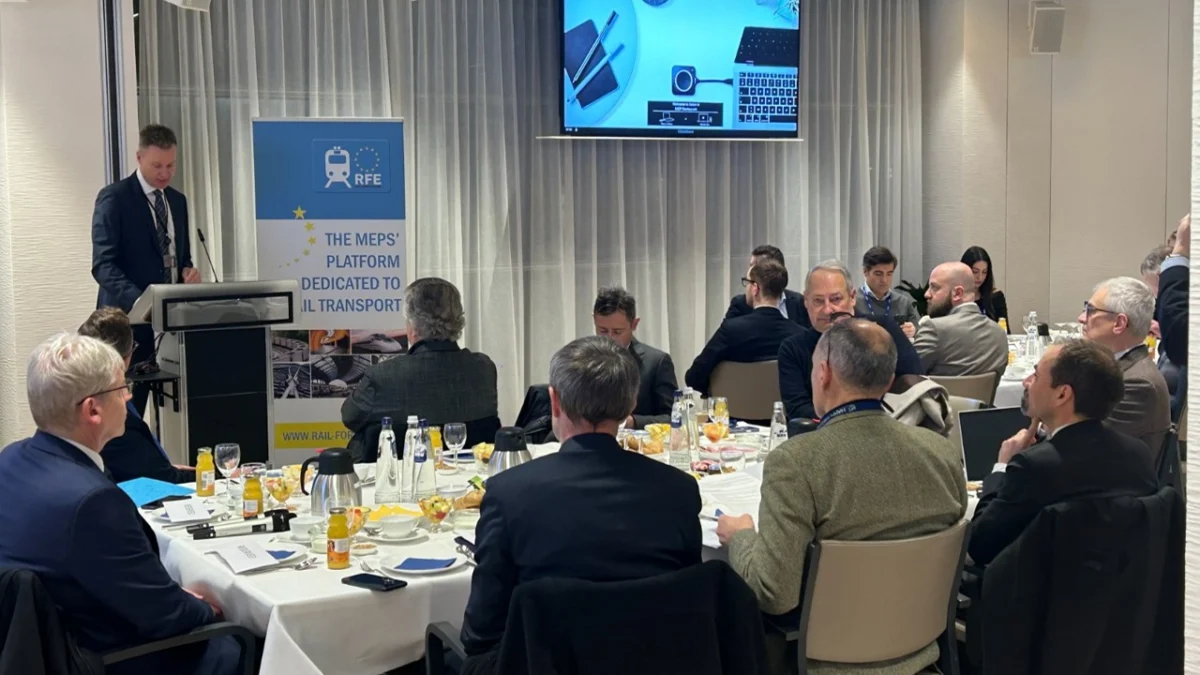
The European rail supply industry stands at a critical historical juncture. Long considered the global benchmark for engineering excellence, safety, and reliability, the sector now faces an existential challenge from state-subsidized international competitors. On January 27, at the Rail Forum Europe event held within the European Parliament, industry leaders issued a clarion call to EU policymakers: to maintain its "generational advantage," Europe must commit to a massive, long-term successor to the current Europe’s Rail Joint Undertaking.
The message delivered by UNIFE (the European Rail Supply Industry Association) was clear: without a robust public-private research and innovation framework backed by nearly €18 billion in funding, the continent risks ceding its technological sovereignty and market leadership to non-EU entities—most notably China.
Main Facts: The Strategic Necessity of Innovation
The core of the discussion centers on the successor to the "Europe’s Rail Joint Undertaking" (EU-Rail), the current partnership under the Horizon Europe program. The industry argues that the European rail supply sector, which accounts for a significant portion of the global market and employs hundreds of thousands of highly skilled workers, cannot survive on prestige alone.
The Financial Roadmap
UNIFE Director General Enno Wiebe outlined a specific, two-pronged financial strategy required to keep the industry afloat and competitive through the next decade:
- Research and Development: A request for €3 billion from the upcoming Horizon Europe/FP10 (Framework Programme for Research & Innovation for the period 2028-2034). This funding is intended to fuel the "brain work" of rail—designing the next generation of digital tools, automation, and sustainable materials.
- Pre-deployment and Scaling: A demand for €15 billion sourced from the European Competitiveness Fund. This larger sum is dedicated to the "pre-deployment" of key technologies. Historically, many European innovations have languished in the "valley of death" between the laboratory and the market; this fund aims to bridge that gap by financing the actual installation of new tech across the vast European rail network.
The Competitive Threat
The urgency of this request is driven by the aggressive expansion of non-EU suppliers. China, in particular, has consolidated its rail industry into state-owned giants that benefit from massive domestic subsidies and a protected home market. These entities are now bidding aggressively for projects within Europe and in emerging markets, often undercutting European firms on price while rapidly closing the technological gap.
Chronology: From Shift2Rail to the Future of FP10
To understand the current demand, one must look at the evolution of European rail research over the last decade. The movement toward a unified, high-tech European rail system has been a multi-stage journey.
2014–2020: The Shift2Rail Era
The predecessor to the current program, Shift2Rail, was the first European rail-focused Joint Undertaking. It succeeded in bringing together competing manufacturers (like Alstom, Siemens, and CAF) to work on common standards. This era focused on basic digitalization and energy efficiency, proving that public-private partnerships could yield tangible results in a fragmented market.
2021–2027: Europe’s Rail Joint Undertaking (EU-Rail)
The current iteration, EU-Rail, shifted the focus toward a "system-of-systems" approach. It aimed to create a flexible, high-capacity, and integrated European network. It was during this period that flagship technologies like the Future Railway Mobile Communication System (FRMCS) and Digital Automatic Coupling (DAC) moved from theoretical concepts to advanced testing phases.
January 27, 2024: The Rail Forum Europe Event
The meeting at the European Parliament served as the formal opening of the lobby for the post-2027 landscape. With the European Commission beginning to draft the outlines of FP10 (the 10th Framework Programme), industry leaders recognized that the window for securing long-term funding is now. Enno Wiebe’s address was a strategic intervention to ensure rail remains a priority in the next EU budget cycle (2028-2034).
Supporting Data: The Technological Pillars of Sovereignty
The industry’s argument for €18 billion is not based on abstract needs but on specific technological milestones that are essential for the European Green Deal and the "Digital Decade" goals.
1. FRMCS: The 5G Backbone of Rail
The Future Railway Mobile Communication System (FRMCS) is the successor to the aging GSM-R (2G) system.
- The Data Need: Modern trains require massive data throughput for autonomous operation, real-time diagnostics, and passenger services.
- The Impact: FRMCS uses 5G technology to allow for "moving block" signaling, which can increase track capacity by up to 40% without laying a single new mile of track. This is critical for high-density corridors where building new infrastructure is geographically or politically impossible.
2. DAC: Revolutionizing Rail Freight
Digital Automatic Coupling (DAC) is often described as the "holy grail" of rail freight.
- The Manual Burden: Currently, most freight wagons in Europe are coupled by hand—a process that has remained largely unchanged since the 19th century.
- The Digital Leap: DAC not only automates the physical connection but also links the air brakes and digital data lines across the entire train.
- The Competitive Edge: By making rail freight faster to assemble and easier to monitor, DAC allows rail to compete directly with the "heavy-emitter" trucking sector. Without DAC, the EU’s goal of doubling rail freight by 2050 is widely considered unachievable.
3. Economic and Environmental Statistics
- Market Share: European suppliers currently hold approximately 45% of the global rail market. However, this share has been slipping as Chinese exports have grown by over 10% annually in certain sub-sectors.
- Employment: The sector supports over 400,000 jobs across the EU, many in regions where manufacturing is the primary economic driver.
- Decarbonization: Rail is responsible for less than 0.5% of transport-related greenhouse gas emissions in the EU. Investing in rail tech is the most efficient way to lower the carbon footprint of the transport sector as a whole.
Official Responses: Voices from the Parliament and Industry
The Rail Forum Europe event brought together a diverse group of stakeholders, each echoing the sentiment that the "status quo" is no longer an option.
Enno Wiebe, Director General of UNIFE
Wiebe’s rhetoric focused on "strategic autonomy"—a buzzword in Brussels that carries significant weight in the current geopolitical climate.
"Investing in Europe’s Rail successor means the European rail supply industry can compete with the EU’s global rivals, who are focusing and investing in tech to pull ahead and achieve market supremacy. This is what Europe does best – policymakers working with private industry to ensure tech development that achieves strategic EU goals like growth, decarbonization, and strategic autonomy."
Wiebe emphasized that the industry is not looking for a handout, but a partnership. The private sector is prepared to match or exceed public investment, provided the regulatory and funding framework is stable.
The European Parliament’s Perspective
Members of the European Parliament (MEPs) present at the forum expressed a mix of support and caution. While there is broad consensus on the importance of the Green Deal, the competition for FP10 funds will be fierce, with sectors like AI, semiconductors, and defense also vying for record-breaking budgets. Support for the rail industry is often tied to its ability to deliver "cross-border connectivity," a key pillar of the European project.
The European Commission’s Stance
While the Commission has yet to finalize the budget for the successor program, officials have noted that any future funding will be strictly tied to "competitiveness." The proposed European Competitiveness Fund, mentioned by Wiebe, is intended to be the EU’s answer to the US Inflation Reduction Act, suggesting that the Commission is beginning to think in terms of industrial defense.
Implications: What Happens if Europe Fails to Act?
The stakes of this funding debate extend far beyond the tracks. The implications of a weakened European rail supply industry would be felt across the continent’s economy and environment.
Loss of Technological Standards
Historically, Europe has set the global standards for rail safety (ERTMS). If Europe stops innovating, non-EU countries will set the standards for the next generation of autonomous and digital rail. This would force European operators to buy foreign technology that may not be compatible with existing infrastructure, creating a dangerous "vendor lock-in" to non-EU entities.
Deindustrialization Risks
The rail supply chain is vast, involving thousands of Small and Medium Enterprises (SMEs) that provide specialized components. If major "integrators" like Alstom or Siemens lose their global edge, the entire ecosystem of SMEs could collapse, leading to a loss of specialized engineering knowledge that took decades to build.
Climate Goal Failure
The EU cannot meet its 2030 and 2050 climate targets without a massive modal shift from road to rail. If the rail network remains slow, fragmented, and technologically outdated, businesses and passengers will continue to choose trucks and planes. The €18 billion investment is, in many ways, a down payment on the EU’s environmental credibility.
Strategic Autonomy
In an era of increasing geopolitical tension, relying on foreign powers for critical transport infrastructure is a security risk. Ensuring that Europe can build, maintain, and innovate its own rail systems is essential for its "strategic autonomy"—the ability to act independently in the global arena.
Conclusion
The call for a successor to Europe’s Rail is more than a request for research funding; it is a demand for a comprehensive industrial policy. As Enno Wiebe and UNIFE have made clear, the next few years will determine whether the European rail industry remains a world leader or becomes a legacy player in a market dominated by others. With a requested investment of €18 billion, the industry is betting that the European Union will choose to lead the digital and green revolution on the tracks, rather than simply watching it pass by.

